LinkToLooks · Guides · Creator Desk
Creator Desk
How to invoice a brand as a creator
Most late payments are not disputes. They are invoices a finance system could not process, and that is entirely preventable.
Part of: For creators
An invoice is a document that makes paying you the easiest thing on someone's desk. Most late payments in creator work are not disputes; they are invoices that could not be processed because something a finance system needs was missing.
Below is what goes on it, and one piece of context that belongs alongside it: a flat fee and affiliate commission are different instruments, and knowing what a sale in your category is actually worth stops you accepting one as a substitute for the other.
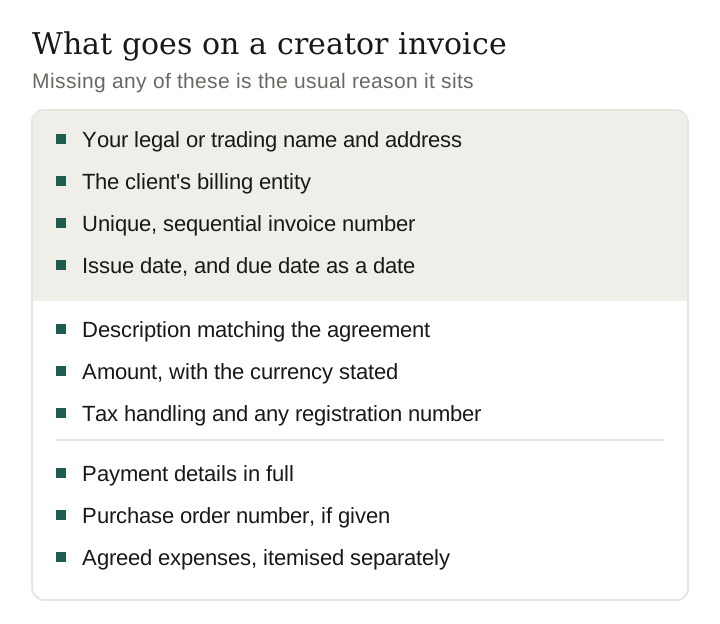
What goes on the invoice
- Your name and address — the legal or trading name you will be paid under, not your handle.
- The client's billing entity. Often not the brand name you dealt with. Ask; getting this wrong routes the invoice nowhere.
- A unique invoice number. Sequential. This is the reference everyone will use to talk about it.
- The issue date, and the due date as a date, not as ‘net 30’. Finance systems sort on dates.
- A description that matches the agreement. If the contract says three Reels and a Story, the invoice says three Reels and a Story, in those words.
- The amount and the currency, stated explicitly. ‘$’ is not a currency when the client is in another country.
- Tax handling as it applies to you. Whether tax is added, included or not applicable, and any registration number you are required to show.
- Payment details in full, including whatever the client's country needs to make a transfer land.
- A purchase order number if they gave you one. Some finance systems will not pay without it, silently.
- Any agreed expenses, itemised separately from the fee.
The terms to agree before you send it
- What triggers payment. Delivery, approval or publication are three different moments and can be weeks apart.
- Who the invoice goes to. A named person and an accounts-payable address, agreed in writing before you deliver.
- What happens to usage beyond the agreed term. Extended usage is a separate fee, and it is easier to agree before the work than after.
- Kill-fee terms. What you are owed if the campaign is cancelled after you have started.
- Revision limits. Unlimited revisions is an unlimited invoice you cannot send.
- Whether affiliate links are part of the deal. Some agreements prohibit them on paid content. Find out before, not after.
None of this belongs on the invoice itself. It belongs in the agreement the invoice refers to, and an invoice that arrives after a conversation about all six is an invoice nobody has to think about.
Flat fee against affiliate income
A brand will sometimes offer commission instead of a fee. That is a real option, not automatically a bad one, and the way to evaluate it is to know what a sale in your category is worth. These are median live listing prices from our own catalogue pulls on 3 September 2026:
| Category | Median order value | Sales needed to match a $500 fee at a hypothetical 5% |
|---|---|---|
| Espresso machines | $319.99 | 32 |
| Cat trees | $106.99 | 94 |
| Dutch ovens | $95.81 | 105 |
| Cashmere knitwear | $80.00 | 125 |
| Hiking boots | $40.00 | 250 |
| Dog collars | $17.00 | 589 |
| Paperbacks | $9.15 | 1,093 |
Order values are live US listing medians pulled 3 September 2026. The 5% rate is a worked illustration, not a rate anyone has quoted us and not a rate we hold.
Re-read on 30 September 2026 with the pulls restricted to US advertisers, the same categories came back at: espresso machines $299.95, cat trees $123.99, Dutch ovens $78.99, cashmere knitwear $50.00, hiking boots $44.00, dog collars $27.00 and paperbacks $8.86. The table stands as the 3 September snapshot; the point it makes, that order value differs by more than an order of magnitude between categories, held.
Prices checked 3 September 2026 against live US retailer listings pulled.
The right-hand column is the argument. It is not a prediction and we are not promising you any of those sales — we have earned nothing ourselves and have no results to cite. It is arithmetic you can redo with your own rate, and it is the fastest way to see whether ‘commission instead of a fee’ is a serious offer in your category or a polite way of not paying you.
Two honest caveats. Median listing price is a proxy for order value, not a measurement of it. And 5% is an illustration: take the real rate from the programme's own terms, because the catalogue API we pull from exposes no commission data at all and we will not invent one.
When it is not paid
- Check it arrived. A surprising share of late invoices were never received by the right address.
- Send a short, factual reminder with the invoice attached again and the due date quoted. No apology and no annoyance.
- Ask your day-to-day contact to chase internally. They usually can, and it usually works.
- Escalate to accounts payable directly with the invoice number and the purchase order.
- Keep everything in writing from this point. Dates, amounts, who said what.
- Know your options before you need them. Late payment remedies differ by country and none of them are our field. This is the point to take advice from someone qualified rather than from a guide.
Frequently asked
What should a creator's invoice include?
Your legal or trading name and address, the client's billing entity, an invoice number, the date, a description tied to the deliverables in the agreement, the amount, the currency, payment terms, and the payment details. Missing any of those is the usual reason an invoice sits.
How long should payment terms be?
Whatever the agreement says. The mistake is not agreeing a number: net 30 and 'on completion' mean different things, and 'on publication' means something different again.
Should I invoice for affiliate income too?
No. Affiliate commission is paid by the network on its own schedule and against its own threshold. Invoicing is for work you agreed to do for a fee.
How do I know what to charge?
That is a rate-card question rather than an invoicing one. What we can add is the other side of the comparison: category order value, which tells you what the affiliate alternative to a flat fee is worth per sale.
Method and scope
- Order-value figures: live US in-stock listings pulled from the CJ product catalogue on 3 September 2026, strictly title-matched, with sample sizes given on our dashboard-metrics page.
- The 5% commission rate in the comparison table is a worked illustration. It is not a rate we hold, have been quoted, or can verify — the catalogue API exposes no commission data, re-checked by schema introspection.
- Median listing price is used as a proxy for order value and is stated as such.
- Invoicing practice described here is general. It is not legal, tax or accounting advice and requirements vary by jurisdiction.
Last verified 3 September 2026 against category order values from live US listings pulled, used as the comparison for a flat fee
How this page was made. Drafted with AI (Claude); not yet independently re-checked. How we work