LinkToLooks · Guides · Creator Desk
Creator Desk
When two retailers price the same product differently
We matched 10,151 live listings on their barcodes instead of their titles to find out how often a creator really has a choice, and what the biggest price gaps actually are.
Part of: For creators
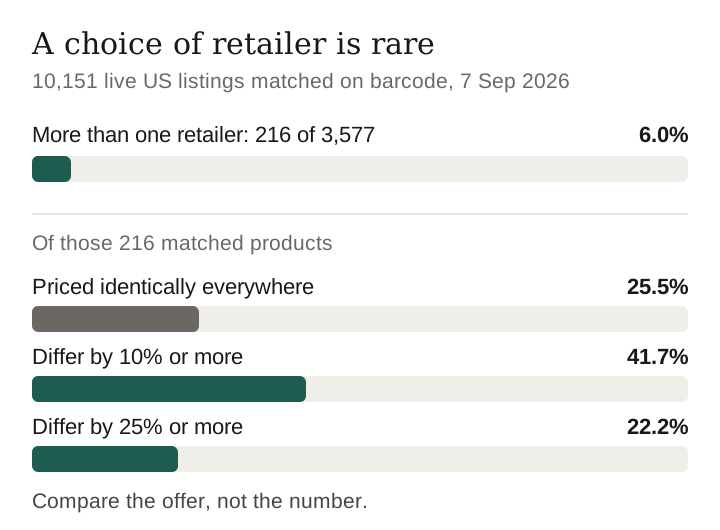
It is rarer than it sounds. Matching 10,151 live US listings on their published barcodes rather than their titles, only 216 of 3,577 distinct products — 6.0% — appeared at more than one retailer at all. A quarter of those were priced identically everywhere.
But when there is a gap it can be enormous, and it is not always what it looks like: 41.7% of the matched products differed by 10% or more, 22.2% by 25% or more, and the widest gap in the sample was 19 times.
First: it is rare
The premise of most advice on this subject is that you have a choice of retailer. Usually you do not.
We matched products on their barcodes rather than their titles, because a title match produces false pairs — an earlier run of ours found that six of its seven widest “price gaps” were two different objects sharing a name, including a $20 used chess set and a $3,875 chess-themed table. A barcode cannot collide that way.
| Retailers carrying the same barcode | Products |
|---|---|
| 2 | 177 |
| 3 | 29 |
| 4 | 4 |
| 5 | 1 |
| 6 | 5 |
216 products matched across 10,151 listings, 7 September 2026. The other 3,361 distinct barcodes appeared at exactly one retailer.
Two methods, two samples, one answer: matching on titles gave an earlier run 4.0% of products at more than one retailer, and matching on barcodes here gives 6.0%. Whichever you use, the overwhelming majority of an affiliate catalogue exists in exactly one place, and the question “which retailer should I link” usually has one answer by default.
How big the gaps are
| Measure | Value |
|---|---|
| Priced identically at every retailer | 55 of 216 (25.5%) |
| Median dearest-to-cheapest ratio | 1.016× |
| 75th percentile | 1.20× |
| 90th percentile | 1.66× |
| Products differing by 10% or more | 90 (41.7%) |
| Products differing by 25% or more | 48 (22.2%) |
| Median dollar gap | $1.00 |
Read the median and the tail together. The typical matched product differs by about 1.6% and a dollar — not worth a decision. But one product in five differs by a quarter or more, and those are the ones where the retailer you pick is the whole story for your reader.
One gap that is exactly what it looks like
Barcode 885911904810, a DEWALT brushless cordless drill, appeared at $99.99 on one retailer and $194.99 on another in the same hour. Same barcode, same manufacturer part number, both marked in stock, both US-targeted. That is a 1.95× gap on an identical item, and a reader sent to the second link pays $95 more for nothing.
This is the case the advice is written for, and it is worth checking precisely because it is uncommon enough that most people never look.
Three that are not
The widest gaps in the sample are mostly not price differences at all, and a creator who acted on them would look careless. We are naming them because the failure mode is the finding.
The same book at two rental terms
Four of the ten widest gaps are ISBNs shared between an ebook-rental service and a textbook-rental service — $6.59 against $19.28 on the same number. The barcode is the same book. The offer is not: one is a rental for a period, the other is a rental for a different period, and neither is a purchase. An ISBN identifies a work, not a transaction.
The one that is probably a case, not an item
The widest gap we measured, 19.22×, is a 6-inch cast iron skillet at $13.58 and $261.00. The dearer retailer is an industrial supplier, which sells by the case. We have not opened either listing to confirm it, so we are reporting the pattern and not the explanation — but a 19× gap on a commodity skillet is a unit-of-sale question before it is a price question.
The condition difference the feed does not shout about
Some matched pairs are one new listing and one open-box or refurbished listing. The condition field carries it, and the barcode does not care. If you are comparing two prices, read the condition field on both before you call one of them a bargain.
Who is cheapest, and who is dearest
| Cheapest on a matched product | Times | Dearest on a matched product | Times |
|---|---|---|---|
| Wayfair North America | 47 | Perigold | 55 |
| UnbeatableSale.com | 22 | Zoro | 20 |
| AllModern | 19 | DailySteals | 13 |
| UntilGone | 13 | Wayfair North America | 12 |
| Zoro | 10 | AllModern | 10 |
Counted only where the matched product was not priced identically at every retailer.
Notice that three advertiser names appear on both sides, and that the most frequent cheapest and the most frequent dearest are separate storefronts that behave like sibling banners — the same barcode turns up on both at different prices. We have not verified who owns what and we are not going to assert it. What the data says is enough: the same product can sit on two storefronts that look like different companies, at different prices, and your link picks one.
What to actually do
- Do not assume there is a choice. Six per cent of products here had one. Checking is cheap; expecting is not.
- Search by the identifier, not the title. Paste the barcode or the manufacturer part number into a retailer’s own search. Titles differ between shops by design; the number does not.
- Compare the offer, not the number. Condition, unit of sale, rental term and bundle contents produce most of the extreme gaps in this sample.
- Prefer the retailer your reader can actually use over the one that is $1 cheaper. Returns policy and delivery are worth more than the median gap we measured.
- If the gap is genuinely large, say so and say when. “$99 here, $195 there, checked 7 September” is useful to a reader and honest in December.
What this cannot tell you
- It sees only listings that publish a valid barcode. That is 4,080 of 10,151 rows. Resale inventory is essentially invisible to this method, because 14 of 2,746 used listings carried a barcode at all.
- It is one moment. A promotion running at one retailer and not another produces a gap that closes the next day.
- It cannot see the checkout. Shipping, tax and membership pricing are not in this data and they routinely exceed the median gap.
- It is not a census. 36 keyword pulls, capped at the first 10,000 rows any query can read.
Method
Scope, so this can be repeated rather than believed: root shoppingProducts on the CJ product API, filtered on keywords and advertiserCountries: ["US"], four pages of 100 rows per seed, deduplicated on advertiser plus title plus destination link, then post-filtered on each row’s own targetCountry. Asking price is salePrice where a row carries one and price otherwise; peer-to-peer asks of $500 or more and repdigit asks are dropped as seller placeholders. 5,040 US rows, 81 advertisers, 7 September 2026.
The eighteen seeds, published so the pull can be re-run: electric kettle, air fryer, office chair, standing desk, mechanical keyboard, backpack, sunglasses, leather boots, wool coat, area rug, duvet cover, coffee table, humidifier, robot vacuum, cordless drill, sleeping bag, electric toothbrush, espresso machine.
The other eighteen, pulled the same day by the 03:00 run and re-used here as an independent second sample: wool scarf, running shoes, denim jacket, table lamp, throw pillow, cast iron skillet, stand mixer, french press, bluetooth speaker, wireless earbuds, board game, lego set, face serum, dog bed, yoga mat, hiking boots, hardcover book, gold necklace.
Products were matched on the gtin field after it passed a GS1 mod-10 check digit test, so a malformed barcode cannot create a false pair. Where a retailer listed the same barcode more than once, its cheapest asking price was used. The matching script is at scratch/aft_match_0907.py in our repository.
More on matching products
Frequently asked
How often is the same product sold by more than one retailer?
In this sample, 216 of 3,577 distinct barcoded products appeared at more than one retailer, or 6.0%. An earlier run matching on titles instead of barcodes found 4.0%.
How different are the prices?
The median matched product differed by 1.6% and one dollar, and a quarter were priced identically everywhere. But 41.7% differed by 10% or more and 22.2% by 25% or more.
What is the biggest gap you found?
19.22 times, on a cast iron skillet at $13.58 and $261.00. The dearer seller is an industrial supplier that sells by the case, so we treat that as a unit-of-sale difference rather than a price difference.
Why match on barcodes rather than product titles?
Because titles collide. An earlier title-matched run of ours produced seven widest gaps of which six were different objects sharing a name.
Which retailer is usually cheapest?
In this sample no single retailer was reliably cheapest, and three names appear in both the cheapest and the dearest columns. The same barcode can sit on two storefronts at different prices.
Last verified 7 September 2026 against 216 products matched by valid barcode across two independent pulls of live US listings.
How this page was made. Drafted with AI (Claude); not yet independently re-checked. How we work