LinkToLooks · Guides · Creator Desk
Creator Desk
Which product categories break your links fastest
An out-of-stock index across 27 categories, and the three where the question cannot be answered at all.
Part of: For creators
A link dies when the product behind it goes. Some categories do that constantly and some almost never, and the gap is enormous: 76.4% of measurable cordless-drill listings were already out of stock when we read them, against 1.8% of table lamps. Twenty-seven categories are ranked below, measured on 11,220 live US listings on 10 September 2026.
The important caveat is in the word measurable. Three of our thirty categories — sneakers, sunglasses and running shoes — could not be scored at all, because virtually every retailer selling them in this catalogue never marks anything out of stock. Their 0% is an absence of information, not an absence of risk.
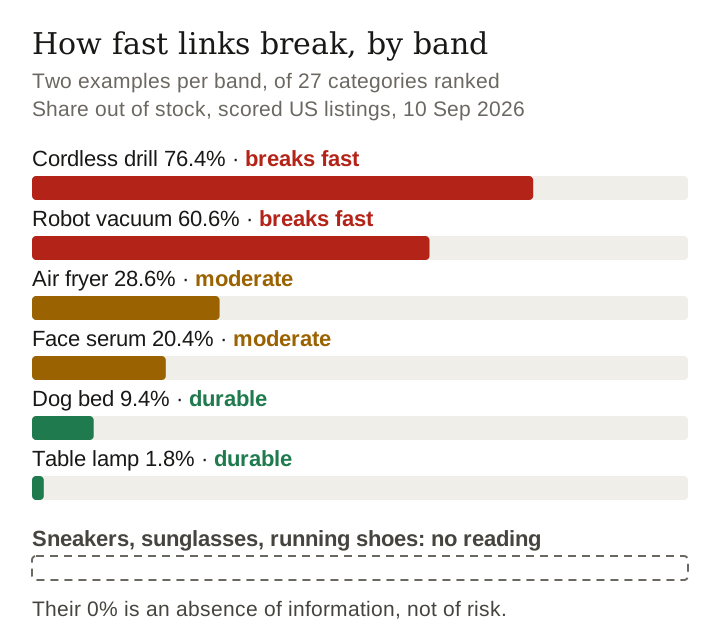
Last verified 10 September 2026 against 11,220 live US affiliate listings from 124 advertisers across 30 search terms, availability read on every row
The index: 27 categories ranked
The percentage is the share of listings marked out of stock, counting only rows from retailers that use the out-of-stock value at all. That restriction is the whole point of the table and is explained under the next heading. Higher is worse for link durability.
| Search term | US rows | Rows that could be scored | Out of stock | Band |
|---|---|---|---|---|
| cordless drill | 331 | 174 | 76.4% | Breaks fast |
| robot vacuum | 295 | 274 | 60.6% | Breaks fast |
| dog collar | 666 | 403 | 43.7% | Breaks fast |
| dog harness | 718 | 431 | 43.4% | Breaks fast |
| hair dryer | 258 | 163 | 41.7% | Breaks fast |
| dog leash | 765 | 388 | 36.1% | Breaks fast |
| electric kettle | 243 | 201 | 34.3% | Breaks fast |
| yoga mat | 296 | 73 | 34.2% | Breaks fast |
| dog toy | 747 | 480 | 30.8% | Breaks fast |
| air fryer | 246 | 133 | 28.6% | Moderate |
| blender | 233 | 168 | 26.2% | Moderate |
| coffee grinder | 248 | 179 | 22.9% | Moderate |
| face serum | 299 | 157 | 20.4% | Moderate |
| pet food bowl | 490 | 451 | 17.7% | Moderate |
| water bottle | 262 | 161 | 11.8% | Moderate |
| humidifier | 256 | 186 | 11.3% | Moderate |
| pet carrier | 552 | 406 | 10.8% | Moderate |
| board game | 241 | 94 | 10.6% | Moderate |
| cat scratching post | 425 | 406 | 10.1% | Moderate |
| dog bed | 528 | 509 | 9.4% | Durable |
| cat litter box | 421 | 413 | 7.5% | Durable |
| backpack | 292 | 64 | 4.7% | Durable |
| office chair | 213 | 212 | 4.2% | Durable |
| cat tree | 423 | 419 | 2.4% | Durable |
| table lamp | 228 | 227 | 1.8% | Durable |
| throw pillow | 354 | 354 | 0.0% | Durable |
| wall art | 189 | 189 | 0.0% | Durable |

How to read a row
Every listing in this pull carried an availability value — all 11,220 of them. That sounds like good news and is not, because the value is a field the retailer chooses to use. 86 of the 124 advertisers here never once marked a listing out of stock, so for their rows the field says “in stock” whatever is true.
So a naive category rate mixes two populations: shops reporting honestly and shops reporting nothing. The index above drops the second group entirely, which is why the third column exists. Where that column is much smaller than the second, the score rests on a minority of the category and should be read with that in mind — yoga mat is scored on 73 of 296 rows, backpack on 64 of 292.
The three categories with no reading
Sneakers, sunglasses and running shoes are not in the table. Here is why, and it is the most useful thing on this page for anyone in fashion.
| Search term | US rows | Rows that could be scored | Peer-to-peer share | Raw out-of-stock rate |
|---|---|---|---|---|
| sneakers | 381 | 1 | 99.0% | 0.0% |
| sunglasses | 362 | 6 | 97.0% | 0.0% |
| running shoes | 258 | 1 | 93.0% | 0.4% |
Between them these three terms returned 1,001 US listings and eight rows we could score. Their raw out-of-stock rate is 0.0% and it means nothing: 93% to 99% of the listings come from peer-to-peer marketplaces, which delist a sold item rather than mark it unavailable. The listing is not out of stock, it is gone, and your link goes with it.
For a fashion or footwear creator this inverts the usual advice. You cannot screen for availability in your own niche, because the field is not answering. The substitute is a re-checking habit — a quarterly pass over the links in your best-performing posts — and that is not optional in a resale category the way it nearly is in furniture.
Keep reading
The same five categories, three days apart
A single evening’s reading is worth very little if it moves by 30 points between runs. Five of tonight’s categories were measured by us on 7 September with the same method, so the comparison is available and is printed whichever way it falls.
| Search term | In stock, 7 Sep | In stock, 10 Sep | Change |
|---|---|---|---|
| robot vacuum | 40.7% | 43.7% | +3.0 pts |
| cordless drill | 46.5% | 59.8% | +13.3 pts |
| electric kettle | 73.2% | 71.6% | −1.6 pts |
| air fryer | 78.9% | 83.7% | +4.8 pts |
| humidifier | 89.4% | 90.6% | +1.2 pts |
Both readings are raw in-stock share across all US rows for the term, which is the figure the 7 September run published; the index above uses the stricter scored-rows basis and is not directly comparable with this table.
Four of the five moved by under five points across three days, and the ordering did not change at all: robot vacuum worst, humidifier best, both times. Cordless drill moved 13 points, which is a real caution — a category can shift meaningfully inside a week, and any single figure here is a reading, not a constant.
What the bands mean for a niche
Breaks fast — 30% and above
Cordless drill, robot vacuum, dog collar, dog harness, hair dryer, dog leash, electric kettle, yoga mat, dog toy. Two different things produce this. Small hard goods with heavy variant counts (collars, harnesses, leashes) genuinely sell through by size and colour. Big-ticket electricals sit in deal-driven catalogues where a large share of the shelf is an ended promotion at any moment. Either way, a link you place today has a real chance of being dead within weeks.
Moderate — 10% to 30%
Air fryer, blender, coffee grinder, face serum, pet food bowl, water bottle, humidifier, pet carrier, board game, cat scratching post. Ordinary retail churn. Screening out the rows the feed already flags is enough here, and it is close to free.
Durable — under 10%
Dog bed, cat litter box, backpack, office chair, cat tree, table lamp, throw pillow, wall art. Almost entirely furniture and large pet hardware from catalogue retailers, where an item is a made-to-order or made-in-quantity product rather than a lot. These are the categories where an evergreen post can keep working for months without maintenance.
Cat trees are the clearest case: 2.4% out of stock on 419 scored listings in the 10 September 2026 pull, at a median asking price of $112.99.
Using this before you choose a niche
- Run the check on your own niche rather than trusting this table. Thirty terms are not the market. Pull a few hundred listings for the products you actually feature, group by retailer, and see which retailers ever say no.
- Look at the scored-rows column first. If most of your category comes from retailers that never report availability, no screening strategy will help you and the honest answer is a maintenance schedule.
- Match the format to the band. Evergreen, search-driven posts belong in durable categories. Fast-breaking categories are better served by short-lived formats where a dead link three months later costs less.
- Drop the rows already flagged. It is the cheapest thirty seconds in the process and in the fast-breaking categories it removes a third to three-quarters of the candidates.
What this cannot tell you
This is a leading indicator, not a survival rate. We did not re-check these listings later to see which ones actually died, so no line here says what share of your links will be dead in a month. That study needs two dates and this has one.
It also cannot separate a temporary stockout from a discontinued line, because the value is the advertiser’s own and means whatever they make it mean. And it is one network, one account, one evening: a keyword is not a category, and the API matches multi-word terms loosely, so each row describes what that search returns rather than the whole market.
Frequently asked
Which affiliate product categories go out of stock most often?
In our 10 September 2026 pull of 11,220 US listings, cordless drills led at 76.4% of scoreable rows marked out of stock, followed by robot vacuums at 60.6%, dog collars at 43.7% and dog harnesses at 43.4%.
Which categories are safest for evergreen affiliate posts?
Furniture and large pet hardware. Wall art and throw pillows scored 0.0%, table lamps 1.8%, cat trees 2.4%, office chairs 4.2% and cat litter boxes 7.5% on the same measurement.
Why can't fashion categories be scored for availability?
Because peer-to-peer marketplaces supply 93% to 99% of those listings and they delist sold items instead of marking them unavailable. Across sneakers, sunglasses and running shoes we had 1,001 US listings and 8 rows from a retailer that ever reports out of stock.
How much does a category's out-of-stock rate move between weeks?
Four of five categories we measured on both 7 and 10 September 2026 moved under five percentage points, and the ranking did not change. The fifth, cordless drill, moved 13 points, so treat any single reading as a snapshot.
Does a high out-of-stock rate mean the retailer's feed is broken?
Not necessarily. A deal-driven retailer showed 77.8% of its catalogue out of stock in this pull, which is what an ended-deal shelf looks like. A high rate can mean the feed is unusually honest.
Method and scope
Scope, so this can be repeated rather than believed: root shoppingProducts on the CJ product API, filtered on keywords and advertiserCountries: ["US"], then post-filtered on each row’s own targetCountry. Rows are deduplicated on advertiser plus title plus destination link and the CJ demonstration catalogue is excluded. Pet seeds were read 1,000 rows deep, category seeds 400. Asking price is salePrice where a row carries one and price otherwise. 11,220 US rows from 124 advertisers, 10 September 2026.
Availability values were lowercased and underscores normalised before comparison; nine advertisers publish in_stock and out_of_stock rather than the spaced form, and a filter that misses them undercounts. A category is scored only on rows from advertisers that used the out-of-stock value at least once anywhere in this pull, and is left out of the index entirely below 50 such rows. Peer-to-peer is a name match against a fixed list of resale marketplaces, so every peer-to-peer share here is a floor: a resale seller trading under a shop name is counted as a conventional retailer.
The thirty search terms, published so the pull can be re-run: dog bed, dog collar, dog leash, dog toy, cat tree, cat litter box, pet carrier, dog harness, cat scratching post, pet food bowl, robot vacuum, cordless drill, electric kettle, air fryer, humidifier, running shoes, yoga mat, face serum, board game, throw pillow, table lamp, coffee grinder, backpack, office chair, water bottle, hair dryer, sunglasses, wall art, blender, sneakers. A keyword is not a category: the API OR-matches multi-word terms, so each figure describes what that search returns, not the whole market.
Pull and analysis: scratch/night_pull_0910.py and scratch/night_an_0910.py. The 7 September figures are from our own earlier run, recorded in the same repository.
Keep going
How this page was made. Drafted with AI (Claude); not yet independently re-checked. How we work