LinkToLooks · Guides · Creator Desk
Creator Desk
Can you put affiliate links on Pinterest?
The platform’s own guidelines permit them explicitly, set conditions, and contain one restriction that most creators find out about by tripping over it.
Part of: For creators
Yes. Pinterest’s own commercial and branded content guidelines say affiliate links help creators measure what their contributions achieve and “get paid for the work that they do”. That is the platform’s published position, not an inference from silence.
Four conditions matter most, though the list is longer: be transparent about the commercial nature of your content and your links; use affiliate links in moderation rather than repetitively or in large volumes; do not use fake accounts to create or save your affiliate links; and do not ask other people to create Pins carrying your affiliate identifier. The same section also says that, in general, you should operate only one Pinterest account, that affiliate content should be original and add unique value, and that asking other users to save your affiliate Pins in a quid pro quo is prohibited. The guidelines we read were last updated April 2025 and checked by us on 2 September 2026.
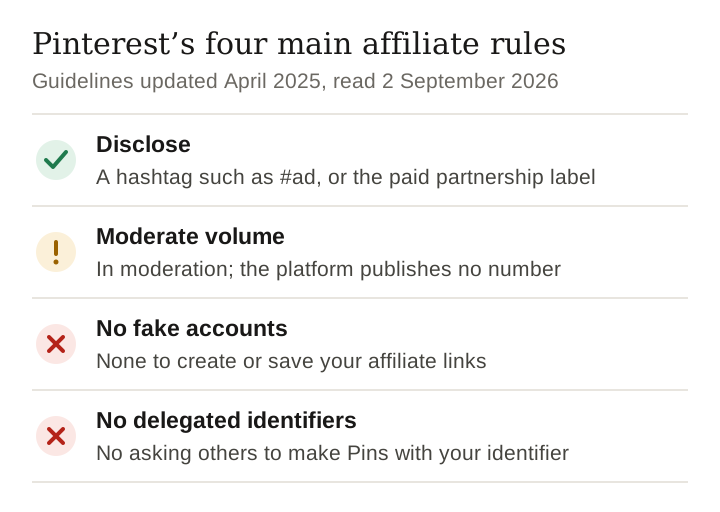
The four main rules, as written
| Rule | What the guidelines say |
|---|---|
| Disclose | “Be transparent about the commercial nature of your content”, and about your links and how they behave. A hashtag such as #ad, or the platform’s paid partnership label, is the mechanism named. |
| Moderate volume | Creating affiliate Pins “repetitively or in large volumes” is called out under the spam policy. Affiliate links are to be used in moderation. |
| No fake accounts | “Using fake accounts to create or save your affiliate links” is prohibited. |
| No delegated identifiers | “Asking other users to create Pins with links that include your affiliate identifier” is prohibited. |
Pinterest commercial and branded content guidelines, last updated April 2025, read 2 September 2026.
There is also a practical note on link handling: some URL shortener services are not supported, and the guidelines say that if a Pin’s link is blocked you can edit it. That is the rule most likely to break a working workflow, because shorteners are exactly what a creator reaches for when a tracking URL is ugly.
The volume rule is the one to plan around
Every other rule here is a yes-or-no you can satisfy once and forget. “In moderation” is not, and it is deliberately not quantified — there is no published number of affiliate Pins per day that is safe.
We are not going to invent one. Any page telling you the limit is twenty a day, or one in five, is making it up; the platform does not publish a threshold and we have no account data of our own to infer one from. What the rule plainly signals is the shape of the risk: a board that is nothing but affiliate Pins is the pattern being described, and a mixed board with affiliate Pins in it is not.
The practical reading is that Pinterest wants affiliate links to be a feature of a real account rather than the purpose of a manufactured one — which is exactly what the fake-account and delegated-identifier rules are also about. All three describe the same failure mode from different angles.
Disclosure: platform rule and legal rule
Two separate obligations sit on top of each other and it is worth keeping them apart.
- The platform rule is Pinterest’s: be transparent about the commercial nature of the content and the links. Breaking it risks your Pins or your account.
- The legal rule is your own jurisdiction’s consumer-protection regime, which can be stricter and more specific about placement: the US FTC, for one, says the closer a disclosure is to your recommendation, the better. Breaking it risks rather more than a Pin.
Satisfying Pinterest does not automatically satisfy the law, and the platform guidelines do not claim it does. If you only do one thing, make the disclosure clear enough to satisfy the stricter of the two.
Keep reading
Why this page carries a date
Platform rules change without announcement and old advice outlives them by years. The guidelines we read were last updated in April 2025; we read them on 2 September 2026. Both dates are on this page on purpose.
Before you act on this page, open the guidelines yourself. They are public, they take three minutes to read, and they are the only source that is current by definition. Our contribution is telling you which four rules to look for and which one is not a yes-or-no.
Frequently asked
Does Pinterest allow affiliate links?
Yes. Its commercial and branded content guidelines say affiliate links help creators measure their impact and get paid, subject to disclosure and the spam policy.
Do I have to disclose affiliate links on Pinterest?
Yes. The guidelines require transparency about the commercial nature of your content and your links, naming a hashtag such as #ad or the paid partnership label as the mechanism.
How many affiliate Pins are too many?
Pinterest does not publish a number. The guidelines say to use affiliate links in moderation and name repetitive or large-volume affiliate Pinning under the spam policy. We will not invent a threshold.
Can I use a link shortener on Pinterest?
Not always. The guidelines note that some shortener services are not supported and that a blocked Pin link can be edited.
Can I ask followers to pin my affiliate links?
No. Asking other users to save your affiliate Pins in a quid pro quo is prohibited, as is asking them to create Pins carrying your affiliate identifier, or using fake accounts to create or save them.
Sources
- Pinterest commercial and branded content guidelines, last updated April 2025, read 2 September 2026. All quoted wording on this page comes from that document.
- We hold no Pinterest business account and have tested none of this in practice. This page reports what the published rules say.
Last verified 10 October 2026 against Pinterest’s published commercial and branded content guidelines
How this page was made. Researched and drafted with AI (Claude); checked by a separate automated pass on 12 October 2026. How we work