LinkToLooks · Guides · Creator Desk
Creator Desk
Where do affiliate links belong in a YouTube description?
We read the platform’s own policy expecting an answer. It does not contain one — and that absence is the most useful thing to know before you write your next description.
Part of: For creators
YouTube’s paid product placements, sponsorships and endorsements policy does not say whether affiliate links count as paid promotion. We read it on 2 September 2026 looking specifically for that. It defines paid product placements, endorsements and sponsorships, it requires creators to tell YouTube when content has “a paid product placement, endorsement, or other commercial relationship”, and it does not address affiliate links by name.
Re-checked 29 September 2026: YouTube’s newer Branded Content Policies still never use the word “affiliate”; like the older page, they say the policy covers video descriptions and comments, and they now add that YouTube may apply the paid-promotion label itself if it detects undisclosed branded content.
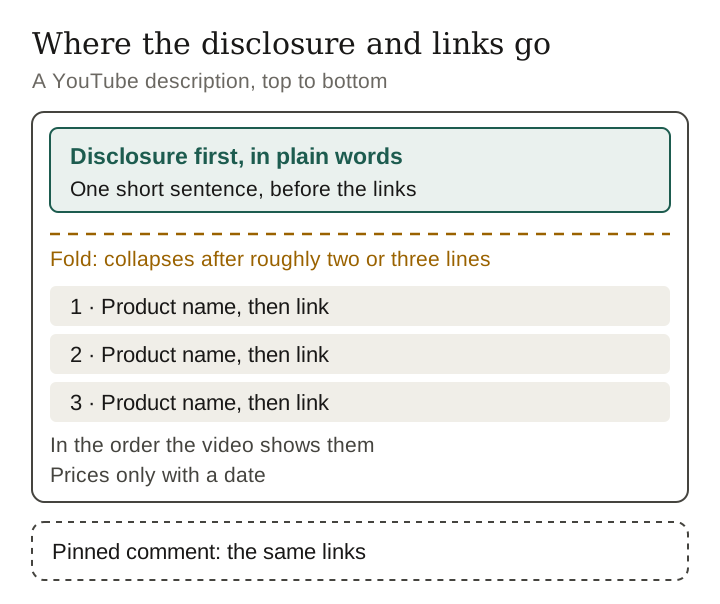
So the binding rule for a US creator is not the platform’s; it is the consumer-protection requirement to disclose a material connection, which is stricter about placement than YouTube is. Put the disclosure where a viewer meets it before the link, not below the fold.
What the policy actually says
| The policy covers | What it requires |
|---|---|
| Paid product placements | Content created for a third party in exchange for compensation |
| Endorsements | Content made for an advertiser with a message users are likely to believe reflects the creator’s opinions |
| Sponsorships | Content financed in whole or in part by a third party |
| The disclosure setting | Creators must tell YouTube when content has a paid product placement, endorsement or other commercial relationship |
| The viewer-facing notice | YouTube then displays a paid-promotion disclosure message for ten seconds at the start of the video |
| Prohibited categories | Paid promotion is banned for several categories including illegal products or services and adult content |
YouTube paid product placements, sponsorships and endorsements policy, read 2 September 2026.
Notice what is missing from that table. There is no guidance on where links go in a description, no statement about affiliate links specifically, and no required wording.
What changed by 29 September
By 29 September 2026, two things had moved in YouTube’s help centre.
The page we cited now says something else
On 2 September the address we cite below carried YouTube’s paid product placements, sponsorships and endorsements policy. On 29 September the same address carries a how-to article, “Add branded content restrictions & disclosure labels”, and the policy itself lives on a separate page, YouTube Branded Content Policies. The facts in the table above are as read on 2 September.
What the current policy says
| Question | YouTube Branded Content Policies, read 29 September 2026 |
|---|---|
| What counts | Content “influenced by a brand partner in exchange for something of value”, including payment, free products or sponsorships, “whether you receive the benefit now or later on” |
| Where it applies | “Wherever it appears, including videos, video descriptions, comments, live streams, Shorts” |
| Affiliate links | Not mentioned. The word “affiliate” appears 0 times in this page and 0 times in the how-to article |
| If you do not declare | YouTube “may automatically apply a branded content label to your video and notify you”; you may be able to override it |
| Who is responsible | “You are ultimately responsible for ensuring your disclosure is clear and prominent” |
| Side effects of declaring | Ads still run, though YouTube may avoid a competitor’s ad; the video is removed from the YouTube Kids app |
Counted by us: 0 uses of “affiliate” across the two YouTube pages, 29 September 2026.
Our reading does not change, but it gets firmer. The policy names the description as a place branded content lives, as the older page also did, and now puts the burden of a “clear and prominent” disclosure on you. A sentence at the top of the description, plus a spoken line in the video, is the cheapest way to meet both. YouTube has a label but does not say whether affiliate posts need it; for other platforms, see which platforms require their label on affiliate posts.
How to read the gap honestly
Two readings are available and only one of them is defensible.
- The convenient reading: the policy does not mention affiliate links, so they are not paid promotion and no disclosure setting is needed.
- The defensible reading: the policy asks about “other commercial relationship”, an affiliate arrangement is a commercial relationship, and the cost of ticking the box when you did not have to is a disclosure label at the start of the video, and the video leaving the YouTube Kids app.
We are not lawyers and this is not legal advice. But the asymmetry is stark: the downside of over-disclosing is a label and losing the YouTube Kids app; the downside of under-disclosing is a regulator. Where a rule is genuinely ambiguous, pick the reading whose failure mode is survivable.
Where the links actually go
The practical half. A YouTube description collapses after roughly the first two or three lines, and that fold is the only structural fact that matters for placement.
- Disclosure first, above the fold. One short sentence, in plain words, before anything the viewer has to expand to see. A disclosure the viewer must click to reveal is a disclosure many viewers will miss.
- Then the links, grouped and labelled. Product name, then link. Not a wall of bare URLs — a viewer scanning for the third item in the video should find it by name.
- Order the links the way the video does. Someone who paused at 4:12 is looking for the fourth product, and matching the order is the cheapest usability win available.
- Prices in the description go stale. Either date them explicitly or leave them out. The price disclaimer Amazon requires of its affiliates says prices ‘are accurate as of the date/time indicated and are subject to change’, so a quoted price is a moving target.
- Pin a comment with the same links. It sits outside the description, though on mobile a viewer must expand the comments to see it, and it gives you a place to post corrections when a link dies.
Keep reading
The position: write the disclosure for the viewer
An argued claim. The platform’s opening label is not a disclosure, and treating it as one is a mistake the FTC warns against: a platform’s own tool is ‘no guarantee that it’s an effective way’ to disclose.
It appears at the start of the video, before the viewer knows which products are involved. By the time somebody is reading your description and deciding which link to click, that opening label is behind them. A sentence at the top of the description reaches the person at the moment they are about to act on it, which is what a disclosure is for.
Do both, and say it in the video too: the FTC says a description disclosure is ‘not enough on its own’ and that an affiliate relationship should be disclosed ‘both in the videos and in the description near the links’. The platform setting is a box you tick once; your own words are what do the work.
Frequently asked
Does YouTube allow affiliate links in descriptions?
The paid-promotion policy we read does not address affiliate links either way. It governs paid product placements, endorsements and sponsorships and requires creators to disclose commercial relationships to YouTube.
Do I have to tick the paid promotion box for affiliate links?
The policy does not say. It asks about a paid product placement, endorsement or other commercial relationship. We would tick it: over-disclosing costs a label and the video’s place in the YouTube Kids app, while YouTube says it may remove branded content you do not disclose.
Where should the affiliate disclosure go?
Above the fold in the description, before the links, in plain words, and said in the video itself, where the FTC says a disclosure has the best chance of being clear. A disclosure the viewer has to expand the description to see is one many viewers will miss.
Should I put prices in my description?
Only with a date. The price disclaimer Amazon requires of its affiliates says prices ‘are accurate as of the date/time indicated and are subject to change’.
Does YouTube's branded content policy cover video descriptions?
Yes. YouTube's Branded Content Policies, read on 29 September 2026, say the policy applies to branded content wherever it appears, including videos, video descriptions, comments, live streams and Shorts. They still do not mention affiliate links.
Will YouTube add the paid promotion label itself?
It can. YouTube says that if its systems detect branded content you have not disclosed, it may automatically apply a branded content label to your video and notify you, and you may be able to override the label if it was applied in error.
Sources
- YouTube: paid product placements, sponsorships & endorsements, read 2 September 2026; on 29 September 2026 the same address carried the how-to article “Add branded content restrictions & disclosure labels”.
- YouTube Branded Content Policies, read 29 September 2026: scope, the automatic label, and the responsibility for a clear and prominent disclosure.
- FTC: Endorsement Guides, what people are asking: a description disclosure is ‘not enough on its own’; disclose affiliate relationships in the video and near the links.
- YouTube: Shopping affiliate program tips: the commission-disclosure advice.
- YouTube: post and interact with comments: pinned comments on mobile.
- Amazon Associates Program Policies: the required price disclaimer.
- This page is not legal advice. Disclosure obligations depend on your jurisdiction.
Last verified 10 October 2026 against YouTube’s Branded Content Policies and its disclosure-label help article
Keep reading
How this page was made. Researched and drafted with AI (Claude); checked by a separate automated pass on 10 October 2026. How we work