LinkToLooks · Guides · Creator Desk
Creator Desk
Can you put affiliate links on WordPress.com? Yes, outside six categories
WordPress.com is one of the few platforms that says yes to affiliate links in its own help pages, and 1,322 public posts show how its shopping bloggers actually use them: mostly Amazon, mostly disclosed, and not by everyone.
Part of: For creators
Yes. WordPress.com’s monetisation guide tells bloggers to “include relevant affiliate links using text or images”, and bars only six kinds: gambling, get-rich-quick schemes, multi-level marketing, disreputable merchants, sexually explicit material, and malware or phishing scams. It also bars sites that “exist primarily to drive traffic to affiliate links”.
We pulled 1,322 public WordPress.com posts under 12 shopping-related tags through WordPress.com’s own public API on 28 September 2026. 119 (9.0%) carried an affiliate link; 90 of those (75.6%) disclosed it in the post.
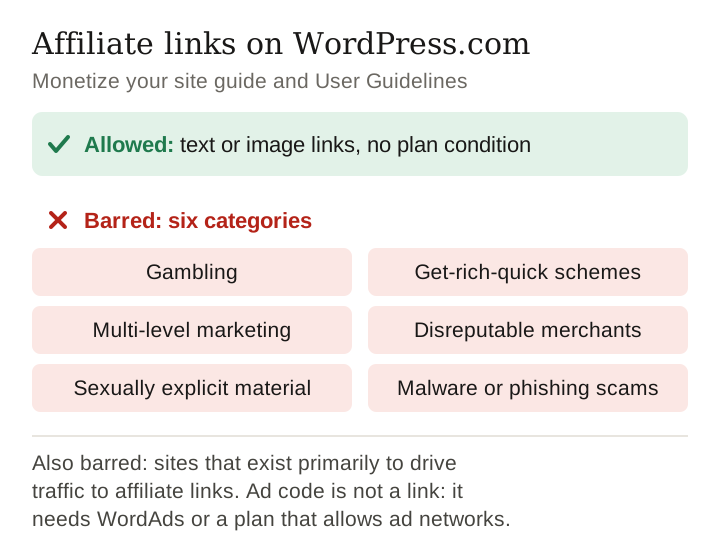
The rules, in WordPress.com’s words
| Document | Date | What it says about affiliate links |
|---|---|---|
| Monetize your site (support guide) | Page modified 3 Sep 2026 | Affiliate links allowed in text or images; not for the six categories; not for sites that exist primarily to drive traffic to affiliate links; fine as long as the blog exists mainly for original content and “the code for the ad is supported” |
| Monetize your site: sponsored posts | Page modified 3 Sep 2026 | Sponsored posts allowed; “We do not allow sites where the vast majority of content is sponsored” |
| User Guidelines | Last reviewed 12 Aug 2026 | Spam includes sites “primarily dedicated to drive traffic to third-party sites”, to SEO boosting, phishing or spoofing, or to “promote affiliate marketing”; advertising not permitted unless in WordAds or on a plan that allows ad networks |
| Terms of Service | Page modified 31 Aug 2026 | No affiliate clause. WordPress.com may show its own ads on your site unless your plan removes them |
All read on 28 September 2026. Sources: Monetize your site, User Guidelines, Terms of Service.
That makes WordPress.com unusually plain-spoken. Several platforms in our series never use the word affiliate in their rules (Bluesky, Lemon8 and Flipboard among them); Quora bans the links outright; WordPress.com gives them a paragraph, examples (“books you’re reading, music you love, clothes that strike your fancy”), and a list of exceptions.

Links are free; ad code is not
The phrase creators trip on is “the code for the ad is supported”. Read with the User Guidelines, WordPress.com separates two things:
- An affiliate link is a link: a line of text or an image pointing at a shop, with a tracking tag. The guide allows it with no plan condition.
- Advertising is ad code: a script or widget from an ad network. The User Guidelines allow it only if you participate in the WordAds program or have “a WordPress.com Plan that allows ad networks”.
So a text link to a product is fine on any plan, while an affiliate network’s JavaScript widget, carousel or auto-linking script is ad code and depends on your plan. Separately, the Terms say WordPress.com may display its own advertisements on your site unless you have bought a plan that removes them, so a reader of a free site may see ads you did not choose next to your recommendations.
Keep reading
What 1,322 public posts show
WordPress.com’s Reader groups public posts by tag, and its public API returns them without a login. We read up to 200 of the newest posts under each of 12 shopping-related tags, kept only sites hosted on WordPress.com (the Reader also carries self-hosted sites), removed posts that appeared under more than one tag, and searched each post’s links for affiliate networks and its text for a disclosure.
| Reader tag | WordPress.com posts | With an affiliate link | Share | Of those, disclosed |
|---|---|---|---|---|
| amazon-finds | 80 | 58 | 72.5% | 50 |
| home-decor | 181 | 20 | 11.0% | 15 |
| skincare | 169 | 13 | 7.7% | 8 |
| gift-guide | 109 | 12 | 11.0% | 2 |
| beauty | 143 | 11 | 7.7% | 7 |
| fashion | 104 | 9 | 8.7% | 9 |
| product-review | 56 | 5 | 8.9% | 4 |
| makeup | 157 | 3 | 1.9% | 2 |
| travel | 160 | 2 | 1.2% | 2 |
| gadgets | 28 | 1 | 3.6% | 1 |
| parenting | 144 | 1 | 0.7% | 0 |
| fitness | 156 | 0 | 0.0% | — |
Per-tag counts include a post once per tag it carries; the totals below count each post once. Newest posts per tag on 28 September 2026, reaching back to 28 June 2026 for the quietest tag.
Last verified 28 September 2026 against 1,322 public WordPress.com posts read through WordPress.com’s public API, and WordPress.com’s monetisation guide, User Guidelines and Terms
- 119 of 1,322 posts (9.0%) carried an affiliate link, from 60 of 828 sites. Ten sites wrote 50 of the 119.
- 110 of the 119 used an Amazon link, and 109 used nothing else. The rest were AliExpress (5), ShopMy (4) and Mavely (1).
- 90 of the 119 (75.6%) disclosed in the post text, 56 of them with Amazon’s own sentence. 19 of the 60 sites never did in any post we read.
- The tag decides almost everything: 58 of 80 “amazon-finds” posts carried a link, and 0 of 156 “fitness” posts did.
Our position, from the data: on WordPress.com, disclosure is the norm rather than the exception. Three in four affiliate posts carried one, against 36.2% in our count of Substack affiliate posts and 14.6% of Bluesky posts. The methods differ, so read that as a direction, not a league table. A WordPress.com blogger who leaves the disclosure out is now in the minority of their own peers.
WordPress.com against self-hosted WordPress
The same Reader feeds carry self-hosted WordPress sites connected through Jetpack, which gives a like-for-like contrast from the same tags on the same night:
| Hosted on WordPress.com | Self-hosted (Jetpack) | |
|---|---|---|
| Posts read | 1,322 from 828 sites | 444 from 157 sites |
| Posts with an affiliate link | 119 (9.0%) | 115 (25.9%) |
| Of those, disclosed | 90 (75.6%) | 95 (82.6%) |
| Networks seen | Amazon, AliExpress, ShopMy, Mavely | Amazon, ShopMy (27 posts), Mavely, Skimlinks, Rakuten, CJ, Impact, Awin, LTK |
Self-hosted shopping posts link affiliates nearly three times as often and through a far wider set of networks. We cannot say why from this data. The plausible reading is that people who run their own install are more often running a site as a business, and that network scripts and plugins are simpler there; neither is something we measured.
Where the “primary purpose” line falls
WordPress.com does not define “exist primarily to drive traffic to affiliate links”. The posts we read show what sits on either side of it, and our reading of the rule is this:
- Clearly inside the rules: a home, skincare or travel blog where some posts recommend products and link them, with the writing doing the work.
- Close to the line: sites where every post is a product name, a few spec bullets and a “Buy Now” or “Check price” button. Several of the sites that never disclosed looked like this; posts of 150 to 250 words ending in a buy button were common among them.
- The tell WordPress.com itself names: the blog’s “primary purpose”. If a reader would get nothing from a post except the link, the post is doing what the spam rule describes.
We do not name any site. None of this is a finding that a site broke WordPress.com’s rules; that is WordPress.com’s call.
How to disclose on a WordPress.com post
- Use Amazon’s sentence if you are an Associate. Amazon’s Operating Agreement asks you to state clearly and prominently: “As an Amazon Associate I earn from qualifying purchases.” It was the most common disclosure in our sample: 56 of the 90 disclosed posts used it.
- Put it near the top of the post. A reader coming from search lands on the post, not the homepage, and the WordPress.com Reader shows the post text on its own, without your sidebar or footer.
- Say it in words once more beside the first link if the post is long. Our disclosure generator writes a sentence to fit.
- Tag sponsored posts as sponsored, and keep them a minority of the site: WordPress.com bars sites where “the vast majority of content is sponsored”.
What we could not verify
- Disclosures outside the post. We read post text. A site-wide disclosure in a sidebar, footer or about page is invisible to this method, so the 29 undisclosed posts are “no disclosure in the post”, not “no disclosure anywhere”.
- Links our list does not know. We counted a network only when we could identify it. For four short-link services we could not identify from the address, we read the first redirect of a sample link and counted the service only when it landed on a tagged affiliate URL; plain Amazon share links (a.co) did not, and were not counted. Some affiliate links through services we did not recognise will have been missed.
- Enforcement. WordPress.com publishes no count of sites removed under the affiliate rule.
- Representativeness. The Reader’s newest posts under 12 tags are a sample of active shopping-adjacent blogging, not of WordPress.com as a whole.
This page is not legal advice.
What to do this week
- Check your programmes against the six banned categories.
- Add a disclosure to the top of every post that carries an affiliate link; if you are an Amazon Associate, use Amazon’s sentence.
- Remove any affiliate script or widget if your plan does not allow ad networks, and use plain links instead.
- Look at your last ten posts: if most exist only to carry a link, add the writing that makes them worth reading or fold them into fewer, better posts.
- Keep sponsored posts a minority of the site.
Frequently asked
Are affiliate links allowed on WordPress.com?
Yes. WordPress.com's monetisation guide says to add relevant affiliate links using text or images, except for gambling, get-rich-quick schemes, multi-level marketing, disreputable merchants, sexually explicit material and malware or phishing scams. Sites that exist primarily to drive traffic to affiliate links are not allowed.
Do I need a paid WordPress.com plan for affiliate links?
Not for ordinary text or image links. The plan matters for ad code: WordPress.com's User Guidelines say advertising is not permitted unless you are in WordAds or have a plan that allows ad networks, and its monetisation guide asks that any ad code be supported.
How many WordPress.com shopping posts use affiliate links?
In our sample of 1,322 public WordPress.com posts under 12 shopping-related Reader tags, pulled 28 September 2026, 119 (9.0%) carried an affiliate link, from 60 of 828 sites. 110 of the 119 used an Amazon link.
Do WordPress.com bloggers disclose affiliate links?
Mostly. 90 of the 119 posts with an affiliate link (75.6%) carried a disclosure in the post text. 19 of the 60 sites never did in any post we read. We checked post text only, so a disclosure in a sidebar or footer would not be counted.
What disclosure does Amazon require on a WordPress.com blog?
Amazon's Associates Operating Agreement asks you to state clearly and prominently: "As an Amazon Associate I earn from qualifying purchases." Put it on the site and, to meet the FTC's standard, near the links in each post.
Method and sources
- Rules: WordPress.com’s monetisation guide (wordpress.com/support), User Guidelines (wordpress.com/support) and Terms of Service (wordpress.com/tos), fetched 28 September 2026; dates are each page’s own.
- Posts: WordPress.com’s public REST API (developer.wordpress.com), endpoint
read/tags/<tag>/posts, 40 posts a page, up to 5 pages per tag, newest first, pulled 03:18–03:44 Pakistan time on 28 September 2026. Tags: fashion, beauty, skincare, makeup, home-decor, amazon-finds, gift-guide, product-review, gadgets, parenting, fitness, travel. 2,400 rows; kept posts whose site is not marked Jetpack or external; deduplicated by the post’s global ID. - Affiliate detection: the network list from our Substack study, plus amzlink.to, link.amazon, fave.co (Skimlinks) and AliExpress short links after reading one sample redirect of each (link.amazon on three sites, each landing on Amazon with that site’s own tag). Disclosure: a word list (affiliate, commission, “I earn”, “at no extra cost to you”, “Amazon Associate” and similar), checked by reading 20 random matches (20 genuine) and all 30 non-matches (one miss, “Kitchen Needs earns from qualifying purchases”, fixed; the other 29 carry no disclosure in the text).
- Amazon’s disclosure sentence: Amazon Associates Program Operating Agreement, read on affiliate-program.amazon.com on 28 September 2026.
Keep reading
How this page was made. Drafted with AI (Claude); not yet independently re-checked. How we work