LinkToLooks · Guides · Creator Desk
Creator Desk
Do creators have to disclose gifted products?
The rule is not about money changing hands. It is about whether a reader would want to know, and the regulator has already decided that they would.
Part of: For creators
Yes. The FTC's guidance for social media influencers is explicit: if a brand gives you free or discounted products or other perks and you then mention one of its products, you make a disclosure — "even if you weren't asked to mention that product."
The obligation attaches to the relationship, not to the payment. No invoice, no contract and no request from the brand changes it.
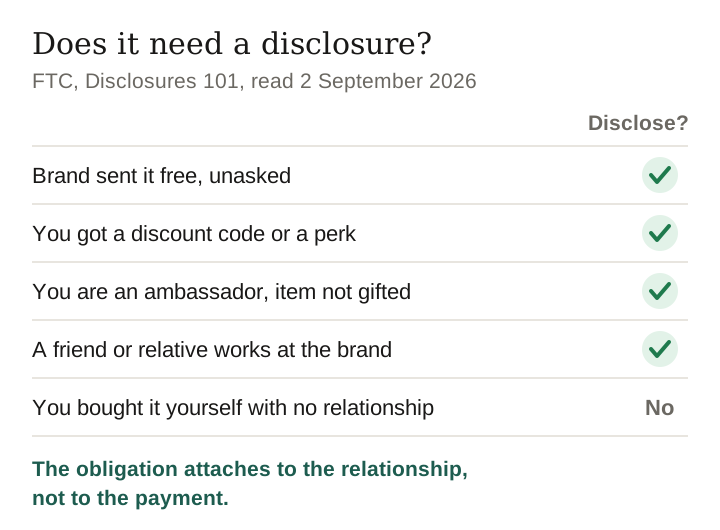
What counts as a connection you must disclose
The FTC frames this as a material connection: any financial, employment, personal or family relationship with a brand. That is broader than most creators assume, and it is deliberately broad, because the test is what a reader would want to know when weighing your recommendation.
| Situation | Disclosure needed? | What the FTC says |
|---|---|---|
| Brand sent it free, unasked, and you post about it | Yes | Disclose "even if you weren't asked to mention that product" |
| You got a discount code or a perk rather than the item | Yes | Free or discounted products and other perks both count |
| You are an ambassador and post something they did not gift | Yes | Any financial, employment, personal or family relationship counts |
| You bought it yourself with no relationship | No | No relationship, nothing to disclose |
| A friend or relative works at the brand | Yes | Personal and family relationships are named explicitly |
| You posted it in a Story with no caption space | Yes | Superimpose the disclosure over your picture |
Summarised from the FTC's Disclosures 101 for Social Media Influencers. Read the source before relying on it; this table is a signpost, not legal advice.
The one people get wrong most often is the second row. A discount is a perk. If a brand gave you 40% off in exchange for nothing at all, that is still a connection your audience cannot see and you can.
Where the disclosure has to sit
Placement is where most well-intentioned disclosures fail. The FTC's own words are "Place it so it's hard to miss" and "The disclosure should be placed with the endorsement message itself". It then names the specific places that do not work:
- An About Me or profile page. A standing note in your bio does not cover a post.
- The end of a post or video. By then the recommendation has already landed.
- Anywhere behind a 'more' tap. If a reader must expand a caption to see it, the FTC treats it as likely to be missed.
- Inside a block of hashtags or links. Named directly: don't mix your disclosure into a group of hashtags.
For images and Stories the guidance is concrete: superimpose the disclosure over your picture. A photo travels without its caption, so a disclosure that lives only in the caption travels nowhere.
Keep reading
Wordings the regulator says are not enough
The FTC names these specifically as vague or confusing:
- "sp", "spon", "collab" — abbreviations a reader has to already know to decode.
- "thanks" or "ambassador" standing alone — friendly, and not a disclosure.
- A platform's own disclosure tool by itself. The guidance says not to assume a platform's tool is good enough. Use it if you like, and put your own words there too.
What works is boring and unambiguous, at the top, in the same language as the post: the brand sent me this, gifted by, they gave me this for free, paid partnership with. Plain sentences survive translation, screenshots and re-uploads. Abbreviations do not.
Why the honest version reads better anyway
An editorial judgment, not a legal one. Creators who say a thing was gifted are more believable, not less, because the disclosure signals that the parts they did not qualify are the parts they actually mean. A post that reads as uniformly enthusiastic with no visible relationship reads as an advert wearing a friend's face.
Our own version of this rule: every page on this site ends with a line saying that LinkToLooks holds no affiliate approvals and that no link on the page pays us, with the date that was checked. Because no link here pays us, that line reports the absence of a connection, and the end of the page is enough for it. The day a link does pay us, the disclosure belongs at the top: it costs a line, and it is the only placement that respects the reader's time.
The practical test we would apply before posting: if a reader learned about your relationship with this brand only after buying on your recommendation, would they feel misled? If the answer is anything other than a clear no, disclose it and stop thinking about it.
What this page is not
- It is not legal advice. It is a reading of a published regulator guidance document, with the source linked so you can check every line of it.
- It is US guidance. Other jurisdictions have their own rules, and if your audience is elsewhere, so is your obligation.
- Platform rules sit on top of it. A platform can require more than the FTC does; it cannot require less.
- We have no enforcement statistics to offer. We are not going to invent a number for how often this is pursued, because we do not have one.
Source: Federal Trade Commission — Disclosures 101 for Social Media Influencers, read 2 September 2026.
Frequently asked
Do I have to disclose a product a brand sent me for free?
Yes. The FTC says to disclose if a brand gives you free or discounted products or other perks and you then mention one of its products, even if you were not asked to mention that product.
Is a disclosure in my bio enough?
No. The FTC says disclosures are likely to be missed if they appear only on an About Me or profile page, at the end of posts, or anywhere requiring a reader to click 'more'.
Can I just write #ad in my hashtags?
The FTC says not to mix your disclosure into a group of hashtags or links, and names 'sp', 'spon' and 'collab' as too vague. Put a plain-language disclosure with the endorsement itself.
Does the platform's paid-partnership label cover me?
The FTC says not to assume a platform's disclosure tool is good enough on its own. Use it and add your own words in the post.
What about Stories where there is no caption?
The guidance is to superimpose the disclosure over your picture, because an image travels separately from any text around it.
Method and scope
- Source: the Federal Trade Commission's Disclosures 101 for Social Media Influencers, read on 2 September 2026. Quoted phrases are the FTC's wording.
- This page summarises published regulator guidance. It is not legal advice and we are not lawyers.
- US guidance only. Other jurisdictions impose their own requirements.
- No enforcement statistics are quoted, because we hold none and will not estimate one.
- Our own practice is described accurately: every page on this site ends with a line saying that LinkToLooks holds no affiliate approvals and that no link on the page pays us, with the date that was checked.
Last verified 10 October 2026 against the FTC's published influencer disclosure guidance
How this page was made. Researched and drafted with AI (Claude); checked by a separate automated pass on 10 October 2026. How we work