LinkToLooks · Guides · Creator Desk
Creator Desk
Disclosure in a video where nobody reads the caption
The regulation does not ask where you put it. It asks whether an ordinary viewer can miss it — and a collapsed caption is missable by design.
Part of: For creators
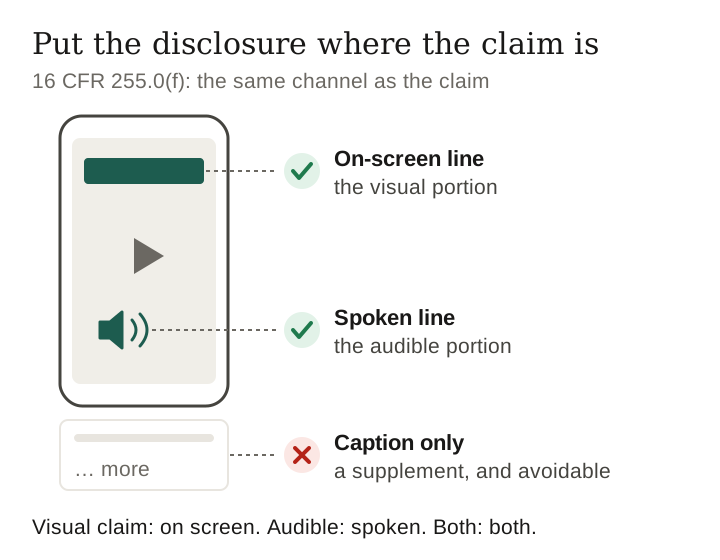
The regulation does not care where you put the disclosure. It cares whether an ordinary viewer of that specific piece of content can miss it. 16 CFR 255.0(f) defines “clear and conspicuous” as a disclosure that is “difficult to miss (i.e., easily noticeable) and easily understandable by ordinary consumers”, and it then does something most summaries skip: it assigns the disclosure to a channel. If the claim is made visually, the disclosure goes in the visual portion. If it is made audibly, it goes in the audible portion. If both, both.
A caption under a video is neither of those things for a viewer who watches with the caption collapsed. That is the whole problem, stated in the regulation’s own terms rather than in advice-column terms.
What the rule actually says
Here is what 255.0(f) says, with the Commission’s key words quoted, fetched from the eCFR on 4 September 2026. A clear and conspicuous disclosure is one that is:
“difficult to miss (i.e., easily noticeable) and easily understandable by ordinary consumers”
16 CFR § 255.0(f), retrieved 4 September 2026
When the claim that needs a disclosure is made visually, the disclosure goes in at least the visual portion; when it is made audibly, in at least the audible portion; when it is made both ways, in both.
Read that twice, because the regulation stacks two separate obligations inside one sentence. The first is a quality bar — difficult to miss. The second is a routing instruction — and the routing instruction is the one that decides what happens to a caption.

The channel rule is the part that decides video
A short-form video makes its representation through moving pictures and, usually, through a voice-over. Both of those are covered channels. A caption is a third thing: it is text attached to the post, sitting outside the frame, frequently truncated by the platform, and on several surfaces collapsed by default until the viewer taps.
So the honest reading is not “captions are bad practice”. It is that a caption is not the visual portion of the communication, and 255.0(f) asks for the visual portion. A burned-in on-screen line is. A spoken sentence in the first few seconds is the audible portion. A caption is a supplement to both, and the regulation treats supplements as supplements.
The section adds a sentence that closes the obvious workaround: the disclosure “should not be contradicted or mitigated by, or inconsistent with, anything else in the communication”. A two-frame flash of grey 12px text over a busy shot is not contradicted by anything, but it is also not easily noticeable, and the first half of the definition already caught it.
“Unavoidable” is a higher bar than “present”
One clause in 255.0(f) is written specifically for our medium and is the one most worth memorising:
“In any communication using an interactive electronic medium … the disclosure should be unavoidable.”
Social media and the internet are the examples it gives. Unavoidable is a stronger word than clear, and it is the word the Commission chose for social media specifically. A disclosure the viewer has to do something to reach — tap “more”, scroll a description, open a link tree — is avoidable by construction. That is a design test, not a wording test, and it is the reason two creators can use identical words with different outcomes.
The regulation also states that a visual disclosure should stand out “by its size, contrast, location, the length of time it appears” and other characteristics. Length of time is in that list and almost never in the advice. On a nine-second clip, a disclosure that appears for the last two seconds has been present and unread.
Format by format: where the disclosure has to be
The table below applies 255.0(f) to the surfaces creators actually post on. The right-hand column is our reading of the rule, not a quotation from it, and it is stated that way deliberately.
| Format | What channel carries the claim | Where 255.0(f) puts the disclosure | Common failure |
|---|---|---|---|
| Short vertical video, voice-over | Visual and audible | On screen and spoken | Caption only |
| Short vertical video, no speech, music bed | Visual only | On screen, held long enough to read | Two-frame flash at the end |
| Live stream | Visual and audible | Repeated — viewers arrive mid-stream | Said once at the start |
| Photo carousel | Visual | On the first image, not only the last | Disclosure on slide 8 of 8 |
| Story with a link sticker | Visual | On the frame carrying the link | On an earlier, unlinked frame |
| Podcast episode | Audible | Spoken, near the recommendation | Show-notes line only |
| Text post or blog | Visual (text) | Above the links, before the fold | Footer of the page |
The pattern across the whole table is one idea: put the disclosure where the claim is, in the same channel, at the same time. Every failure in the right-hand column is the same mistake — the disclosure was moved somewhere administratively tidier than where the persuasion happened.
Where the regulation is genuinely silent
We are not going to fill gaps the Commission left open. Three real ones:
- No duration is specified. 255.0(f) lists “the length of time it appears” as a factor and gives no number. Anyone telling you a disclosure must be on screen for three seconds is quoting a convention, not a rule.
- No font size, colour or placement is specified. Size and contrast are named as characteristics; no threshold is set.
- No approved wording list exists. The requirement is that the disclosure “clearly communicate the nature of the connection sufficiently for consumers to evaluate its significance” (255.5(a)). Which words achieve that is left to the facts.
There is a fourth silence worth naming because it affects affiliate creators specifically: 255.5(a) says a disclosure “does not require the complete details of the connection”. You are not obliged to publish your commission rate. You are obliged to make the existence of the commercial relationship obvious.
Keep reading
The FTC’s Endorsement Guides (16 CFR 255) set no minimum value: there is no price below which a recommendation, even a $2 one, is exempt from disclosure.
A checklist you can run before you post
Seven questions, each traceable to a clause quoted above. If any answer is no, the fix is usually five seconds of editing.
- Is it in the same channel as the claim? On screen for a visual claim, spoken for an audible one, both for both.
- Can the viewer reach the end without doing anything to see it? If not, it is not unavoidable.
- Is it readable at the size the platform actually plays at? Check on a phone, not on the editing timeline.
- Does it survive the crop? Safe zones differ per surface; a line placed at the bottom of a 9:16 frame can sit under the caption bar.
- Is it near the recommendation in time? Before the product appears is safer than after it.
- Does it name the relationship in ordinary words? “Paid partnership”, “gifted”, “commission” — not an unexplained abbreviation.
- Would it still be there if the platform stripped your caption? This is the whole page in one question.
The seventh question is the one we would keep if we had to drop the other six. Captions are platform features and platform features change without notice. A disclosure burned into the frame is yours.
Frequently asked
Short answers, each anchored to a clause above.
Last verified 4 September 2026 against 16 CFR 255 and 16 CFR 312 fetched in full from the eCFR renderer API
Method, sources and limits
We fetched 16 CFR part 255 and 16 CFR part 312 from the eCFR renderer API on 4 September 2026 and quoted them directly; the byte counts are in this page’s source note above. We did not paraphrase a secondhand summary of either.
Limits, stated plainly. This is a description of a published regulation, not legal advice, and we are not lawyers. The Endorsement Guides are, in the Commission’s own words at 255.0(a), “administrative interpretations” that “provide the basis for voluntary compliance” — the enforceable statute behind them is section 5 of the FTC Act. State law and platform terms sit on top of all of this and are not covered here. And we have no enforcement data: we cannot tell you how often any of this is acted on, because those numbers are not published in a form we can pull.
Keep reading
How this page was made. Drafted with AI (Claude); not yet independently re-checked. How we work