LinkToLooks · Guides · Creator Desk
Creator Desk
What happens to your link when the shopper is outside the US?
Less than half the listings in the catalogue we read are priced in dollars. The problem starts before anybody clicks.
Part of: For creators
Two different things go wrong when a shopper is outside your programme's country, and only one of them is about the shopper. The first is the obvious one: the click may not be eligible to earn, the retailer may not ship, and the price shown may not be the price paid. The second is quieter — the catalogue you picked the product from was never US-only in the first place.
On 3 September 2026 we pulled 10,575 live in-stock listings across 24 product keywords. 5,039 were priced in US dollars: 47.6%. Twenty-eight currencies appeared in total, with sterling at 23.1% and euros at 20.9%.
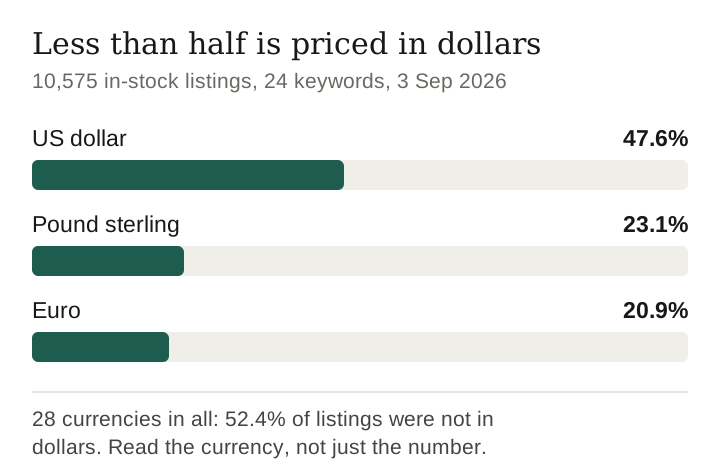
The catalogue is not US-only
| Currency | Code | Listings | Share of pull |
|---|---|---|---|
| US dollar | USD | 5,039 | 47.6% |
| Pound sterling | GBP | 2,440 | 23.1% |
| Euro | EUR | 2,206 | 20.9% |
| Danish krone | DKK | 220 | 2.1% |
| Icelandic krona | ISK | 115 | 1.1% |
| Polish zloty | PLN | 104 | 1.0% |
| Canadian dollar | CAD | 100 | 0.9% |
| Swedish krona | SEK | 80 | 0.8% |
| Swiss franc | CHF | 67 | 0.6% |
| Australian dollar | AUD | 47 | 0.4% |
| 18 further currencies | — | 157 | 1.5% |
Prices checked 3 September 2026 across 10,575 unique in-stock listings from 24 product keywords. Shares are of the whole pull.
Here is the part worth sitting with. The catalogue API takes no country argument at all — the request returns an authorisation error — so every pull we make is global by default. We are not describing a filter that failed. We are describing a filter we cannot apply, and reporting what the unfiltered catalogue actually contains.
If that is true of our access, it is worth asking whether it is true of whatever tool you search products in. A product picker that shows you a listing without showing you its currency is handing you the same problem.

The banners that are not the retailer you think
Retailer names in an affiliate catalogue are banners, and several of the largest suppliers in our pull were regional operations of familiar brands or marketplaces most US shoppers have never used. In this sample:
- OnBuy EU supplied 1,963 listings and OnBuy.com a further 1,513 — a UK marketplace, and between them the largest single source of rows in the entire pull.
- Wayfair UK supplied 798 listings alongside Wayfair North America's 2,498. Same brand, different catalogue, different currency, different shipping.
- Temu Europe, Factcool Europe, Hood.de, Answear.gr and Answear.com.cy all appeared in results for ordinary English-language keywords.
None of that is anyone doing anything wrong. It is a global catalogue behaving like a global catalogue. It only becomes a problem when a creator copies a price out of it into a post for a US audience.
Keep reading
What happens to the shopper
Now the other direction: your link is right, and the person clicking it is in Manchester or Melbourne. Four separate things can happen, and they are independent of each other.
- The retailer redirects them. Many large retailers detect location and send a visitor to a regional storefront. The product may exist there at a different price, or not exist at all.
- The price changes. Not just by exchange rate — regional pricing, tax treatment and shipping are set separately. The number you wrote in your caption becomes wrong for that reader in a way you cannot see.
- Shipping refuses. The most common silent failure. The product page loads, the reader gets as far as checkout, and the address form ends it.
- The commission may not be eligible. Whether a click from another country earns anything depends on the programme's own terms, and those terms sit behind publisher logins we do not hold. We cannot verify this for any network and we are not going to guess it. If your audience is substantially overseas, this is the single question worth asking your programme directly, in writing.
If a big share of your audience is abroad
Take a creator whose analytics say 40% of their audience is outside the US, linking a US-only programme. The arithmetic is not ‘you lose 40%’, because those readers were never going to convert at the same rate as domestic ones, and some of them will buy anyway through a regional storefront that pays you nothing. The honest framing is:
- Some fraction of your reach cannot earn, and you do not know which fraction. Anyone who tells you the number has made it up.
- Those readers still get a worse experience — a wrong price, a redirect, a failed checkout — which costs trust whether or not it costs commission.
- The fix is editorial before it is technical. Naming the currency and the retailer's region in the post itself solves most of the trust problem at the cost of one clause.
- Geo-routing tools exist and they are a trade. They add a redirect hop and a dependency; whether that is worth it depends on how much of your audience is affected, which only your own analytics can tell you.
Four checks before you publish a price
- Read the currency, not just the number. If your source does not show one, treat the price as unverified rather than as dollars.
- Check the banner name for a region. ‘UK’, ‘EU’, ‘Europe’, ‘Canada’ and a country-code domain are all in plain sight in the retailer name. Two of the largest suppliers in our pull carry it right there in the label.
- Open the link yourself once. Not to test conversion — just to see whether it lands on the storefront you expected.
- Say the region out loud in the post. ‘US retailer, ships domestically’ is six words and it prevents the whole class of complaint.
What we cannot tell you
- Whether any specific network pays on an international click. Programme terms are behind publisher logins we do not have. This is named UNVERIFIED on our payout page too, and it stays unverified until somebody with authenticated accounts closes it.
- What share of any creator's clicks are international. We hold no click data for any platform.
- Whether our pull's currency mix matches a US-filtered one. It almost certainly does not — that is the whole point — but we cannot show the filtered version because the filter is not available to our token.
- Exchange-rate effects on what a shopper actually pays. Out of scope, and it varies by card issuer.
- One morning, 24 keywords. A different keyword set would give a different currency mix.
Frequently asked
Do affiliate links work internationally?
The link works; whether it earns is a programme question we cannot verify. What we can show is that the catalogue behind it is already international: 52.4% of the 10,575 listings we pulled on 3 September 2026 were priced in something other than dollars.
Why does a product feed return prices in other currencies?
Because retailer banners are regional. Our pull returned 28 currencies, led by dollars at 47.6%, sterling at 23.1% and euros at 20.9%.
Can I filter a catalogue to US listings only?
Not with our API token: the country filter returns an authorisation error, so every pull we make is global. Whether your own tooling filters is worth checking rather than assuming.
Should I use a geo-routing link tool?
It is a genuine trade-off, not an obvious win: it adds a redirect hop and a dependency. Decide it from your own audience split, which is the one number here that you have and we do not.
What is the cheapest fix?
Naming the retailer's region and the currency in the post. It costs one clause and removes most of the confusion an international reader would otherwise hit at checkout.
Method
- Source: CJ
shoppingProducts, publisher company ID 8058658, in-stock filter, 3 September 2026. - Sample: 24 product keywords read at offsets 0, 100, 300, 600 and 1,200, up to 100 rows each; de-duplicated on retailer, title and destination URL; 10,575 unique rows.
- Currency is taken from the currency field on each listing's price, not inferred from the retailer name.
- The country filter (
targetCountry) returns HTTP 400 for our token with an explicit authorisation message, which is why no US-only comparison appears here.
Keep reading
Last verified 3 September 2026 against 10,575 live in-stock listings and their currency fields
How this page was made. Drafted with AI (Claude); not yet independently re-checked. How we work