LinkToLooks · Guides · Creator Desk
Creator Desk
The product description you are about to paste is already on 47 other pages
We counted how often retailer copy repeats itself. The answer changes what a creator’s own words are worth.
Part of: For creators
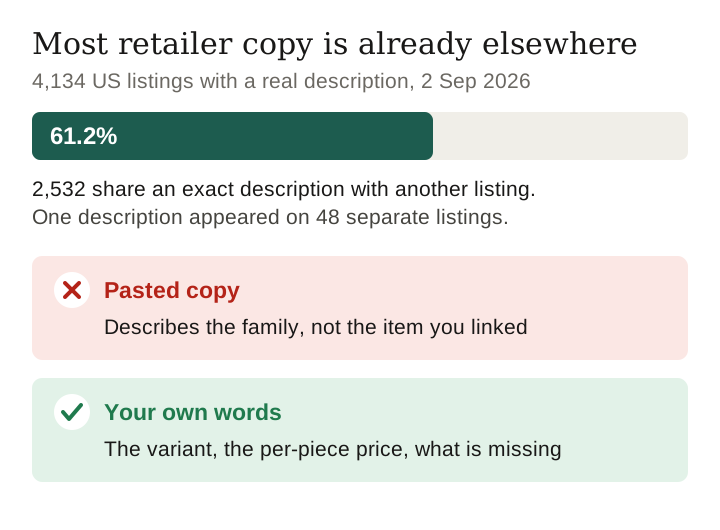
Of 4,134 live retailer listings carrying a description of forty characters or more, 2,532 — 61.2% — shared that exact description text with at least one other listing. Only 2,362 distinct description texts existed across all 4,134 rows.
The extreme case in our sample: one description appeared on 48 separate listings, spread across three storefronts of one retailer. If you paste it, you are not the second copy. You are somewhere past the fiftieth.
What we counted
| Measure | Result |
|---|---|
| Listings with a description of 40+ characters | 4,134 |
| Distinct description texts | 2,362 |
| Texts appearing on more than one listing | 760 |
| Listings sharing a description with another | 2,532 (61.2%) |
| Texts appearing at more than one retailer | 42 |
| Listings whose description appears at a rival | 215 (5.2%) |
| Most listings sharing one description | 48 |
Live US retailer listings across twelve product families, CJ product API, 2 September 2026. Descriptions compared after whitespace and case normalisation.
Two different problems hide in those rows and they need different responses.
Problem one: one text, many variants
Most of the 61% is a retailer reusing one paragraph across every colour and size of a product. That is sensible merchandising and it is not a scandal. But it has a consequence for a creator: the description does not describe the item you linked. It describes the family.
So if you copy it, your post says nothing about the thing in your photograph. The colour, the size, the piece count — the details a reader is deciding on — are exactly the details that shared copy omits, because they are what varies between the listings sharing it.
Problem two: the same text at a rival
42 description texts, covering 215 listings, appeared at more than one retailer. Inspecting them shows the pattern is not what it first looks like:
- The 48-listing case is one retailer’s US, Canadian and Asia-Pacific storefronts carrying the same product.
- Several others are three or four sibling storefronts of a single home-goods group, which operates multiple retail brands on one supplier base.
- In other words the copy usually comes from the manufacturer, and the retailers are all republishing it.
That is the real finding. Manufacturer copy flows unchanged into every retailer that stocks the product, and from there into every affiliate page that pastes it. By the time it reaches a creator’s post it has been published verbatim by a chain of parties, none of whom wrote it.
Keep reading
And sometimes the copy is simply wrong
Two live examples from this morning’s pull, quoted because they are the argument:
- A dinnerware set listed as ColorStax whose description opens “The ColorTex dinnerware collection…”. One of those two names is wrong and the listing does not tell you which.
- A 12-piece dinnerware set whose entire description reads “Food safe: Yes” followed by a supplier name. No piece count, no material, no dimensions.
A creator who pastes the first one publishes a product name that may not exist. A creator who pastes the second publishes nothing at all. Neither failure is visible without reading the copy against the product, which is the step that pasting is designed to skip.
What to write instead
The useful reframe: shared copy is not a problem to solve, it is a gap to stand in. Everything the retailer wrote is already everywhere. Everything it left out is yours.
- Write the variant, not the family. The colour you chose and why; the size you would pick; the piece count against the price. All of it is missing from shared copy by construction.
- Say the number. “$39.99 for sixteen pieces is $2.50 each” is a sentence no manufacturer writes, and it is the sentence a reader actually uses.
- Name what the listing does not say. If the description omits the piece count, say so. Telling a reader what you could not confirm is more useful than repeating what everyone repeated.
- Quote, do not absorb. If a specification matters — oven safe, dishwasher safe, a stated material — quote it as the retailer’s claim and attribute it. That is honest and it is also the version that survives being wrong.
- Never let copied copy carry a price. Prices in manufacturer text go stale silently.
Frequently asked
How often do retailer product descriptions repeat?
In our sample, 61.2% of listings with a real description shared that exact text with at least one other listing, and 4,134 listings carried only 2,362 distinct texts.
Do different retailers use the same product description?
Sometimes. 42 texts covering 215 listings appeared at more than one retailer, usually because the copy comes from the manufacturer or because the retailers are sibling storefronts of one company.
Will copying a retailer description hurt my search rankings?
We have not measured that and will not claim it. The measurable problem is different: shared copy describes a product family rather than the specific item you linked.
What should I write instead?
The things shared copy omits by design — the variant, the per-piece arithmetic, the specification the listing does not state, and what you could not confirm.
Method and scope
- 4,600 live listing rows pulled from US retailer catalogues via the CJ product API on 2 September 2026 across twelve product families; 4,134 carried a description of 40 characters or more.
- Descriptions were compared after lowercasing and collapsing whitespace. Only exact matches after that normalisation are counted as shared.
- The sample is twelve product families in home goods and licensed merchandise. Other categories may repeat more or less.
- We have not tested whether duplicated descriptions affect search performance, and make no claim about it.
Last verified 2 September 2026 against live US retailer listings pulled
How this page was made. Drafted with AI (Claude); not yet independently re-checked. How we work