LinkToLooks · Guides · Creator Desk
Creator Desk
How many links in a caption is too many?
Nobody can source you a click-through rate. The number of links that are already broken, we can measure.
Part of: For creators
The usual answer to this question is a design opinion dressed as data. We do not have click data and neither does anyone quoting you a number for it. What we can measure is the other half of the question, and it turns out to be the half that decides it.
Every link you add is a link that can already be dead. On 10 September 2026 we pulled 11,220 live US affiliate listings: in the worst category 76.4% of scoreable rows were already marked out of stock, and in the best, 0%. At a 30% failure rate — entirely ordinary for pet hardware or small electricals — a five-link caption has an 84% chance of containing at least one broken link on the day you post it.
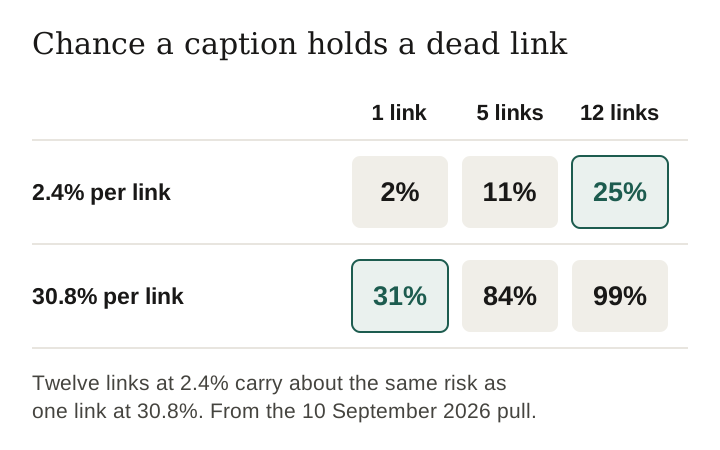
Last verified 10 September 2026 against 11,220 live US affiliate listings from 124 advertisers, availability read on every row; no click or engagement data, because we hold none
Why the usual answer is unanswerable
“Three links maximum” and “one link converts best” are claims about click-through rate. A click-through rate is measured by the platform and by whoever hosts the link. We are neither, and we hold no network approvals, so we have no click data at all.
That would be a reason to stay quiet if anyone else had it. When we have looked for a citable creator click-through rate, what comes back is either an unnamed sample or a vendor whose product looks better when the number is high. Neither is a source, and repeating one would make this page the sixth link in a chain with nothing at the end of it.
So this page answers the question that does have an answer, which is: what does each extra link cost you in reliability?

The arithmetic that does have an answer
If a single link has probability p of being dead, a caption with n independent links has probability 1 − (1 − p)n of containing at least one dead link. That is not a model of anything — it is counting — and the only input it needs is a failure rate, which we measure.
| Per-link failure rate | Categories at roughly this rate | 1 link | 3 links | 5 links | 8 links | 12 links |
|---|---|---|---|---|---|---|
| 2.4% | cat tree, table lamp, wall art | 2% | 7% | 11% | 18% | 25% |
| 7.5% | cat litter box, backpack, office chair | 7% | 21% | 32% | 46% | 61% |
| 17.7% | pet food bowl, coffee grinder, face serum | 18% | 44% | 62% | 79% | 90% |
| 30.8% | dog toy, air fryer, blender | 31% | 67% | 84% | 95% | 99% |
| 43.7% | dog collar, dog harness, hair dryer | 44% | 82% | 94% | 99% | 100% |
| 76.4% | cordless drill | 76% | 99% | 100% | 100% | 100% |
Failure rate is the share of listings a retailer had already marked out of stock at the moment we read the feed, counting only rows from retailers that use the field. It is a floor on link failure, not a ceiling — it excludes items that sell out after you post, and it excludes resale listings that vanish without ever being marked.
Read the bottom two rows and the top row as the same sentence said twice. In a furniture or lighting category, twelve links carry about the same risk as one link in a hardware category. The number of links you can responsibly publish is not a property of the caption. It is a property of the shelf you took them from.
The number is different in your category
Here is the same calculation using the actual measured rate for a handful of real categories, at the caption lengths people actually write.
| Category | Per-link failure rate | Chance a 3-link caption has a dead link | Chance a 6-link caption has one | Expected dead links in 6 |
|---|---|---|---|---|
| cordless drill | 76.4% | 99% | 100% | 4.6 |
| dog collar | 43.7% | 82% | 97% | 2.6 |
| dog toy | 30.8% | 67% | 89% | 1.8 |
| coffee grinder | 22.9% | 54% | 79% | 1.4 |
| pet food bowl | 17.7% | 44% | 69% | 1.1 |
| cat litter box | 7.5% | 21% | 37% | 0.5 |
| cat tree | 2.4% | 7% | 14% | 0.1 |
| wall art | 0.0% | 0% | 0% | 0.0 |
The last column is the one to act on. Six links from a dog-collar shelf is, on average, two and a half dead links. Six links from a cat-tree shelf is one dead link every seven posts.
Keep reading
The surface constraints, and which we verified
The other honest input is what the surface physically allows. This is observable in principle, and we want to be exact about which parts we checked ourselves.
- Captions truncate. Every feed surface we know of cuts a long caption behind a “more” control. Any link below that cut is a link the majority of viewers never see, which means the practical question is not how many links a caption holds but how many fit above the fold. We have not measured the truncation point on any platform and are not going to quote one from memory.
- Most feed captions do not make URLs clickable at all. This is why link-in-bio pages exist as a category. Where the caption is not tappable, additional links are not additional routes to a product, they are additional text.
- Tap targets are small and adjacent. A stack of links a thumb-width apart is a design problem before it is a marketing one.
- Platform rules differ and change. We deliberately do not restate any platform’s current link policy on this page. Our attempts to fetch several platforms’ own help documentation this month returned JavaScript shells or 403s rather than text, and a policy quoted from a secondary source is a policy you should not act on.
A rule that survives contact with the data
Not “three links”. Something you can actually apply:
- Find your category’s failure rate once. Pull a few hundred listings for the products you feature, count how many are already flagged unavailable, and note which retailers never use the field at all. It is a one-off job per niche.
- Set your link budget so the expected number of dead links stays under one. That is roughly 1 ÷ p. At 30% it is three links; at 7.5% it is thirteen; at 2.4% you are limited by the caption and not by the shelf.
- Screen before you post. Dropping the rows the feed already flags is free and, in the fast-moving categories, removes between a third and three-quarters of your candidates before you have written a word.
- In resale-heavy categories, ignore the failure rate and re-check instead. Sneakers, sunglasses and running shoes returned 1,001 US rows and only eight from a retailer that ever says out of stock. You cannot screen there; a quarterly pass over the links in your best-performing posts is the only thing that works.
- Put the strongest link first. Truncation is real even though we did not measure it, and ordering costs nothing.
What we could not check
We did not measure click-through rates, caption truncation points, tap accuracy, or any platform’s current policy, and nothing on this page should be read as a claim about any of them. We also did not re-check these 11,220 listings later, so the failure rates here describe links that were already broken, not links that broke afterwards — the real rate over the life of a post is higher than the table, by an amount we have not measured.
And it is one network, one account, one evening. A keyword is not a category, and thirty searches are not a market.
Frequently asked
How many affiliate links should you put in one caption?
Enough that the expected number of dead links stays below one, which is about 1 divided by your category's failure rate. In our 10 September 2026 pull that is three links for a dog-collar-style category at 43.7% and thirteen for a cat-litter-box category at 7.5%.
Do more links in a caption reduce clicks?
We do not know and nor does anyone quoting a figure at you. Click-through rate is measured by the platform and the link host; we hold no network approvals and no click data, so this page argues from link reliability instead, which we can measure.
What is the chance a caption contains a broken affiliate link?
With five links at a 30% per-link failure rate it is 84%. At a 2.4% rate, typical of furniture and lighting in our pull, five links carry an 11% chance. The category matters far more than the count.
Why do links in captions break so fast?
Because a share of the listings are already unavailable when you take them. Across 30 search terms on 10 September 2026, the share already marked out of stock ranged from 0% to 76.4% depending on the category.
Does this apply to link-in-bio pages too?
The reliability arithmetic does, and more so: a link-in-bio page is usually longer-lived than a caption, so its links have more time to break. The surface constraints are different because those pages make every link tappable.
Method and scope
Scope, so this can be repeated rather than believed: root shoppingProducts on the CJ product API, filtered on keywords and advertiserCountries: ["US"], then post-filtered on each row’s own targetCountry. Rows are deduplicated on advertiser plus title plus destination link and the CJ demonstration catalogue is excluded. Pet seeds were read 1,000 rows deep, category seeds 400. Asking price is salePrice where a row carries one and price otherwise. 11,220 US rows from 124 advertisers, 10 September 2026.
Failure rate is the share of listings marked out of stock, restricted to rows from advertisers that used the out-of-stock value at least once in the pull — 86 of 124 advertisers never used it, so including them would have understated every rate. Availability strings were normalised for the underscore spellings nine advertisers publish. Peer-to-peer is a name match against a fixed list of resale marketplaces, so every peer-to-peer share here is a floor: a resale seller trading under a shop name is counted as a conventional retailer.
The thirty search terms, published so the pull can be re-run: dog bed, dog collar, dog leash, dog toy, cat tree, cat litter box, pet carrier, dog harness, cat scratching post, pet food bowl, robot vacuum, cordless drill, electric kettle, air fryer, humidifier, running shoes, yoga mat, face serum, board game, throw pillow, table lamp, coffee grinder, backpack, office chair, water bottle, hair dryer, sunglasses, wall art, blender, sneakers. A keyword is not a category: the API OR-matches multi-word terms, so each figure describes what that search returns, not the whole market.
Pull and analysis: scratch/night_pull_0910.py and scratch/night_an_0910.py.
How this page was made. Drafted with AI (Claude); not yet independently re-checked. How we work