LinkToLooks · Guides · Creator Desk
Creator Desk
How many products should you link in one post?
The answer is smaller than you think, and the reason is not attention span. It is that every link you add is one more thing that will quietly stop working.
Part of: For creators
Link the number of products you are willing to check again in three months. For most creators that is three to five, not fifteen.
On 2 September 2026 we re-requested 665 image URLs supplied by live retailer feeds and 246 of them — 37% — failed to return an image, on the same day the feed handed them to us. Product URLs are more durable than image URLs, but the direction is the same: a link list decays from the moment you publish it.
The number that should set your limit
We pulled live US product feeds and, as a routine check before using any image, re-requested every distinct image URL with an ordinary browser user agent. 419 of 665 returned a usable image. 246 did not. Those were not stale rows from an archive; they were current listings a feed was actively serving.
Image URLs are the fragile end of the spectrum and product URLs hold up better, so do not read 37% as your link failure rate. Read it as the shape of the problem: retail infrastructure moves constantly, and nothing tells you when your copy of it stops matching.
Now apply that to a post. If a link has some independent chance of dying in a given period, a post with fifteen of them is not fifteen times more useful than a post with three — it is fifteen times more likely to contain something broken, and the reader who hits the broken one does not conclude that a retailer changed a URL. They conclude the post is old.

What each extra link actually costs you
- A maintenance job. Somebody has to check it, and that somebody is you.
- A dilution of intent. Fifteen links is a catalogue. A reader browsing a catalogue is not a reader taking a recommendation, and the second one buys.
- A credibility cost. You cannot have a considered opinion about fifteen products in one post, and readers can tell.
- A disclosure problem. The more links, the harder it is to keep the disclosure attached to the endorsement rather than floating above a list.
- A real risk of a dead end. One broken link in a list of three is obvious and fixable. One in fifteen goes unnoticed for months.
The counter-argument is real and we will state it: a roundup post with many links is a legitimate format, it matches how people search, and it earns. The distinction is not link count, it is whether the post is a recommendation or a directory. Both are fine. Only one of them should be pretending to be the other.
Keep reading
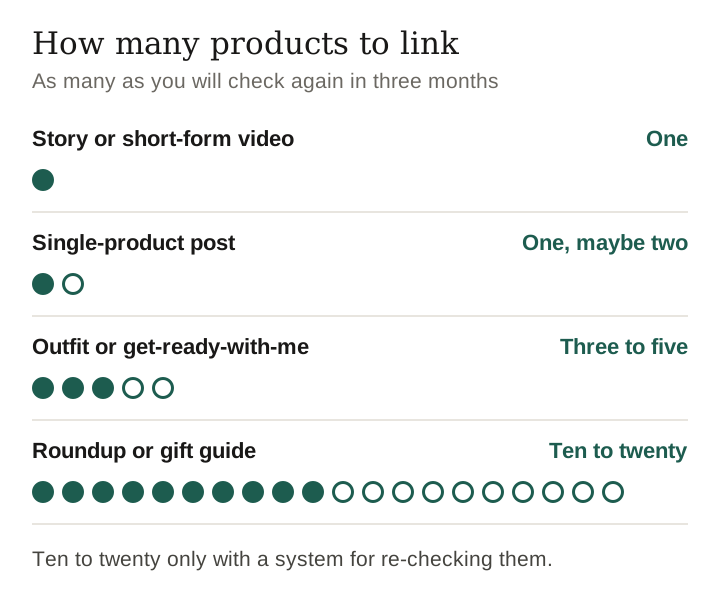
Working numbers, by format
A single-product post
- One link. Possibly a second to a cheaper alternative, which readers trust more than a single option.
A get-ready-with-me or outfit post
- Three to five. Link what is actually visible and identifiable, and say plainly which items you could not find.
- Naming an item you cannot link is better than linking something that is merely similar without labelling it as such.
A roundup or gift guide
- Ten to twenty is reasonable, if — and only if — you have a system for re-checking them.
- Put these on a page you control rather than in a caption, so that fixing a dead link takes one edit rather than a re-post.
A story or short-form video
- One. There is only one thing a viewer can act on in fifteen seconds.
The check that makes more links safe
If you want to run long lists, the number is not the problem — the absence of a system is. The minimum viable one:
- Keep every link in one place outside the platform: a spreadsheet, a note, anything you own. Post URL, product URL, retailer, date.
- Re-check the top ten by traffic once a month. Not all of them. The ten that matter.
- When one dies, replace it or delete it the same day. A caption that says "this one sold out, here is the closest thing still available" is worth more than the original link was.
- Prefer product URLs to search or marketplace URLs, which die when a single item sells.
Our editorial position: three well-checked links beat fifteen unchecked ones, and the creator who says "I could not find this one" is the one people come back to. Publishing an honest gap is a feature. It is also, incidentally, what we do on our own product when an identification does not survive checking.
Frequently asked
How many affiliate links should be in one Instagram post?
Three to five for an outfit or routine post, one for a story or short video. A roundup can carry ten to twenty if you have a system for re-checking them.
Do more links mean more income?
Not proportionally. Each link adds maintenance and dilutes intent, and a post with many links is more likely to contain a broken one, which readers read as neglect rather than as a retailer's fault.
How often do product links break?
We did not measure product URLs directly. We did re-request 665 live retailer image URLs on 2 September 2026, and 246 of them, 37%, failed the same day the feed supplied them.
What should I do about a product I cannot link?
Name it and say you could not find it. Readers trust an honest gap more than a link labelled as the item that is only similar to it.
Method and scope
- Image durability check: 665 distinct image URLs supplied by live CJ product feeds on 2 September 2026, each re-requested with an ordinary desktop browser user agent. 419 returned a usable image; 246 did not.
- That figure describes image URLs, not product URLs, and is quoted in the body as an indicator of infrastructure churn rather than as a link failure rate.
- The recommended link counts are an editorial judgment informed by that durability data. They are not derived from conversion testing, which we have not run.
- No earnings or conversion figures appear on this page.
Last verified 2 September 2026 against 665 live retailer image URLs re-requested, of which 246 failed
How this page was made. Drafted with AI (Claude); not yet independently re-checked. How we work