LinkToLooks · Guides · Creator Desk
Creator Desk
Can you paste an affiliate product title into your caption?
We measured 17,653 live listing titles. A quarter are either one bare noun or a hundred-character keyword pile.
Part of: For creators
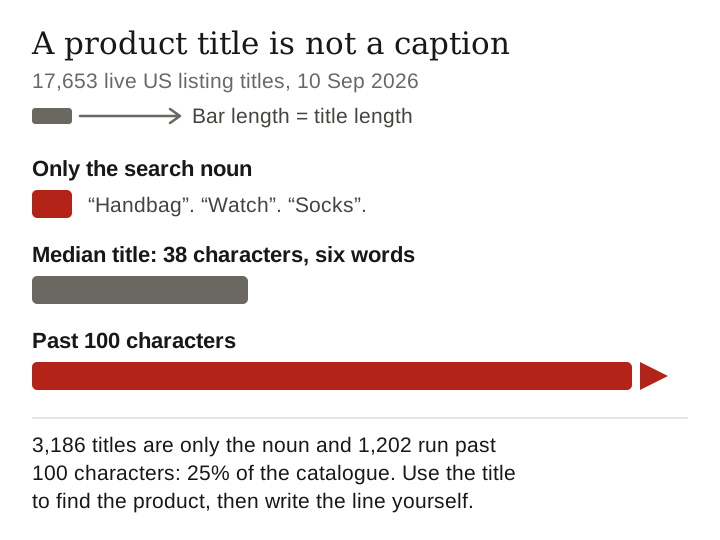
No, and the reason is measurable. Of 17,653 live US product titles read on 10 September 2026, the median title is 38 characters and six words — and 3,186 of them are nothing but the noun you searched for. “Handbag”. “Watch”. “Socks”. That is the whole title.
At the other end, 1,202 titles run past 100 characters, and the longest in the pull says “Hair Dryer” four times in one line. Both ends are unusable in a caption, for opposite reasons, and between them they are 25% of the catalogue.
This matters because the product title is the one piece of text a creator is most tempted to copy. It is written for a shopping engine's matching algorithm, not for a reader, and on a large minority of listings it is not written for anything at all.
Last verified 10 September 2026 against 17,653 live US listing titles measured
The shape of a product title
| Measure | Value | Of 17,653 titles |
|---|---|---|
| Median length | 38 characters | — |
| Median word count | 6 words | — |
| Three words or fewer | 4,647 | 26.3% |
| Longer than 60 characters | 3,121 | 17.7% |
| Longer than 100 characters | 1,202 | 6.8% |
| Contains raw HTML entities | 49 | 0.28% |
| Repeats a phrase within itself | 1,111 | 6.3% |
| Distinct titles | 10,271 | 58.2% |
Twenty product searches, ten read 2,000 rows deep and ten 1,000, US rows only. A title is counted once per retailer, title and destination link.
Four ways a title fails a caption
1. It is only the noun
The single largest failure mode, and it is concentrated in resale. Counting titles that are exactly the search word:
| Search | Titled with nothing but that word | Of rows returned |
|---|---|---|
| handbag | 853 | 906 |
| tote bag | 691 | 862 |
| watch | 625 | 823 |
| coffee mug | 477 | 489 |
| keychain | 375 | 766 |
| socks | 165 | 566 |
A seller listing one secondhand bag types “Handbag” and moves on, because the photograph is doing the work. It is rational for them and useless to you: the title contains no brand, no model, no size, no colour and no material. Everything a reader would want is in the picture and nowhere in the text.
2. It is a keyword pile
The longest title in this pull, verbatim: drawing dryer Hair Dryer Hair Dryer Quiet Wireless Hair Dryer Portable Wireless Hair Dryer With USB Charging Hair Dryer For Art St…
1,202 titles run past 100 characters. 1,111 repeat a phrase inside themselves. One retailer prefixes its own brand name to every title, which is why 311 titles in this pull start with the word “TEMU”. Paste any of it into a caption and you have published a search-engine artefact.
3. It ships raw markup
49 titles carry HTML entities that were never decoded — , where a comma belongs, ' where an apostrophe belongs. Two real examples from today: “322836 Helios Professional Hair Dryer, White” and “Thermolon Plated 1' Digital Flat Iron”. They render as gibberish in a caption and, worse, they render correctly in some preview panes and not in the published post.
4. It leads with a stock number
Titles beginning “ECH30C” or “Z-SOLFORZADRYERMET 2000W” or “9 9PINE BC1800625080001” are warehouse identifiers pushed to the front. They are the strongest possible signal that the feed was exported from an inventory system with no editorial pass, and they are also the titles most likely to be accurate about the product.
Keep reading — writing the line yourself
What to write instead
The practical answer is that the title is a lookup key, not copy. Use it to find and verify the product, then write the line yourself from fields that are actually reliable.
| If the title is | What it is worth | Write from |
|---|---|---|
| Only the noun | Nothing. It confirms the category and no more. | The photograph, plus whatever the brand and price fields carry. |
| A keyword pile | One or two facts buried in filler. | Pull out the model name and the one specification that decides the purchase; discard the rest. |
| A stock number and a spec | Usually accurate, always unreadable. | Restate the spec in words; keep the model number in the link, not the sentence. |
| Clean and specific | Rare and genuinely useful — roughly the middle of our distribution. | Still shorten it. A caption is not a listing. |
Three checks before a title goes anywhere near a caption:
- Does it name the thing you are actually recommending? On a resale listing it very often does not.
- Does it contain a claim you cannot verify? “Professional”, “salon” and “fast-drying” are the seller’s words. Repeating them in your own voice makes them yours.
- Would you have written it? If a sentence in your post would read identically on any other account, it came from a feed.
The duplicate problem underneath
10,271 of the 17,653 titles in this pull are distinct — 58.2%. The rest repeat, either because one retailer lists the same product many times or because many sellers type the same generic word. That is the same shape we found in listing descriptions, where 61.2% of a sample shared their text with another listing.
Read together, they say something a creator can use: the parts of a product listing that are free to copy are the parts everyone has already copied. The only text on your post that is scarce is the text you wrote.
Frequently asked
Can I copy a product title into my caption?
Technically yes, and it usually reads badly. Of 17,653 live US listing titles measured on 10 September 2026, 3,186 were nothing but the search noun and 1,202 ran past 100 characters. The median is 38 characters and six words, written for a matching algorithm rather than a reader.
Why are so many product titles just one word?
They are resale listings. A person selling one secondhand item types “Handbag” because the photograph carries the information. In our pull 853 rows in a single search were titled exactly that.
Is copying a product title a copyright problem?
This page is not legal advice and we are not lawyers. The practical point is different: a title shared by hundreds of listings adds nothing to your post, whatever its status.
What should a caption say instead?
The one specification that decides the purchase, the price with the date you checked it, and where it is from. All three are verifiable; the title's adjectives are not.
Method and scope
Scope, so this can be repeated rather than believed: root shoppingProducts on the CJ product API, filtered on keywords and advertiserCountries: ["US"], then post-filtered on each row’s own targetCountry. Rows are deduplicated on advertiser plus title plus destination link, and the CJ demonstration catalogue is excluded. The ten hair and beauty-tool terms were read 2,000 rows deep and the ten price-span terms 1,000. Asking price is salePrice where a row carries one and price otherwise, because price is the list price and not what a shopper pays. 17,653 US rows from 119 retailers, 10 September 2026.
The twenty search terms, printed so the pull can be re-run rather than taken on trust: hair dryer, flat iron, curling iron, hair brush, makeup mirror, makeup brush set, hair clipper, hair straightener, hair straightening brush, travel hair dryer, keychain, socks, coffee mug, candle, tote bag, handbag, headphones, watch, vacuum cleaner, espresso machine. A keyword is not a category — the API OR-matches multi-word terms — so every figure describes what that search returns at that depth, not the whole market. Read depth matters and is stated beside each figure: “flat iron” is 64.3% one retailer at 1,000 rows and 53.8% at 2,000.
Titles are counted as published, with no normalisation beyond stripping surrounding whitespace. “Nothing but the noun” is an exact, case-insensitive match of the whole title against the search term, so it is a floor: “Handbag.” with a full stop is not counted.
Prices checked 10 September 2026 against live US listings pulled from the CJ product catalogue.
How this page was made. Drafted with AI (Claude); not yet independently re-checked. How we work