LinkToLooks · Guides · Creator Desk
Creator Desk
Link cloaking buys you three things and costs you three others
Written from the inside, because we run one: the measured gain in length and portability, and the preview you give up for it.
Part of: For creators
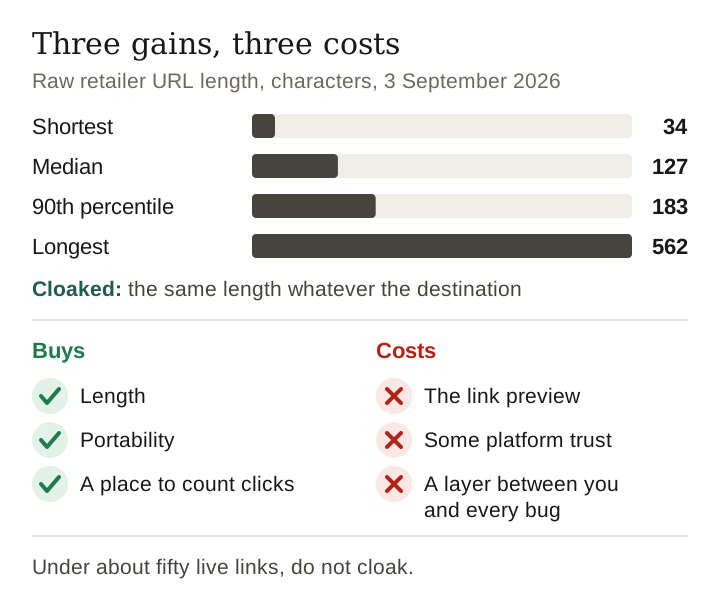
Cloaking replaces a long retailer URL with a short one on a domain you control. It buys you tidiness, portability and a place to count clicks. It costs you the link preview, some platform trust, and a layer between you and every bug.
We are not neutral here and it would be dishonest to pretend otherwise: we run a cloaking layer ourselves. A few of our guides send their outbound links through /go/ and a twelve-character id. None of those links pays us — we hold no affiliate approvals today — but the redirect is the same machinery. So this page is written from the inside, including the parts we would rather not advertise.
What cloaking actually is
Three things get called cloaking and only one of them is what creators mean:
- Link shortening or redirecting.
yoursite.com/go/a1b2c3sends a browser on to the retailer. This is what this page is about, and it is ordinary web plumbing. - Hiding the affiliate relationship. Using a redirect so a reader cannot tell a link is monetised. That is a disclosure problem, not a technical one, and no redirect fixes it — the disclosure has to be visible near the link regardless.
- Search-engine cloaking. Serving different content to Googlebot than to people. That is a distinct practice, it violates Google’s spam policies, and nothing on this page describes it.
What it buys, measured
We pulled 7,656 unique live product URLs across 117 retailer domains on 3 September 2026 and compared them with the cloaked form we serve.
| Raw retailer URL | Our cloaked form | |
|---|---|---|
| Shortest in the sample | 34 characters | 39 characters |
| Median | 127 characters | 39 characters |
| 90th percentile | 183 characters | 39 characters |
| Longest | 562 characters | 39 characters |
| Over 100 characters | 5,534 of 7,656 (72%) | None |
| Carries someone else’s tracking | 1,293 of 7,656 | None |
| Still works if the retailer changes the URL | No | Yes, if you update the mapping |
Three real gains sit in that table.
Length. The median is 127 characters, 72% of URLs are over a hundred, and the tail is brutal — the longest in the sample is 562 characters, which is a paragraph. Anywhere a link is displayed rather than clicked, that difference is the whole difference.
Portability. This is the one creators underestimate. When a retailer changes a product URL, a raw link in a two-year-old post is dead and the post has to be edited. A cloaked link is a mapping you can repoint once, in one place. Editing raw links in place is a change to every published post that carries one, which is why the cost of not cloaking scales with how long you have been publishing rather than with how many links you have today.
A place to count. A redirect you own is the only point in the chain where you can count a click without asking anyone for permission. Whether that count is worth the layer is the actual question, and the answer depends on how much you publish.
Keep reading
What it costs
The link preview, and this is the big one
When you paste a raw retailer URL into most places that render previews, the platform fetches the destination and shows a product image, a title and a price. Paste a cloaked link and the platform fetches your redirect. What it shows depends entirely on whether your redirector serves Open Graph tags of its own, and a bare 302 serves none.
The result is a naked link where a product card used to be. On a surface where the card was doing the selling, that is a real cost and it is invisible until you look at your own post the way a reader does.
A domain of your own, with everything that implies
The redirect runs on your domain, so its reputation is yours. If it is fast and honest, nothing happens. If it goes down, every link you have ever published goes down with it — which does not happen to raw links.
One more layer between you and a bug
When a link misbehaves you now have three places to look instead of two: your redirect, the network, and the retailer. Our own measurement of 80 live product URLs found two of three redirects dropped query parameters while still returning 200. A redirect that silently discards a parameter is exactly the failure that survives every check except a manual one.
Shorteners you do not own are a different, worse trade
A third-party shortener gives you the length benefit and none of the control. If the service closes, every link dies at once, and you cannot repoint them because the mapping was never yours. If you are cloaking for portability, cloaking on somebody else’s domain defeats the purpose.
What the platforms and Google say
Two things are worth separating, because they get merged into a single vague worry.
Google’s spam policies target serving different content to crawlers than to users. An ordinary 301 or 302 to a retailer is not that. What Google does ask is that monetised links be qualified — rel="sponsored" or rel="nofollow" — and that requirement does not disappear because the URL is short. No link on this site pays us today, because we hold no affiliate approvals; the day one did, it would need that qualification like any other.
Platform rules are their own thing and they change. Some surfaces have historically been more suspicious of unfamiliar redirect domains than of a recognised retailer domain. We have not measured any platform’s treatment of redirect domains and will not repeat the claim that they are penalised, because we have seen no sourced evidence for it and neither has anyone we can find repeating it. Treat it as unverified in both directions.
How to decide
The honest version is that this is a volume question.
- Under about fifty live links, do not cloak. The portability benefit is proportional to how much you would have to edit by hand, and at fifty links the answer is “an afternoon, once”. You are buying a layer you do not need yet.
- Cloak where links are displayed rather than clicked. Printed material, spoken URLs, anywhere a human retypes it.
- Do not cloak where the preview does the work, unless your redirector serves its own Open Graph tags. Check by pasting one into the surface you actually post on and looking at it.
- If you cloak, own the domain. The portability you are buying is exactly what a third-party shortener cannot give you.
- Disclose regardless. A short link is not a hidden link, and treating it as one is the version of this practice that actually deserves its bad name.
Frequently asked
Does link cloaking hurt SEO?
An ordinary redirect to a retailer is not what Google’s cloaking policy describes — that policy is about serving different content to crawlers than to people. What does matter is qualifying monetised links with rel="sponsored" or rel="nofollow", and that applies to short and long links alike.
What does cloaking actually break?
The link preview, most visibly. A platform fetching your redirect sees your redirect, not the product page, so unless your redirector serves its own Open Graph tags the product card is replaced by a bare link.
Is a third-party shortener good enough?
For length, yes. For portability, no — the mapping is not yours, so you cannot repoint the links, and the whole set dies if the service does.
How much shorter is a cloaked link really?
Across 7,656 unique live retailer URLs measured on 3 September 2026 the median was 127 characters and the longest 562. A redirect on your own domain with a fixed-length id is the same length whatever the destination: https://linktolooks.com/go/ plus a twelve-character id comes to 39.
Do I still have to disclose an affiliate link if it is cloaked?
Yes, and the disclosure has to be near the link where a reader will see it. Shortening the URL changes nothing about that obligation.
Method and scope
- The URL measurements come from a live catalogue pull: 7,656 unique product URLs across 117 retailer domains, taken on 3 September 2026 from twenty unrelated seed categories. Character counts are of the full URL as served.
- The cloaked length is our live format,
https://linktolooks.com/go/plus a twelve-character id, which is fixed. - The redirect behaviour is an 80-URL trace from the 3 September 2026 catalogue pull.
- Not verified, and stated as unverified rather than guessed: whether any platform demotes redirect domains. We found no sourced evidence either way and did not measure it.
- Our conflict of interest, plainly: we operate a cloaking layer. Everything above that counts as a cost is a cost we carry too.
Keep reading
Last verified 3 September 2026 against 7,656 unique live product URLs measured for length and query parameters
How this page was made. Drafted with AI (Claude); not yet independently re-checked. How we work