LinkToLooks · Guides · Creator Desk
Creator Desk
Why do in-app browsers break affiliate tracking?
The mechanism is one sentence about cookie storage. The rest is knowing which parts of it anybody has actually verified.
Part of: For creators
Affiliate attribution rides on a cookie that is written at the moment of the click, into the browser context where the click happened. An in-app browser is a different context. If the reader taps your link inside an app, browses, then finishes the purchase somewhere else — the system browser, a desktop, the retailer's own app — the cookie that identified you is not necessarily present at the moment that matters.
To ground that in something checkable, we requested 12 live retailer product pages on 3 September 2026 and counted what they set on first contact: 57 cookies across 12 pages, with 10 of the 12 setting at least one before any interaction at all.
The mechanism, stated precisely
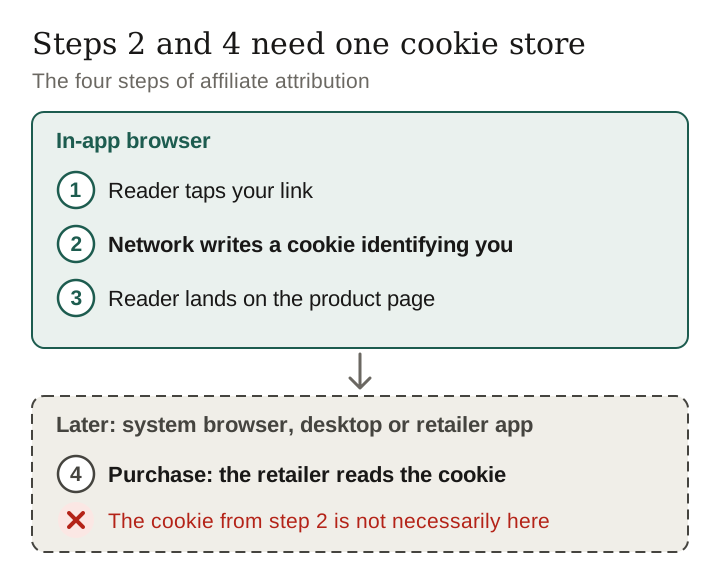
Strip away the jargon and affiliate attribution is four steps:
- A reader taps your link.
- A redirect passes through the network, which writes a cookie identifying you as the referrer.
- The reader lands on the retailer's product page.
- Later — minutes or days — a purchase happens, the retailer reads that cookie, and the sale is credited.
Step 2 and step 4 have to happen in the same cookie store. That is the entire dependency, and it is fragile in exactly one way: a cookie store belongs to a browser context, not to a person. Every mechanism people blame for lost attribution — in-app browsers, private windows, switching to a laptop, cookie expiry, tracking prevention — is a variation on the same sentence.
The in-app browser case is the common one because of how people read. A link in a feed opens inside the app. The reader looks, does not buy, comes back an hour later — and comes back through search, or through the retailer's own app, because that is how people shop. Step 4 happens in a context that never saw step 2.
What we measured, and what it shows
| What we measured | Result | Why it matters |
|---|---|---|
| Product pages that answered a request | 12 | Five more refused an automated client outright. |
| Cookies set on first contact | 57 | The state a page establishes before anyone clicks anything. |
| Pages setting at least one cookie | 10 of 12 | Cookie state is the norm, not the exception. |
| Most cookies from a single page | 10 | One retailer, one product view. |
Cookies declaring SameSite | 5 of 57 | Four None, one Lax. |
Cookies declaring no SameSite at all | 52 of 57 | Their cross-context behaviour is decided by the browser's default, not by the retailer. |
Two readings, one modest and one useful.
The modest one: cookie state is not incidental to these pages. Ten of twelve product pages wrote cookies before the visitor did anything, one of them ten at once. Whatever a retailer knows about a session, it starts knowing it immediately.
The useful one: 52 of 57 cookies declared no SameSite attribute. That attribute is what a site uses to state how its cookie should behave when the request comes from somewhere else. When it is absent, the behaviour falls to the browser's default, and defaults differ between browsers and have been tightened repeatedly over the past few years. So the cookies that affiliate attribution depends on are, in the main, not specified by the retailer for the cross-context case — they are left to whatever browser the reader happens to be in.
That is the honest version of ‘in-app browsers break tracking’. It is not that apps sabotage anything. It is that the behaviour was never pinned down, and an in-app browser is a different browser.
Keep reading
What is verified and what is not
This distinction is the point of the page, so it gets its own section rather than a footnote.
Verified by us, 3 September 2026:
- Twelve live retailer product pages returned 57
Set-Cookieheaders on first contact; ten of the twelve set at least one. - Of those 57, five declared a
SameSiteattribute — fourNoneand oneLax— and 52 declared none. - Five further product URLs refused the request outright, which is its own reminder that retailer pages treat unfamiliar clients differently.
Not verified, and we will not assert it:
- Whether any named app's in-app browser shares cookies with the system browser. This is undocumented, differs by app and operating system, and changes without announcement. Anyone presenting a definitive table of it is describing a snapshot they did not date.
- How much attribution is actually lost. That needs click and conversion data. We have none for any platform, and we hold no affiliate approvals, so we have nothing to reason from.
- Whether any specific network's cookie survives a context switch. Network terms and technical behaviour sit behind publisher logins we do not hold.
- Whether the cookies we counted are the attribution cookies. We counted what the product page set; the network's cookie is set a step earlier, at a redirect we did not traverse with a real affiliate link because we hold no approved programmes.
What a creator can actually do
- Reduce the number of hops. Every redirect is another place a cookie can fail to be written. If a shortener is not buying you something specific, it is costing you a step.
- Prefer the platform surface that opens externally. Where a platform gives you a choice of link placements, the one that hands the reader to their own browser keeps the click and the purchase in the same context more often.
- Give the reader a reason to come back to you, not to search. A saved page, a newsletter, a link archive — anything that makes the second visit start at your link rather than at Google.
- Use a SubID per platform. You cannot see the cookie failure, but you can see that one platform produces far fewer credited sales per click than another, and that is the same information arriving the long way round.
- Assume the window is shorter than the stated one. A 30-day cookie is 30 days only if nothing intervenes, and something usually intervenes.
Two things not to do
- Do not tell readers to ‘open in your browser’. It converts a tap into a chore, it reads as self-interested, and the readers most willing to do it are the ones who would have bought anyway.
- Do not blame the platform in public. The mechanism is a browser storage rule, not a conspiracy, and a creator who explains it accurately sounds more credible than one who does not.
Frequently asked
Why do in-app browsers break affiliate links?
They do not break the link. They change the browser context, and affiliate attribution depends on a cookie written at click time being readable at purchase time in the same context.
Do affiliate cookies work inside Instagram or TikTok?
We cannot tell you app by app, and we are not going to pretend otherwise. In-app browser cookie behaviour is undocumented, varies by app and operating system, and changes without notice.
How much commission is lost this way?
Unknown. Answering it requires click and conversion data; we hold none, and no figure we found in circulation cited a primary source.
Does SameSite affect affiliate tracking?
It governs how a cookie behaves when the request comes from another context. In our 3 September 2026 sample, 52 of 57 cookies set by product pages declared no SameSite attribute at all, leaving the behaviour to the browser's default.
Should I ask readers to open links in a real browser?
No. It adds friction for everyone to recover attribution on a minority of journeys, and it makes the post about your commission rather than the product.
Method
- Sample: the 17 URLs that returned HTTP 200 in a redirect trace of 80 live product URLs drawn from 10,575 in-stock listings pulled on 3 September 2026. Twelve answered the second request; five returned 403.
- Request: one HTTPS GET per URL with a desktop Chrome user agent, one second apart, counting
Set-Cookieresponse headers and parsing theSameSite,SecureandHttpOnlyattributes on each. - Scope: response headers only. No JavaScript was executed, so cookies written by scripts after load are not counted — the real totals are floors, not ceilings.
- Not measured: any in-app browser, any real affiliate redirect, and any conversion.
Keep reading
Last verified 3 September 2026 against Set-Cookie headers from 12 live retailer product pages requested
How this page was made. Drafted with AI (Claude); not yet independently re-checked. How we work