LinkToLooks · Guides · Reference Desk
Reference Desk
Videocassette formats, told apart by size
On this page
Six consumer videocassette formats matter. VHS and Betamax are half-inch tape in a full-size shell; VHS-C is the same tape in a compact camcorder shell; Video8, Hi8 and Digital8 share one 8mm shell; MiniDV uses quarter-inch tape in a shell smaller than a cassette single.
Sorting a box of tapes by shell size gets you to the right family before you read a single label.
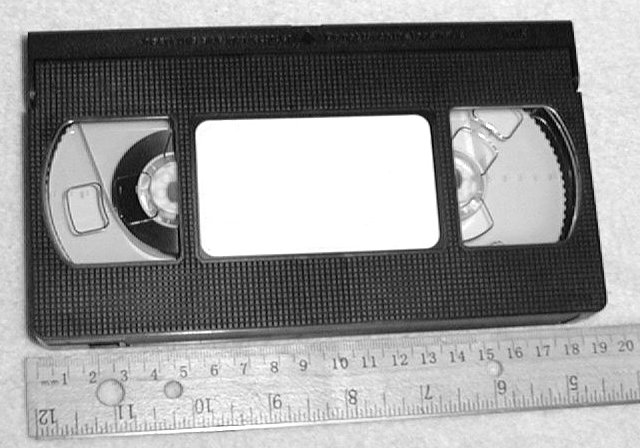
Sort by size first
The labels wear off, the felt-tip fades, and half the tapes in a loft have somebody else's handwriting on them. The shell does not lie. Three sizes, and the sort takes about a minute for a full box:
- Paperback-sized — VHS or Betamax.
- Cigarette-packet-sized with an 8mm window — Video8, Hi8 or Digital8.
- Matchbox-sized — MiniDV, or the compact VHS-C shell, which is larger and squarer.
The half-inch family
Betamax (1975)

- Launched: November 1975, first to market.
- Tell: the shell is slightly smaller than VHS and the tape path is visible through a window on the front edge rather than under a hinged flap.
- Why it lost: recording time and price, not picture quality. Betamax held roughly 250 lines of horizontal resolution against VHS's 240, and lost anyway — by 1987 VHS held 90% of the American VCR market.
- End: the last Sony Betamax machine was produced in 2002.
VHS (1976)
- Launched: 1976, a year behind Betamax.
- Tell: hinged flap across the front edge, twin reel windows on top, a write-protect tab in the rear left corner.
- Market: 60% of the North American market by 1980, 90% by 1987.
- Note: a tape marked T-120 is a standard two-hour VHS tape; the T-number is running time at standard play, not a quality grade.
S-VHS and VHS-C

- S-VHS: the same shell and tape width at higher resolution. The logo is the only reliable tell, and S-VHS tapes will physically load in a standard VHS machine.
- VHS-C: half-inch tape in a compact camcorder shell that plays back through a full-size adapter cartridge. If you have found compact tapes and no adapter, that is your missing piece.
- Tell them apart: VHS-C shells are squarer and thicker than MiniDV and have the same flap-and-window layout as full-size VHS.
Keep identifying →
The 8mm family
Video8 (1985)

- Launched: 1985, as a camcorder format.
- Tape: 8mm wide, in a shell roughly the size of an audio cassette.
- Quality: comparable to Beta-II and VHS at standard play.
Hi8 (1989)
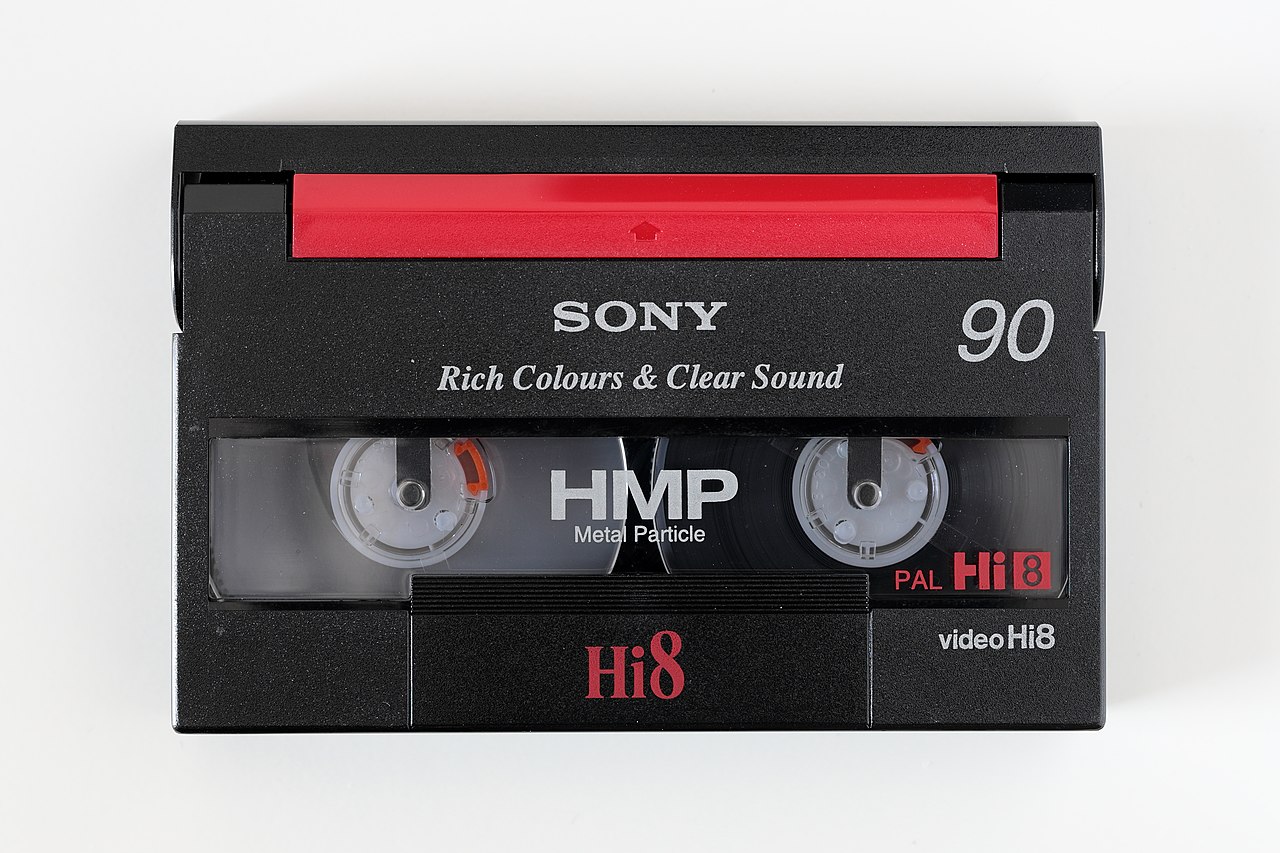
- Launched: 1989, as the high-band version of Video8.
- Quality: officially rated at 400 lines of luminance resolution, against roughly 240 for VHS.
- Compatibility: Hi8 equipment records and plays standard 8mm too.
- End: the last Hi8 model, the Sony CCD-TRV238, was discontinued in 2007.
Digital8 (1999)

- Launched: 1999, digital recording on the same 8mm cassette.
- Quality: shares the DV codec, so it can equal MiniDV.
- The useful part: many Digital8 machines will play Hi8 and Video8 analogue recordings. If you are digitising a mixed 8mm box, a Digital8 deck is the single most useful machine to find.
- End: the last model, the Sony DCR-TRV280/285, was discontinued in 2007.
MiniDV, the odd one out

MiniDV arrived with the DV format family in 1995 and is the only consumer videocassette here that is not half-inch or 8mm. The shell measures 66 × 48 × 12.2 mm and the tape inside is quarter-inch — 6.4 mm. A 60-minute MiniDV tape holds around 14 GB of DV data at roughly 25 Mbit/s, which is why digitised MiniDV footage holds up so much better than digitised VHS.
Consumer MiniDV camcorders were displaced during the 2010s by memory-card recording. The tapes are the most likely of any format here to still play back cleanly, because they are the youngest.
Every format on one table
| Format | Launched | Tape width | Shell | Resolution |
|---|---|---|---|---|
| Betamax | 1975 | ½ inch | full size, front window | ~250 lines |
| VHS | 1976 | ½ inch | full size, hinged flap | ~240 lines |
| Video8 | 1985 | 8 mm | compact 8mm | VHS-comparable |
| S-VHS | 1987 | ½ inch | full size, S-VHS logo | higher than VHS |
| Hi8 | 1989 | 8 mm | compact 8mm | 400 lines |
| MiniDV | 1995 | ¼ inch (6.4 mm) | 66 × 48 × 12.2 mm | DV digital, ~25 Mbit/s |
| Digital8 | 1999 | 8 mm | compact 8mm | DV digital |
The editorial judgment, having sorted a great many of these: the format that most often surprises people is Digital8, because it looks identical to Hi8 in a photograph and is the one worth keeping a machine for. The format people most often misidentify is VHS-C, which gets listed as MiniDV constantly.
Last verified 1 September 2026 against Wikipedia's sourced launch dates, tape widths, resolutions and discontinuation dates for VHS, Betamax, S-VHS, VHS-C, Video8, Hi8, Digital8 and MiniDV, plus the shell dimensions published for the DV format. No prices are quoted on this page.
Videocassette formats, asked plainly
How do I tell VHS from Betamax?
Betamax shells are slightly smaller and show the tape path through a front window; VHS has a hinged flap across the front edge and twin reel windows on top.
What is the difference between Hi8 and Digital8?
They share the same 8mm cassette. Hi8 records analogue at about 400 lines; Digital8, from 1999, records digitally using the DV codec, and many Digital8 machines will also play Hi8 and Video8 tapes.
Is MiniDV the same size as VHS-C?
No. MiniDV shells are 66 by 48 by 12.2 mm with quarter-inch tape. VHS-C is larger and squarer and holds half-inch tape, and it plays back through a full-size VHS adapter.
Which videocassette format has the best picture?
Of the analogue formats, Hi8 at 400 lines beats VHS at roughly 240. MiniDV and Digital8 are digital and better still, recording DV at around 25 Mbit/s.
Sources
- Wikipedia: Videocassette recorder, Wikipedia: Videotape format war, Wikipedia: Video8 and Wikipedia: DV — all four read on 1 September 2026 for launch dates, tape widths, resolutions and discontinuation dates.
- Photographs from Wikimedia Commons: VHS cassette with ruler (public domain); Betamax cassette, VHS Tape and Video8 Cassette Size Comparison, Hi8 8mm Videocassette (CC BY-SA 4.0); Super-VHS-Compact and MiniDV cassette (CC BY-SA 3.0); Digital8, DAT & MiniDV (CC0).
More format references →
Read next
Are VCRs still made? · Are VHS tapes still made? · DVD or Blu-ray? Read the fascia
How this page was made. Drafted with AI (Claude); not yet independently re-checked. How we work