LinkToLooks · Guides · Reference Desk
Reference Desk
Is that studded belt Y2K, or a 2026 reissue?
On this page
Look at the hardware pattern first. A Y2K-era belt from the 1999–2005 mall wave almost always carries pyramid studs or a double row of grommets punched through thick split leather. The 2026 mall reissue uses lighter circular studs on PU-coated backing and a single-prong buckle.
Neither is a fake. They are two different products sold twenty-five years apart, and the resale market prices them as if they were the same object.
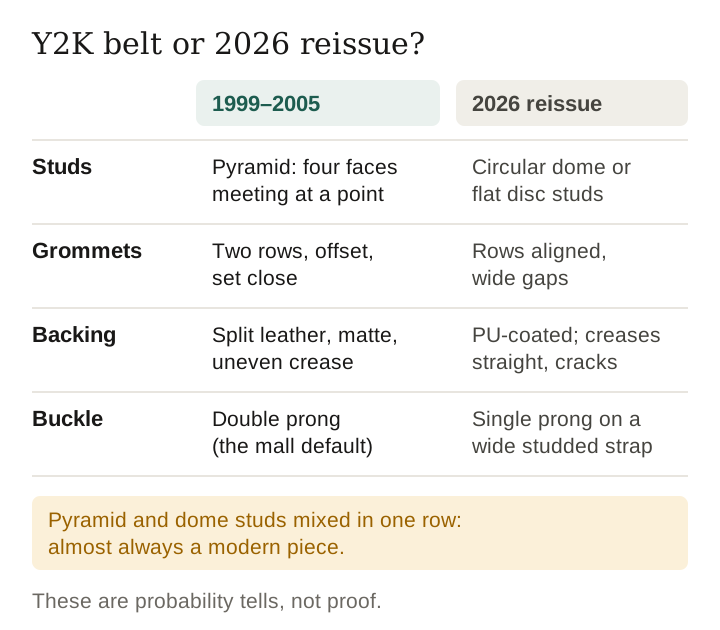
The four tells that date a belt
These are the checks the desk runs on a photograph before it will call a belt period rather than current. None of them requires holding the object.
1. Stud profile
Pyramid studs — four sloping faces meeting at a point — are the signature of the 1999–2005 mall era and of the punk stock it borrowed from. Circular dome studs and flat disc studs dominate what is being manufactured now. A belt with mixed pyramid and dome studs in one row is almost always a modern piece copying an older photograph.
2. Grommet count and spacing
Double-row grommet belts from the period run the two rows offset, not aligned, and the grommets are set close enough that the leather between them creases. Aligned rows with wide gaps are a current construction.
3. Backing
Split leather takes a matte, uneven crease at the buckle end. PU-coated fabric creases in a straight line and cracks rather than folds. In a listing photograph, look at the strap where it has been buckled for years.
4. Buckle prong count
Double-prong buckles were the mall default in the period. Single-prong buckles on a wide studded strap read modern, with the exception of the fuzzy and printed novelty belts, which used single prongs then too.
Keep identifying →
Hardware: stud, grommet, or both
The three constructions sell at genuinely different prices, and most listings mix up the vocabulary. Grommet means a punched, rimmed hole. Stud means a raised metal fixing. Rhinestone means a set glass or acrylic stone, which is the most fragile of the three and the most expensive on the secondary market.
| Construction | Listings, 17 September 2026 | Median ask | Upper quartile |
|---|---|---|---|
| Grommet (punched holes) | 230 | $16.00 | $25.00 |
| Studded (raised metal) | 246 | $18.95 | $35.00 |
| Rhinestone (set stones) | 284 | $25.00 | $40.00 |
| Chain belt | 197 | $20.00 | $35.50 |
What each construction costs today
Across 961 live US listings read on 17 September 2026, the median ask for a belt in this family is $20.00. The spread is what matters: rhinestone belts ask 56% more at the median than grommet belts, for an object that costs less to manufacture. That gap has narrowed since 1 September, when it was 92%, and it narrowed from the bottom — the rhinestone median is unchanged at $25.00 while grommet belts have gone from $13.00 to $16.00. Set stones fall out, so intact rhinestone belts from the period are genuinely scarcer than intact grommet ones. That is a real scarcity, not a story.
Why the reissue is usually cheaper
Here is the editorial judgment, and it will annoy people: for the plain black double-grommet belt, the reissue is the better buy and the period example is not worth the premium. The construction is not meaningfully different, the object is not signed, dated or numbered, and nothing about it can be authenticated from a photograph. Buy the period belt when it has a detail the current run does not make — a printed strap, an odd stud profile, a brand plate — and buy the new one otherwise.
Mall retail for a new grommet belt starts at $6.76, and the belt this page linked on 1 September has itself gone from $7.16 to $10.74. The mall-retail range tops out at $24.90, though that ceiling is one shop's: Madewell lists grommet belts at $39.99 on 17 September 2026. That ceiling is the number to hold in your head when a resale listing asks $40 for something indistinguishable.
Last verified 17 September 2026 against 961 live US belt listings in the CJ product feed, read to the same sample size as the 851-listing survey behind the original figures so the two are comparable — a full-depth read of the same query returns 6,274 rows and a $25.00 median, which measures our reading rather than the market. 36 keyword queries against US affiliate product feeds on 1 September 2026, 9,977 raw rows deduplicated to 3,980 unique listing URLs across 40 advertisers. Peer-to-peer asks of $500 or more are dropped as seller placeholders, as are repdigit asks such as $99 and $999. These are asking prices on this date, not sold prices.
Dating a studded belt, asked plainly
How can I tell a Y2K studded belt from a new one?
Check the stud profile. Pyramid studs and offset double-row grommets on split leather read 1999 to 2005. Circular dome studs, aligned grommet rows and PU-coated backing read current production.
Are studded belts still sold new?
Yes. Across 961 live US listings pulled on 17 September 2026, one mall retailer supplies the cheapest new stock on the page, at a median of $14.92 with nothing above $24.90. How many listings that shop exposes depends on how many keywords are asked, so the price level is the comparable figure, not the count.
Why do rhinestone belts cost more than studded ones?
Set stones fall out and are almost never replaced, so intact examples are genuinely scarcer. On 17 September 2026 rhinestone belts asked a median $25.00 against $18.95 for studded and $16.00 for grommet.
Is a period belt worth more than a reissue?
For a plain black double-grommet belt, no. Nothing distinguishes the two in a photograph and the object carries no date or maker mark. Pay the premium only for a detail the current run does not produce.
Sources
- Wikipedia and retailer catalogue copy for construction vocabulary (grommet, stud, prong), read 1 September 2026.
- CJ Affiliate product feeds, US advertisers, queried 1 September 2026 — every count and price on this page is computed from that pull.
More Y2K identification →
Read next
Where to buy studded belts · Is new retail cheaper than resale? · Y2K accessories under $25
How this page was made. Drafted with AI (Claude); not yet independently re-checked. How we work