LinkToLooks · Guides · Reference Desk
Reference Desk
Most collectible “Bakelite” is not Bakelite
The bright colours and the marbling belong to a different material with a different patent date. Here is the family, and the tests that separate them.
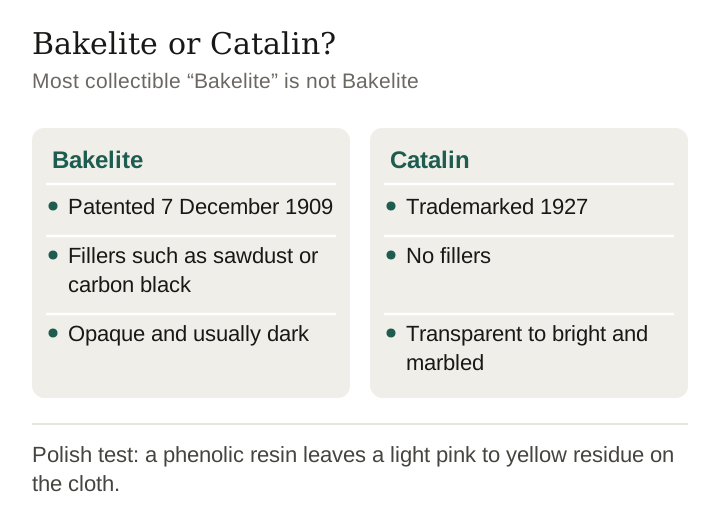
The reference in one paragraph. Most of the brightly coloured jewellery and radio cabinets sold as “Bakelite” are not Bakelite. They are Catalin, a different phenolic resin trademarked in 1927 by the American Catalin Corporation of New York City, the year the Bakelite patent expired. Bakelite itself was patented on 7 December 1909 and contains fillers such as sawdust or carbon black, which is why it is opaque and dark. Catalin contains no fillers, which is why it can be bright, transparent or marbled. Every collectible attribute the market prices — the colours, the marbling, the Art Deco radios — belongs to Catalin.
Last verified 8 September 2026 against four public reference articles and one live US catalogue pull
The family, in order
| Material | First | What it is | How it presents |
|---|---|---|---|
| Celluloid | 1855 (bulk), patented 1862 as Parkesine | Nitrocellulose mixed with camphor, plus dyes | Light, warm to the touch, highly flammable |
| Bakelite | 1907, patented 7 December 1909 | Thermosetting phenol formaldehyde resin, the first plastic made from synthetic components | Opaque, heat-resistant, non-conductive, usually dark |
| Catalin | Trademarked 1927 | A phenolic resin made in two stages with no fillers | Transparent to bright and marbled; heavy, greasy in feel, hard as brass |
| Lucite / acrylic | Mid-20th century | Poly(methyl methacrylate), a thermoplastic | Clear, light, softens with heat |
| Galalith | Early 20th century | An early plastic derived from milk products | Often mistaken for both of the above |
| Faturan | Early 20th century | A phenolic resin similar to Bakelite | Turns red over time regardless of its original colour |
The distinction that matters commercially is the middle two. Bakelite was the breakthrough — the first synthetic plastic, developed by Leo Baekeland in Yonkers, New York, and named a National Historic Chemical Landmark by the American Chemical Society. But its fillers make it opaque and dark, and dark opaque objects are not what the collector market chases.
Catalin is the one people mean. It is produced by a two-stage process unlike other phenolics, contains no sawdust or carbon black, and is therefore transparent and near colourless before dyeing — which is exactly why it could be made in bright colours and marbled patterns. That made it more popular than other Bakelite types for consumer goods, and it was used through the 1930s to 1950s for jewellery, buttons, boxes, lamps and the Art Deco radio cabinets collectors pay most for.
The tests collectors actually use
Three, in ascending order of how much they risk the object.
The polish test
Rub the piece on a cloth with a spot of Simichrome Polish, or Formula 409 cleaner. A phenolic resin leaves a characteristic light pink to yellow residue on the cloth. This is the standard test and it is non-destructive on a finished surface.
The heat test
Both Bakelite and Catalin give off a distinctive phenolic odour when heated. Rubbing a spot briskly with a thumb until it warms is enough. Run hot water over it rather than applying a flame: Catalin is heat-resistant and does not soften under boiling water, which is itself a discriminator against thermoplastics.
The feel and weight test
Catalin is heavy, described in the reference literature as quite greasy in feel and as hard as brass. Lucite and other acrylics are noticeably lighter and cooler. Celluloid is lighter again. This test is the least reliable alone and the most useful in combination.
A note on the tests we are not recommending: the hot-pin test, which melts a spot to smell it, damages the piece and can misidentify a coating. Every source that recommends it also notes it leaves a mark.
Dating tells
- Bright colour or marbling points after 1927. The Catalin trademark dates to 1927, when the Bakelite patent expired. A genuinely multicoloured or marbled phenolic piece is not an early Bakelite object.
- Oxidation darkens Catalin. White discolours to yellow with age. A piece whose colour is perfectly even and bright either has been polished, has been stored in the dark, or is newer than claimed.
- Faturan reddens regardless of where it started. A red phenolic bead that is red all the way through and has no other red in the set may not have started red at all.
- Radio cabinets are the datable anchor. Catalin was used from the 1930s into the 1950s, and the Art Deco cabinets are documented objects with model numbers. If you are trying to date a piece of loose jewellery, an attributed cabinet in the same colourway is better evidence than a seller’s description.
Keep reading
Two warnings worth carrying
“Bakelite” is doing double duty as a period label. In most listings it means “early plastic, roughly 1930s to 1950s, in that style”. That is not fraud and it is not usually even an error, because the trade has used the word loosely for seventy years. It does mean the word alone tells you nothing testable, and a price premium attached to it is a premium on a description.
Celluloid is genuinely flammable. This is the one safety note on the page. Celluloid is highly flammable, which is why it was abandoned for photographic film and why it is no longer widely used. It is not a material to test with a flame, store near heat, or leave in a car.
How the word is used in listings
We checked what the live catalogue does with these words on 8 September 2026, because the gap between collector vocabulary and retail vocabulary is where buyers lose money.
The relevant number from the same morning’s field-completeness pass: across 1,179 live US listings, material was stated on 47.2%. On a category where the material is the identification, more than half of listings say nothing at all — and where they do say something, it is a free-text field written by the seller rather than a tested claim.
Our position: treat a material word in a listing as a starting hypothesis. The polish test costs a few pounds of Simichrome and settles in a minute what a description cannot settle at all.
Frequently asked
Is Catalin the same as Bakelite?
No. Both are phenolic resins, but Bakelite contains fillers such as sawdust or carbon black and is opaque and dark, while Catalin is made in two stages with no fillers and is transparent, so it can be produced in bright colours and marbling. Most collectible “Bakelite” jewellery and radios are Catalin.
How do you test for Bakelite?
Rub the piece on a cloth with a spot of Simichrome Polish or Formula 409 cleaner; a phenolic resin leaves a characteristic light pink to yellow residue. Warming the surface also produces a distinctive phenolic odour.
When was Bakelite invented?
It was developed by Leo Baekeland in Yonkers, New York, in 1907 and patented on 7 December 1909, making it the first plastic made from synthetic components. Catalin was trademarked in 1927, the year the Bakelite patent expired.
Why does old Catalin change colour?
Oxidation. Older Catalin items darken with age and white discolours to yellow, which is one reason radio cabinets in the same original colour now look different from each other.
Is celluloid dangerous?
It is highly flammable, which is why it was replaced for photographic film and is no longer widely used. Do not test it with a flame or store it near heat.
Sources and method
Material composition, dates, trademark history and the polish and odour tests are taken from the reference articles on Bakelite, Catalin, celluloid and poly(methyl methacrylate), all read on 8 September 2026. The listing-completeness figure comes from a pass over 1,179 live US listings across eight product families pulled the same morning.
What this cannot show. We have not handled or tested any of these materials ourselves; this is a reference assembled from published sources, and every test described is one the literature documents rather than one we ran. It does not cover valuation, which depends on maker, colour, condition and form in ways no chemistry test addresses. And the family above is not exhaustive — Condensite, Crystalate, Micarta and Ebonite are all adjacent early plastics that a seller may or may not distinguish.
Keep reading
How this page was made. Drafted with AI (Claude); not yet independently re-checked. How we work