LinkToLooks · Guides · Creator Desk
Creator Desk
Can you put affiliate links on X? Yes, as a labelled paid partnership
X puts affiliate links in the same box as a paid brand deal, so an affiliate post needs X’s Paid Partnership label and cannot promote 11 product categories, and the label X asks for has changed three times in two years.
Part of: For creators
Yes, you can post affiliate links on X, but X’s Paid Partnerships Policy defines a product that earns you a commission “through affiliate links or discount codes” as a paid partnership. That brings three rules with it: turn on X’s Paid Partnership disclosure, make the product clear in the post without anyone having to click, and keep off 11 barred product categories, from supplements to alcohol.
We read the policy in the Internet Archive’s capture of 6 September 2026, because help.x.com showed our browser a verification challenge on 27 September, and traced it through five dated captures back to its first, on 27 June 2024.
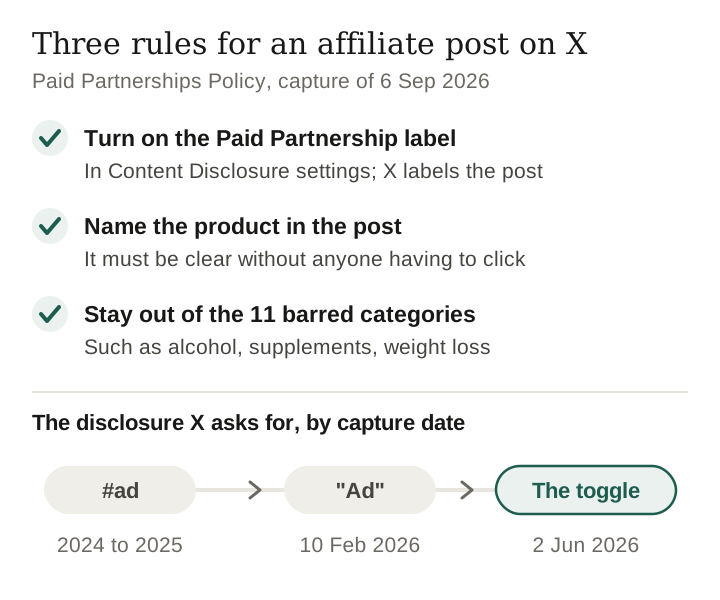
The three rules for an affiliate post
X’s Paid Partnerships Policy lists four situations that make a post a paid partnership: the product was gifted, you were paid, the product earns you a commission through affiliate links or discount codes, or you have a commercial agreement such as an ambassador role. The third one is every affiliate link. For those posts the policy says:
| Rule | What the policy says | In practice |
|---|---|---|
| Label | Organic paid-partnership posts must have the “Paid Partnership” disclosure on, from Content Disclosure settings; X then labels the post | Switch it on for every affiliate post |
| No click needed | The product, service or call to action must be clearly promoted without requiring users to click on any additional links | Name the product in the post; a bare link is not enough |
| Barred categories | 11 categories are not eligible for paid partnership promotion; more in Australia, the EU and the UK | Some affiliate programmes cannot be promoted on X at all |
Source: X Paid Partnerships Policy, Internet Archive capture of 6 September 2026.
The policy also says you remain responsible for complying with advertising law, including the FTC’s Endorsement Guides in the US, and that X may suspend accounts whose sole purpose is to break the policy. It is separate from X’s advertising policies: something barred as a paid partnership may still be allowed as a paid X Ad.

The 11 categories you cannot promote
These are not eligible for paid partnership promotion anywhere, which means an affiliate post for them breaks the policy whatever the label says:
- Adult and sexual products and services
- Alcoholic beverages and accessories
- Contraceptives
- Dating and marriage services
- Drugs and drug-related products, including CBD supplements
- Geo-political, political or social issues used for commercial purposes
- Health and wellness supplements
- Pharmaceutical and medicine-related products, including over-the-counter medicines
- Tobacco and vaping products
- Weapons and weapons-related products
- Weight loss products and services, including detox teas
In Australia, the European Union and the United Kingdom two more are added: financial products (loans, investment services, crypto, buy-now-pay-later) and gambling. The policy says X may consider exceptions case by case on request, through a sales representative.
For affiliate creators the practical casualties are wellness and diet: supplement, protein, detox-tea and weight-loss programmes are common affiliate offers, and on X they are barred from this route.
Keep reading
The label has changed three times
The Internet Archive has captured the policy page in 21 separate months, the first on 27 June 2024. We read five across the two years. The affiliate clause is in every one; the disclosure it asks for is not:
| Capture | Affiliate links count? | Disclosure required |
|---|---|---|
| 27 Jun 2024 (first capture) | Yes | Posts “must include #ad” |
| 17 Jun 2025 | Yes | Posts “must include #ad” |
| 10 Feb 2026 | Yes | “clear and conspicuous language” such as “Ad” or “Promoted Content” |
| 2 Jun 2026 | Yes | The “Paid Partnership” disclosure, switched on in Content Disclosure settings; X labels the post |
| 6 Sep 2026 (latest capture) | Yes | Unchanged from June: the toggle |
Two things follow. Advice that says “just add #ad on X” describes the 2024–2025 policy, not today’s. And the current rule depends on a control inside X’s post composer, which the policy describes but which we could not see without an account; if you cannot find it, the older wording shows what X considered clear before the toggle existed.
Mechanics: 23-character links, edits
- Link length does not matter. X’s developer documentation says every URL is wrapped in t.co and counted as 23 characters, whatever its original length, so shortening an affiliate link buys no room.
- Edits are limited. Our link-editing check found X allows edits for one hour, up to five times, for Premium subscribers only. A wrong affiliate link found the next day means deleting and reposting.
- Name the product. The no-click rule means the post itself carries what you are recommending; it also reads better than a link on its own.
Where this leaves an affiliate creator
Among the rulebooks we have read, X’s is one of those that name affiliate links outright, as TikTok’s, Medium’s and Quora’s do. That makes it easier to follow than most: no guessing whether a commission counts. Our position, from the text: on X, treat every affiliate post exactly like a sponsored post, label on, product named in the post, and check the category list before you join a programme you plan to promote there.
The frequent rewrites are the weak point. A creator who learned the rule in 2024 and added #ad to every post is following a version X replaced twice since.
What we could not verify
- The live page. help.x.com showed our browser a verification checkbox on 27 September 2026 that did not clear on its own, and we do not complete those. We read the Internet Archive’s capture from 6 September 2026.
- The toggle itself. We did not sign in, so we have not seen the Content Disclosure setting or which accounts have it.
- Reach. Whether labelled or link posts are shown to fewer people is not stated in the policy, and we did not test it.
- Enforcement. How often X acts on unlabelled affiliate posts is not published.
What to do this week
- Switch on the Paid Partnership disclosure for every post carrying an affiliate link or your discount code.
- Rewrite any link-only affiliate posts you pin so the product is named in the text.
- Check your programmes against the 11 barred categories, and the two extra ones if your audience is in Australia, the EU or the UK.
- Keep a plain-language disclosure in the post too; the FTC duty is yours, not X’s.
Frequently asked
Are affiliate links allowed on X?
Yes, but X's Paid Partnerships Policy counts a product that earns you a commission through an affiliate link or discount code as a paid partnership. Such posts must carry X's Paid Partnership disclosure, and some product categories may not be promoted this way at all.
How do I label an affiliate post on X?
In the version of the policy captured on 2 June and 6 September 2026, you switch on the Paid Partnership disclosure in the Content Disclosure settings when creating the post, and X labels it. Earlier versions asked for #ad, then for wording like Ad or Promoted Content.
Which affiliate products can't be promoted on X?
Eleven categories are not eligible for paid partnership promotion worldwide, including alcohol, health and wellness supplements, weight loss products, over-the-counter medicines, dating services, tobacco and weapons. In Australia, the EU and the UK, financial products and gambling are added.
Does a long affiliate URL use up characters on X?
No. X wraps every URL in its t.co shortener and counts it as 23 characters, whatever its original length.
Method and sources
- X Paid Partnerships Policy: Internet Archive captures of help.x.com/en/rules-and-policies/paid-partnerships-policy from 27 June 2024, 17 June 2025, 10 February 2026, 2 June 2026 and 6 September 2026, each read for the affiliate clause and the disclosure sentence. The capture list came from the Archive’s CDX index (captures in 21 months, first 27 June 2024).
- X developer documentation, counting characters, read 27 September 2026.
- We did not sign in to X or post. This page is not legal advice.
Last verified 27 September 2026 against five dated captures of X’s Paid Partnerships Policy and X’s developer documentation
Keep reading
How this page was made. Drafted with AI (Claude); not yet independently re-checked. How we work