LinkToLooks · Guides · Creator Desk
Creator Desk
What changed in TikTok’s Branded Content Policy on 31 August 2026?
Not the part about affiliate links: we compared the new policy with the April 2026 version it replaced, line by line, and the affiliate clause and the disclosure rule are word for word the same — what moved is which countries allow alcohol, dating, finance, medicine, vitamin and gambling promotions, and those categories still need an invitation from an approved brand through TikTok One.
Part of: TikTok for creatorsFor creators
For a creator posting affiliate links, the 31 August 2026 policy changed nothing in the rule itself. Both versions define branded content to include a product “for which you will receive a commission on any sales”, for example through an affiliate link or a promotional code, and both require the commercial content disclosure toggle. The changes are in the restricted-industries lists: 50 country openings across six categories (these categories still need a brand’s invitation through TikTok One), Luxembourg added to the “not allowed” lists for alcohol, dating, finance, medicines, vitamins and gambling, energy-drink promotion barred in Kuwait, and a new section letting government bodies partner with creators.
Last verified 27 September 2026 against TikTok’s Branded Content Policy (published 4 August 2026, effective 31 August 2026), its archived April 2026 version, and TikTok’s help article on the content disclosure setting, all read in a browser
What did not change
We split both versions into lines and compared them. 105 lines in the April text, 115 in the new one. Every sentence a creator posting affiliate links acts on is identical in both:
- The definition. Branded content is content that promotes or reviews a third-party brand “in exchange for payment or any other incentive”, and it includes gifted products, paid posts, commission via “an affiliate link or promotional code”, and brands you have or had a commercial relationship with, such as an ambassadorship.
- The toggle. “When posting Branded Content, you must enable the commercial content disclosure toggle.” The content is then labelled automatically, and may be added to the Commercial Content Library where the law requires, possibly staying there after you delete the post.
- The product must be clear without the link. The product or service must be clear “without requiring viewers to access your profile page or any links”, named aloud or in the caption. For affiliate posts that is the practical rule: a “link in bio” video that never says what the product is fails it.
- The prohibited list. Same fifteen headings. Weight-loss supplements, teeth whitening and hair-growth products, CBD, vapes, multi-level marketing and “get-rich-quick” offers were barred from branded content in April and still are.
So if you read a summary that says TikTok “now” counts affiliate links as branded content from 31 August, the date is right and the “now” is not: the April 2026 text already said it. Our own fifteen-platform label comparison cites the 31 August version, which is the one in force; nothing in it changes.
The wording edits in the shared sections are small, for example: “minors” became “children” in the four clauses about children, “racial or ethnic origin” became “race or ethnic origin”, and a few commas moved.
What did change: 50 market openings in six categories
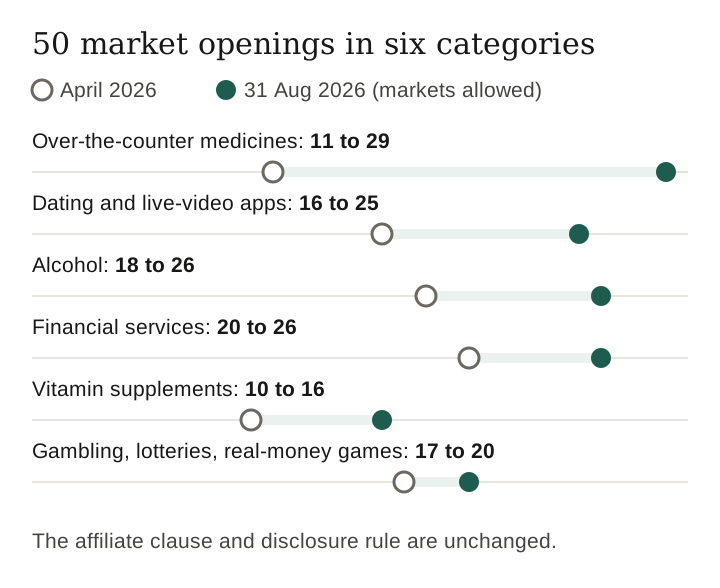
TikTok’s “restricted” industries are allowed only in listed markets, shown only in the market where the post was made, and age-gated. Counting the markets each version allows:
| Restricted category | Markets allowed, April 2026 | Markets allowed, 31 Aug 2026 | Newly allowed |
|---|---|---|---|
| Over-the-counter medicines | 11 | 29 | 18: Azerbaijan, Bahrain, Bangladesh, Belarus, France, Germany, Iraq, Jordan, Kazakhstan, Kuwait, Lebanon, Morocco, Oman, Pakistan, Qatar, South Africa, Spain, United Kingdom |
| Dating and live-video apps | 16 | 25 | 9: France, Germany, Israel, Italy, Kenya, Nigeria, South Africa, Spain, United Kingdom |
| Alcohol | 18 | 26 | 8: Germany, Italy, Kenya, Nigeria, South Africa, Spain, Ukraine (25+), United Kingdom |
| Financial services | 20 | 26 | 6: France, Germany, Italy, South Africa, Spain, United Kingdom |
| Vitamin supplements | 10 | 16 | 6: France, Germany, Israel, Italy, Spain, United Kingdom |
| Gambling, lotteries, real-money games | 17 | 20 | 3: France, Germany, Spain |
| Prescription medicines | 2 | 2 | none: Canada and the United States only, in both |
Counts are of countries named in each category’s “restricted to audiences aged …” lists. No country moved the other way: nothing allowed in April is missing from the new allowed lists.
Three further changes sit outside the table:
- Luxembourg is now named as “not allowed” in all seven categories in the table. It appeared in none of the April lists, allowed or not.
- Energy drinks are now not allowed in Kuwait. Elsewhere they remain 18+ and must not feature children.
- A new government section. Verified government and intergovernmental bodies may partner with creators for tourism and culture, public-interest messages such as health and safety, and jobs or volunteering; election bodies may commission content limited to taking part in elections and referendums, such as logistics, voter registration, encouraging turnout and recruiting election staff or volunteers. Paid political advertising stays banned.
The pattern is plain from the table: the UK, Germany, Spain, France and Italy account for 26 of the 50 openings. If you post from one of those five and a brand invites you through TikTok One, more categories have been open to you since 31 August. The rest of Western Europe gained nothing: the current policy names Austria, Belgium, Ireland, Luxembourg, the Netherlands, Portugal and Switzerland as “not allowed” in all seven categories in the table.
The invitation rule, and why it matters for affiliate links
Both versions carry one sentence that is easy to skim past: for the industries and products the policy lists, you can post branded content only “if you have been invited by an approved brand.” The brand needs explicit permission from TikTok and a Registered Business Account, and “Brands may only partner with content creators through the TikTok One platform.”
Our reading, not TikTok’s wording: because an affiliate link makes a post branded content, an affiliate link to a credit card, a vitamin, an alcohol brand, a dating app or a betting site falls under the invitation rule too. Joining a network’s programme for a supplement brand does not by itself look like an invitation through TikTok One. If that reading is right, the 50 new market openings widen what an invited creator may post; they do not open those categories to ordinary affiliate links. We have asked no one at TikTok, and a network or brand with a TikTok One arrangement may know otherwise — ask them before you post.
Keep reading
How the toggle works, per TikTok’s help page
The policy says to use the toggle; TikTok’s help article on promoting a brand says how, and adds four details worth knowing. We read it on 27 September 2026; we have not used the setting ourselves.
- Two labels. Promoting your own brand or business is labelled “Promotional content”; branded content for another business is labelled “Paid partnership”. An affiliate post is the second kind.
- You can turn it on after posting, from the post’s More options → Ad settings. That is the fix if you forgot.
- You cannot change the label once it is on. The help page says a published post’s label “can’t be changed”; the remedy it gives is deleting the post and posting again.
- TikTok says it does not cost reach. Turning the disclosure setting on, it says, “won’t affect the distribution of your post in feeds on TikTok.” We have no data to confirm or dispute that.
The setting sits under Content disclosure and ads on the post screen (under More options if you are not in TikTok One), under Content disclosure in LIVE settings, and under Show more when uploading on the web.
What to do this week
- Keep doing what April required. Toggle on for every post with an affiliate link or code, and name the product in the video or caption so it is clear without the link. Write the disclosure as well: UK advice from the ASA and CAP on influencer ads, dated 6 August 2026, says a platform’s own label “may not be enough on its own” and, if you are unsure, to add an “Ad” label; our label comparison also says to keep a written disclosure next to the link.
- Check your niche against the prohibited list first. Weight-loss supplements, teeth whitening, hair growth, CBD and vapes cannot be promoted as branded content in any market.
- If you promote finance, vitamins, alcohol, dating or gambling, find out whether the brand has invited you through TikTok One before you post a link, whichever market you are in.
- Fix old posts by toggling, not by editing links. TikTok documents no caption edit after posting, as we found when we checked nine surfaces; the disclosure toggle is the one thing you can add later.
What we could not verify
- Whether TikTok Shop affiliate videos with a product showcase are treated identically in practice. The policy does not distinguish them; the Shop has its own rules, which we did not read for this page.
- Whether enforcement changed on 31 August. A policy diff shows what the text says, not what moderators do.
- Market-specific Requirements, which TikTok links from the policy for underwear, trailers and energy drinks. We compared the global policy only.
- Whether the April archive is the only earlier version. TikTok labels it “Last updated: April 2026”; there may have been versions between, and we compared only the two TikTok publishes.
Frequently asked
Does TikTok count an affiliate link as branded content?
Yes, and it did before 31 August 2026. Both the April 2026 and the 31 August 2026 versions include content where you earn “a commission on any sales (for instance, via an affiliate link or promotional code)”.
What changed in TikTok’s Branded Content Policy on 31 August 2026?
The restricted-industries market lists. We counted 50 new country openings across over-the-counter medicines, dating apps, alcohol, financial services, vitamins and gambling, plus Luxembourg added to the not-allowed lists of those six categories and of prescription medicines, Kuwait barring energy drinks, and a new section for government partnerships.
Can I turn on the TikTok paid partnership label after posting?
Yes. TikTok’s help page says you can turn on the content disclosure setting before or after posting, but once a post is labelled the label cannot be changed.
Does the TikTok disclosure toggle reduce reach?
TikTok says turning it on will not affect distribution in feeds. We have no data of our own on this.
How we compared the two versions
- On 27 September 2026 we opened TikTok’s current Branded Content Policy (published 4 August 2026, effective 31 August 2026) and the archived version labelled “Last updated: April 2026”, linked from the current page, in a browser.
- We took each page’s visible text up to the site footer, split it into lines, normalised whitespace and apostrophes, and listed lines present in only one version. For the restricted industries we parsed each category’s allowed and not-allowed country lists and compared them as sets.
- We read TikTok’s help article on promoting a brand, product or service for how the toggle works. It is undated on the page.
- We do not have a TikTok account posting affiliate content and did not test the setting. Nothing here is legal advice; the policy itself says it is not exhaustive and that you are responsible for complying with local law.
Keep reading
How this page was made. Drafted with AI (Claude); not yet independently re-checked. How we work