LinkToLooks · Guides · Creator Desk
Creator Desk
Disclosure rules outside the US: what we could read
A dated finding about the UK guidance, an honest blank where EUR-Lex refused us, and the reason a mixed audience should aim at the strictest regime it touches.
Part of: For creators
We could read the UK rules today. We could not read the EU ones, and rather than paraphrase a secondhand summary we are telling you that. The ASA and CAP pages returned 200 on 4 September 2026 and carry a genuinely useful, dated finding: the UK influencer guidance is currently flagged by its own publisher as pending an update, because the Digital Markets, Competition and Consumers Act 2024 replaced the Consumer Protection Regulations underneath it.
EUR-Lex answered our request with an AWS bot challenge (HTTP 202, no document), so the Unfair Commercial Practices Directive is not quoted here. That is a scope limit, not a claim that the directive says nothing.
What we could and could not reach, with status codes
Source access decides what a page like this can honestly contain, so we are publishing the fetch log rather than describing it.
| Source | Status | Bytes | Used here? |
|---|---|---|---|
| ASA/CAP — Influencers’ guide (landing) | 200 | 48,187 | Yes |
| ASA/CAP — UK non-broadcast Code (contents) | 200 | 60,643 | Yes |
| ASA/CAP — Influencers’ guide PDF | 403 | 263 | No |
| ASA AdviceOnline — influencer marketing entry | 404 | 32,322 | No |
| EUR-Lex — Unfair Commercial Practices Directive | 202 | 0 (AWS WAF challenge) | No |
All five were requested with an ordinary desktop browser user agent, because several regulators’ sites refuse default scripted agents and a 403 from that cause would be a measurement artefact rather than a finding.

The UK finding: the guidance is mid-transition, and says so
The single most useful thing on the ASA page is a notice that most articles about UK influencer rules do not mention, presumably because they were written before it appeared. It says the guidance will be updated in due course, now that the Digital Markets, Competition and Consumers Act 2024 (DMCCA) has brought in unfair commercial practices (UCP) provisions, in Chapter 1 of Part 4, to replace the Consumer Protection Regulations. It then says:
“The advice remains broadly correct with some changes to the legal underpinning.”
ASA/CAP, Influencers’ guide to making clear that ads are ads, page dated 23 March 2023, notice read 4 September 2026
Two things follow, and both are practical.
- The guidance is still the guidance. Its publisher says the advice remains broadly correct. Anyone telling you UK influencer rules were swept away in 2024 is overstating it.
- The legal underpinning moved. Any article that cites the Consumer Protection from Unfair Trading Regulations as the live UK basis is citing a framework that has been replaced, whatever the article’s publication date says.
That is a dated, checkable fact about the state of a regulator’s own guidance, which is exactly the kind of thing that goes stale silently. We will re-check it rather than let this page age into being wrong.
Where the UK rule actually lives
The UK system separates the code from the guidance in a way the US system does not. The obligation sits in the CAP Code; the influencers’ guide is an interpretation of it. Section 02 of the non-broadcast Code is titled Recognition of marketing communications, and the ASA’s own contents page describes it as “rules about making sure material is clearly identifiable as marketing communications / advertisements / advertorials”.
Two adjacent sections matter to the same creator and are worth knowing exist: section 03, Misleading advertising, which the contents page describes as covering substantiation, pricing, the use of the word “free”, availability and comparisons; and section 08, Promotional marketing, covering competitions and prize draws. A creator running a giveaway for a UK audience is in section 08 as well as section 02.
The shape that is common to both systems
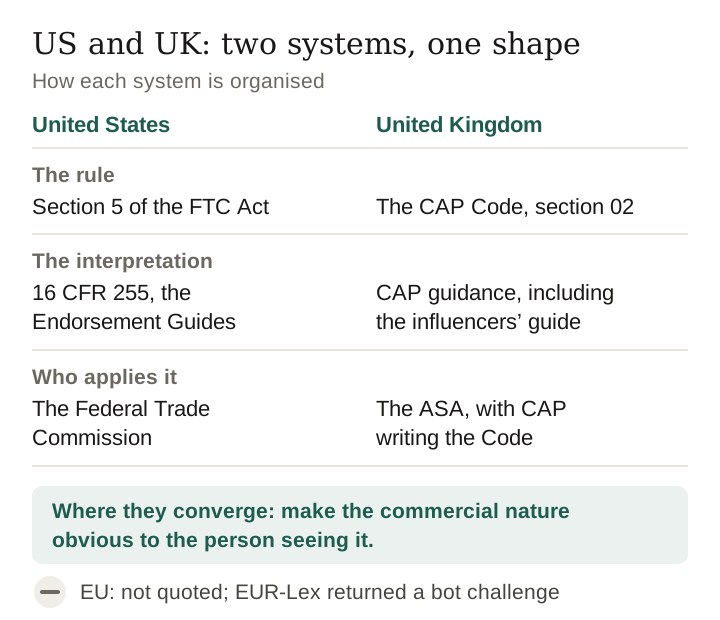
We can compare the US and UK structures without quoting a source we could not read, because the comparison is about how each system is organised.
| United States | United Kingdom | |
|---|---|---|
| The rule | Section 5 of the FTC Act | The CAP Code, section 02 |
| The interpretation | 16 CFR 255, the Endorsement Guides | CAP guidance, including the influencers’ guide |
| Who applies it | The Federal Trade Commission | The ASA, with CAP writing the Code |
| The test | Clear and conspicuous, unavoidable in interactive media (255.0(f)) | Marketing communications must be obviously identifiable as such |
| Covers unpaid free product | Yes, expressly (255.5(a)) | Covered by the guidance we could read at landing level |
The convergent point across both is the one to actually act on: the obligation is to make the commercial nature obvious to the person seeing it, and neither system accepts a disclosure the audience has to go looking for. A creator who satisfies the stricter reading of one is, in practice, close to satisfying the other.
Keep reading
The rule follows the audience, not your passport
The question creators ask is “which country’s rules apply to me”, and it has the wrong subject. Advertising regulation is consumer-protection regulation, and consumer-protection regimes are organised around the consumer being protected. A UK-based creator with a largely American audience is producing advertising directed at American consumers.
Which means the practical answer for anyone with a mixed audience is not to pick a regime. It is to satisfy the strictest reading you are plausibly exposed to, because the alternative is per-post triage on an audience split you cannot see accurately anyway.
That is a position, not a quotation, and we are labelling it as one.
What we are not writing, and why
This page was commissioned to cover disclosure rules outside the US. It covers the UK. It does not cover the EU, and it does not cover Canada, Australia or anywhere else, for one reason in each case: we could not read the primary source today.
EUR-Lex answered our request with an AWS WAF challenge rather than a document. We could have summarised the Unfair Commercial Practices Directive from secondary sources — there is no shortage of them — and it would have read perfectly well. It would also have been a page about what other people say a directive says, published by a site whose entire claim is that it checks things itself.
So the EU half of this row stays unwritten until we can fetch the text. If you need it now, go to EUR-Lex in a browser, where the challenge resolves and the document is free to read.
Frequently asked
Last verified 4 September 2026 against ASA/CAP pages fetched with a browser user agent; EUR-Lex returned a bot challenge and is not quoted
Method, sources and limits
Five sources were requested on 4 September 2026 with a desktop Chrome user agent; the status codes and byte counts are in the table above. Only the two that returned 200 are used. The UK quotation is verbatim from the ASA page named beside it.
Limits. This is not legal advice. The UK material here is read at guidance and Code-contents level, not from the full Code text or the guide PDF, both of which we could not retrieve today. No EU position is stated. Nothing here should be read as covering any jurisdiction not named.
Keep reading
How this page was made. Drafted with AI (Claude); not yet independently re-checked. How we work