LinkToLooks · Guides · Creator Desk
Creator Desk
Giveaway rules for creators: prize, chance, consideration
The federal frame is short and quotable. The part that actually varies is state law — so this page names where it stops instead of guessing past it.
Part of: For creators
Three words decide it: prize, chance and consideration. If a promotion has all three, it is a lottery, and lotteries are restricted at both levels: federal law makes mailing lottery material a crime (18 U.S.C. § 1302), and state law such as Florida’s (Fla. Stat. § 849.09) prohibits running one outside its stated exceptions. Remove chance and you have a contest. Remove consideration and you have a sweepstakes. Federal law gives us a definition for the second of those — 39 U.S.C. § 3001(k)(1)(D) defines a sweepstakes as “a game of chance for which no consideration is required to enter” — and that single clause is the load-bearing idea in this entire subject.
What we cannot give you is the state layer, and it is the layer that actually varies. This page tells you the federal frame we can source, and then says clearly where it stops.
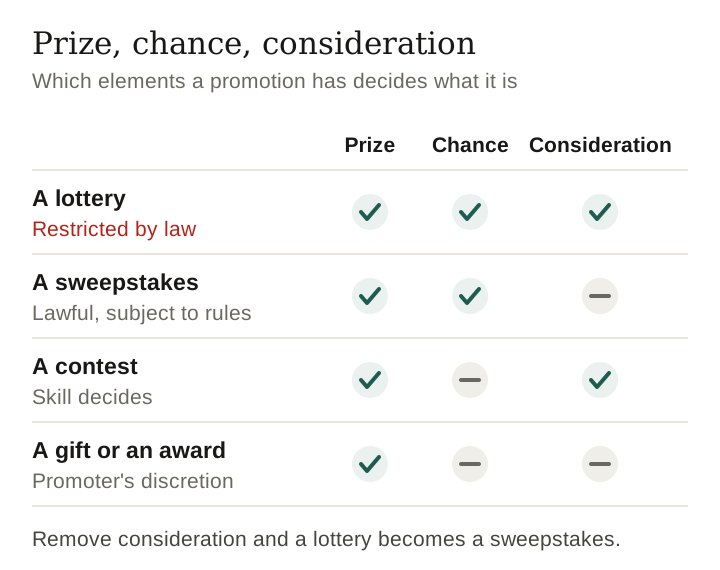
Prize, chance, consideration — the test
Every promotion of this kind is classified by which of three elements it contains.
| Elements present | What it is | Legality |
|---|---|---|
| Prize + chance + consideration | A lottery | Restricted by federal and state law, with narrow exceptions such as lotteries a state runs |
| Prize + chance, no consideration | A sweepstakes | Lawful, subject to disclosure and state registration rules |
| Prize + consideration, no chance (skill decides) | A contest | Not a lottery, since chance is missing; state rules on paid-entry contests are not covered here |
| Prize alone, awarded at the promoter’s discretion | A gift or an award | Outside the framework, but still an endorsement question |
The row that catches creators is the first one, and it is almost never reached deliberately. It is reached by adding a requirement that looks like engagement and functions like consideration.

The one federal definition we can quote
“…sweepstakes means a game of chance for which no consideration is required to enter.”
39 U.S.C. § 3001(k)(1)(D), retrieved 4 September 2026
The same subsection defines a skill contest as a “puzzle, game, competition, or other contest” in which a prize is offered, “the outcome depends predominately on the skill of the contestant”, and a purchase or payment is required. Note the word predominately: a contest with a random tiebreaker is not automatically a game of chance, and a “contest” judged on nothing in particular is not automatically a contest.
State the limit of this source honestly. Title 39 is the Postal Service title. Section 3001 is about what is mailable, and these definitions were written for that purpose. We quote them because they are a published federal definition of the terms, not because this section governs an Instagram giveaway. It does not.
What counts as consideration is the part that moves
Consideration is straightforward when it is money. It gets interesting when it is effort. The commonly drawn distinction is between monetary consideration and non-monetary consideration — time, data, or effort demanded of the entrant — and how a given state treats the second one is a question for that state’s law.
Because we cannot source a fifty-state answer, here is the honest version: the entry mechanics below are the ones that create the question. We are not telling you which side of the line they fall on in your state.
- Buy something to enter. Unambiguous monetary consideration.
- Pay for shipping or a “processing fee”. Still money.
- Complete a long survey or upload substantial content. The classic non-monetary consideration argument.
- Follow, like, tag, share. The everyday creator mechanic, and the one most often assumed to be free of consideration.
- Enter once per purchase, with a free alternate entry route. The alternate-entry method exists precisely to remove consideration, which is why so many packaged promotions carry one.
The pattern behind the alternate-entry method is worth understanding even if you never run a paid promotion: it is a structural fix, not a wording fix. “No purchase necessary” is a sentence that describes a mechanism. If there is no mechanism, the sentence is false.
The disclosure list Congress wrote, and why it is worth copying
39 U.S.C. § 3001(k)(3) lists what a mailed sweepstakes has to disclose. Again: this governs the mail, not your feed. But it is a published list of what a legislature considered the minimum honest description of a prize promotion, and as a template for your own rules it is better than anything you would draft from scratch.
- A statement that no purchase is necessary to enter.
- A statement that a purchase will not improve the chances of winning.
- All terms and conditions, including the rules and entry procedures.
- Who the sponsor is, with a principal place of business or contact address.
- The estimated odds of winning each prize.
- The quantity, estimated retail value and nature of each prize.
- The schedule of any payments made over time.
Item five is the one that most changes how a promotion reads. Item four is the one that matters most for a creator running a giveaway on a brand’s behalf, because it forces the question of who the sponsor actually is — you, or them. That question decides who fulfils the prize when something goes wrong, and it is better settled in writing before the post goes up.
The bit creators forget: the prize is a material connection
Giveaway posts get treated as a separate category from sponsored posts, and under the Endorsement Guides they are not. 16 CFR 255.5(a) names, in its own list of material connections, “the possibility of being paid, of winning a prize”, or of appearing in TV or other media promotions.
That clause cuts in two directions at once, and both are worth spelling out.
- For you, the creator: if a brand supplied the prize, you have received free product. 255.5(a) treats free or discounted product as a material connection “regardless of whether the advertiser requires an endorsement in return”. So the giveaway post is disclosable on the ordinary grounds, before anyone reaches the giveaway rules.
- For your entrants: an entrant who posts about the product to enter is an endorser with the possibility of winning a prize — which is exactly what 255.5(a) lists. If your entry mechanic asks people to post, your rules should tell them to disclose.
The second bullet is the one almost no giveaway rules cover, and it costs nothing to add a line about.
Where the federal frame stops and we stop with it
We are not going to publish a fifty-state table, because we cannot source one and a wrong one would be worse than none. What we can name precisely is what is missing:
- State registration and bonding. Some states require sweepstakes above a prize-value threshold to be registered and bonded in advance. Thresholds and procedures differ.
- Non-monetary consideration. Whether a like, a follow or a tag is consideration is a question for each state’s law, and we have not sourced the answers.
- Eligibility and age. Restrictions on minors entering, and on which jurisdictions may be included, vary.
- Platform rules. Meta, YouTube and X each publish their own promotion rules, and those are contractual terms that bind you independently of any law.
If your prize is meaningful in value, this is the point at which the honest advice is a lawyer in your state, not a longer article. A page that pretends otherwise is selling confidence it does not have.
Frequently asked
What makes a giveaway a lottery?
The presence of all three of prize, chance and consideration. Remove chance and it is a contest; remove consideration and it is a sweepstakes. Lotteries are restricted at federal and state level: mailing lottery material is a federal crime (18 U.S.C. 1302), and Florida, for one, prohibits running a lottery outside its stated exceptions (Fla. Stat. 849.09).
Is asking people to follow and tag a friend 'consideration'?
That is a question for each state's law. We cannot source a fifty-state answer and are not going to invent one.
What is the federal definition of a sweepstakes?
39 U.S.C. 3001(k)(1)(D) defines it as 'a game of chance for which no consideration is required to enter'. That section governs mailable matter, so it is a definition to borrow rather than a rule that governs a social post.
Do I have to disclose that the brand gave me the prize?
16 CFR 255.5(a) treats free or discounted product as a material connection regardless of whether an endorsement was required in return, so yes - independently of anything in the giveaway rules.
Should my entrants disclose too?
If your entry mechanic asks them to post about the product, 255.5(a) lists 'the possibility of being paid, of winning a prize' among material connections. A line in your rules telling entrants to disclose costs nothing.
Last verified 10 October 2026 against 39 U.S.C. 3001 and 16 CFR 255 as published, fetched today
Method, sources and limits
39 U.S.C. § 3001 was fetched from the Legal Information Institute on 4 September 2026 (99,673 bytes) and the definitions are quoted verbatim. 16 CFR 255 came from the eCFR renderer API the same day. Both are cited for what they say; neither is presented as governing a social-media giveaway, and section 3001 explicitly governs mailable matter.
This is not legal advice and we are not lawyers. The state layer, which is the layer that decides most real questions here, is not covered and we have said where it is missing rather than filling it in.
Keep reading
How this page was made. Researched and drafted with AI (Claude); checked by a separate automated pass on 12 October 2026. How we work