LinkToLooks · Guides · Creator Desk
Creator Desk
Getting paid as a non-US creator: the methods, and what they cost
Three charges, kept apart, with every published figure dated - and an honest note on the one number we could not read anywhere.
Part of: For creators
The cost of being paid from the United States is three separate charges, and creators usually only notice the first one. There is what the payment rail charges to receive the money, what it charges to convert it, and what US tax withholding takes before either — 30% by default until the paperwork says otherwise.
There is also a fourth cost nobody bills you for. We pulled 2,095 live listings from a US-facing affiliate catalogue on 7 September 2026 with no country filter: only 37.7% were priced in US dollars, and 20 currencies and 42 target countries were present. If you write prices into your posts from an unfiltered feed, some of them are not the number your reader will be charged.
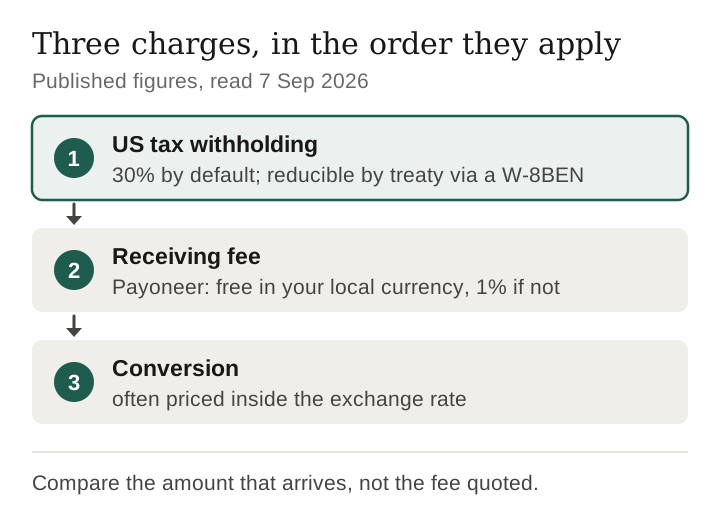
The three charges, separately
Most advice on this subject collapses everything into one number, which is how people end up surprised twice. Keep them apart:
- Receiving. What it costs to have the money land. Often zero, and it depends on how the payer sends it more than on who you are.
- Converting. Turning US dollars into your currency. This is where the real money goes, and it is frequently priced inside an exchange rate rather than shown as a fee.
- Withholding. Tax taken at source before the payment is sent at all. Nothing to do with your bank.
A creator comparing “free” against “1%” is comparing the first charge only, which is the smallest of the three for most people.
What each rail says it costs
These are the published figures, read from each provider’s own pricing page on 7 September 2026, with the date each page states.
| Rail | Published charge | As stated on |
|---|---|---|
| Payoneer — from another Payoneer balance | Free | Pricing page, updated 1 January 2026 |
| Payoneer — receiving account in your local currency | Free | same page |
| Payoneer — receiving account in a currency that is not your local currency | 1% (minimum 1.00 USD or equivalent) | same page |
| Payoneer — payer uses a credit card | up to 3.99% + 0.49 USD | same page |
| Payoneer — payer uses ACH bank debit (US only) | 1% | same page |
| Payoneer — card, annual fee | 29.95 USD | same page |
| Payoneer — card, replacement | 12.95 USD / 9.95 EUR / 9.95 GBP | same page |
| Wise — receiving into the account | Free; account details in AUD, CAD, EUR, GBP, HUF, NZD, PHP, SGD and USD described as without fees | Receive-money pricing page, read 7 September 2026 |
| PayPal — international commercial transactions | 1.50% on all commercial transactions, in addition to the domestic rate | Merchant fees page, last updated 1 September 2026 |
| PayPal — fixed fee by currency received | e.g. 0.59 AUD, 0.59 CAD, 2.90 BRL | same page |
Quoted as published. We have not tested any of these rails with a real payment, and the figures a given account sees can differ by country and by product tier.
Read the third row of the Payoneer block against the second. The same provider is free or 1% depending on whether the currency you are receiving is your local one — which for a creator paid in USD outside the US is the row that applies. “Free to receive” is true and is not about you.
The conversion charge is the one to watch
Receiving fees are visible and small. Conversion is neither, because it is usually not presented as a fee at all: the provider gives you a rate, and the difference between that rate and the real one is the charge.
Wise’s own send-money page describes the practice it is selling against, and the description is fair to quote because it names the mechanism: providers charge more by “hiding extra fees in the exchange rate” while saying their transfers are free, and Wise states it uses “the live mid-market rate, and a small, upfront fee”.
What you can do without our number: run the same amount through two providers’ own calculators on the same day and compare the figure that arrives, not the fee that is displayed. That comparison is the only one that includes the rate.
Withholding comes first, and it is 30% by default
Before any rail is involved, a US payer may withhold tax. The IRS page on non-resident alien withholding, last reviewed 14 March 2026, states that certain kinds of income received by a foreign person are “subject to U.S. tax of 30%”, with a reduced rate or exemption possible where the Code or a tax treaty provides one. The certificate that lets a payer apply a treaty rate is the W-8BEN, which we have written up separately.
The ordering matters when you are working out what a commission is worth: withholding applies to the payment, then the rail charges apply to what is left, then conversion applies to that. A 1% receiving fee on top of a 30% withholding is not a 31% cost, and it is also not the 1% the pricing page advertises.
Keep reading
The catalogue itself is not in dollars
This is our own measurement rather than a quoted fee, and it is the part of the exposure nobody bills for. We pulled a US-facing affiliate catalogue with no country filter — the way an unfiltered feed query actually behaves — and looked at what currency the prices were quoted in.
| Currency of the asking price | Rows | Share of 2,095 |
|---|---|---|
| USD | 790 | 37.7% |
| EUR | 567 | 27.1% |
| GBP | 407 | 19.4% |
| CAD | 85 | 4.1% |
| DKK | 70 | 3.3% |
| AUD | 55 | 2.6% |
| SEK | 27 | 1.3% |
| Fifteen others | 94 | 4.5% |
Eight seeds, 2,095 unique rows, 20 currencies and 42 target countries present, 7 September 2026. Root shoppingProducts, keyword filter only, no country argument.
Two consequences for a creator outside the US, and they point in opposite directions.
- Writing a price into a post from an unfiltered pull is risky. A number that came back as 45 might be 45 euros. Filtering on the row’s own country field before you quote anything fixes this, and it is a post-filter you apply yourself — the API has no country filter argument on this root, for anyone.
- Being outside the US is not only a cost. 62% of these rows were targeted somewhere other than the United States, which means there is non-US inventory in the same catalogue. Whether your programme lets you earn on it is a separate question we cannot answer for your account.
Even inside the US-targeted rows the mismatch is not zero: 30 of 779 rows marked targetCountry: US were priced in something other than dollars — 3.9%. Small, and not zero, which is the worst kind of error rate because it survives spot checks.
How to choose, without us picking for you
We are not going to name a winner. We have not moved money through any of these rails, and a recommendation from a page that has not is worth nothing. What we can give you is the order to ask the questions in.
- What will the network actually send, and how? This decides more than your choice does. A network that only pays by cheque or only into a US bank account eliminates most of the options before you compare any fee.
- Will you be receiving in your local currency or in dollars? On the published Payoneer schedule that single answer is the difference between free and 1%.
- How large and how frequent are the payments? Fixed fees dominate small balances; percentage fees and conversion dominate large ones. A creator clearing $40 a month and one clearing $4,000 should not pick the same rail.
- Compare the amount that arrives, not the fee that is quoted. Same amount, same day, two calculators.
- Do the tax paperwork before you optimise the rail. Thirty per cent dwarfs every fee on this page.
What we could not verify
- Any conversion percentage. Stated above; it is the biggest gap on this page.
- CJ’s publisher terms.
www.cj.com/legal/publisher-service-agreementreturned HTTP 404 on 7 September 2026. We cannot tell you what it says about payment to non-US publishers. - Awin. Its publisher page would not resolve from this machine at all.
- Amazon’s payment-method help page. The URL we held for it returned 404, so no Amazon payment mechanics are quoted here.
- What any of this costs in practice. We have no affiliate approvals and have been paid nothing, so nothing on this page is experience. It is published schedules plus one measurement of our own.
Method and sources
Provider pages were fetched with an ordinary browser user agent on 7 September 2026 and the raw responses kept: Payoneer pricing (HTTP 200, 328,280 bytes, page states updated 1 January 2026), PayPal merchant fees (HTTP 200, 1,699,975 bytes, page states last updated 1 September 2026), Wise receive-money and send-money pricing (HTTP 200), and the IRS non-resident alien withholding page (HTTP 200, last reviewed 14 March 2026). Two intended sources failed and are listed above rather than quietly dropped.
The currency measurement is a live CJ shoppingProducts pull with keywords only and no country argument, eight seeds — wool scarf, table lamp, wireless earbuds, board game, face serum, gold necklace, hiking boots, stand mixer — three pages of 100 rows each, deduplicated on advertiser plus title plus link. 2,095 unique rows, 7 September 2026. Currency is taken from the asking price, which is the sale price where a row carries one and the list price otherwise.
Keep going
Frequently asked
What does it cost to receive US affiliate income abroad?
Three separate charges: the rail's receiving fee, the currency conversion, and US tax withholding. On Payoneer's published schedule receiving into a local-currency account is free and receiving into a non-local currency is 1%, minimum 1.00 USD.
Is PayPal more expensive for international payments?
Its published merchant fees add 1.50% for international commercial transactions on top of the domestic rate, plus a fixed fee by currency received, as stated on its fees page last updated 1 September 2026.
What is the conversion fee?
We could not read a specific percentage from any provider's pricing page, and we will not estimate one. Compare the amount that arrives in two providers' calculators on the same day.
Why is 30% taken before I see the money?
That is the default US withholding rate the IRS states for certain income paid to a foreign person, reducible under a tax treaty via a W-8BEN.
Are affiliate catalogue prices in dollars?
Not reliably. In an unfiltered pull of 2,095 live rows on 7 September 2026, 37.7% were priced in USD, with 20 currencies present. Even among US-targeted rows, 3.9% were priced in another currency.
Last verified 7 September 2026 against the Payoneer, PayPal and Wise pricing pages and the IRS non-resident alien withholding page, all fetched, plus a live 2,095-row CJ pull for the currency table.
How this page was made. Drafted with AI (Claude); not yet independently re-checked. How we work