LinkToLooks · Guides · Creator Desk
Creator Desk
Paid partnership labels are not an FTC disclosure
The toggle is your contract with the platform. The words in the frame are your compliance with the rule — and only one of the two follows your video when it leaves.
Part of: For creators
A platform’s built-in label is a platform feature. It is not a legal defence, and nothing in 16 CFR 255 mentions one. The Endorsement Guides were written around a functional test — is the disclosure difficult to miss, is it in the channel carrying the claim, is it unavoidable — and a toggle in an app satisfies that test only to the extent that the label it produces actually does those things on the surface where it appears.
That is the position this page argues, and the argument rests on an absence we can demonstrate: we fetched 16 CFR 255 in full on 4 September 2026 and searched it. There is no mention of a platform label, a branded-content tool, or a disclosure feature of any kind. The regulation is written about disclosures, not about the buttons that produce them.
The finding is an absence, and here is how we checked it
Claiming a regulation does not say something is a stronger claim than quoting what it does say, so the method matters. We pulled the full text of 16 CFR part 255 from the eCFR renderer API — 106,357 bytes, sections 255.0 through 255.6, examples included — and read it for any reference to a disclosure mechanism supplied by a platform. There is none. What the regulation supplies instead is the functional definition at 255.0(f) and the material-connection obligation at 255.5(a).
255.5(a) puts the obligation on a connection, not on a format. Any tie between the person endorsing a product and the company selling it has to be disclosed, clearly and conspicuously, if the audience would not reasonably expect it and if it:
“might materially affect the weight or credibility of the endorsement”
16 CFR § 255.5(a), retrieved 4 September 2026
Every part of that rule is about the relationship and the audience. None of it is about which product surfaced the disclosure. A platform toggle can help you satisfy it. It cannot satisfy it on your behalf, because the obligation was never framed in terms the toggle could discharge.

What the platform label genuinely does for you
This is not an argument against using the tools. They do three real things, and a page that only listed their limits would be less useful than one that says what they are for.
- They are consistent. The label renders the same way on every post, which is exactly the property a hand-typed line lacks across a hundred uploads.
- They satisfy the platform’s own rules. Branded-content policies are contractual: TikTok’s branded content policy and YouTube’s paid product placement setting are terms you agreed to, and enforcement there is the platform removing your post, which happens far more often than a regulator contacting you.
- They are machine-readable. A structured flag is something a brand’s compliance team can audit at scale. Several campaign contracts require it for that reason alone.
So the label is worth switching on. The mistake is treating it as the end of the question rather than the beginning.
Four gaps between the label and the rule
| Gap | Why it matters under 255.0(f) |
|---|---|
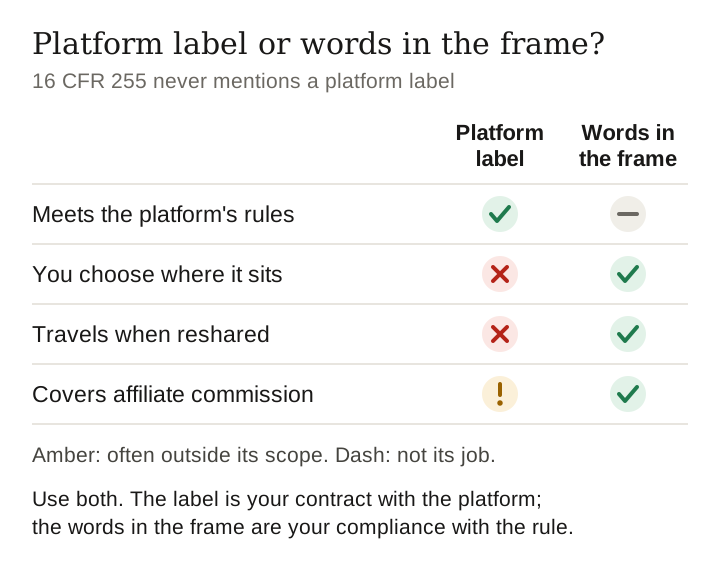
| The label describes the relationship the platform knows about | 255.5(a) covers business, family and personal relationships, free or discounted product, early access, prize entry and the possibility of future payment. A branded-content flag is typically about a paid brand deal, which is one item on that list. |
| Placement is the platform’s choice, not yours | 255.0(f) asks whether the disclosure is difficult to miss on the surface where it appears. Where a label sits, how long it shows and whether it survives a reshare are product decisions that change without notice. |
| It does not travel | The same clip cross-posted, downloaded, or embedded elsewhere arrives without the label. The claim travels; the platform feature does not. |
| Affiliate commission is often outside its scope | Most built-in labels were designed for brand partnerships. A commission earned on a link is a material connection under 255.5(a) whether or not any brand deal exists. |
The third row is the one we would put first if the table were ordered by how often it bites. A creator who relies entirely on a platform label has a disclosure that exists only inside one app.
The position: use both, and know which one is load bearing
Here is the argument, stated as a position rather than a hedge. Switch the label on, and then write the disclosure as though the label were not there. The label is your contract with the platform. The words you put in the frame are your compliance with the rule. They serve different masters and only one of them follows your content when it leaves.
The objection to this is clutter, and it is a fair objection: two disclosures on one nine-second clip looks like a legal notice. Our answer is that the second one is usually four words in the visual portion, and that four words is a smaller cost than the alternative. It is also the version that still reads correctly in a screen recording, which is how a surprising amount of short video is actually redistributed.
Keep reading
How to stack them without doubling the clutter
- Turn the platform label on first, before you write anything. It is a contractual obligation and it takes one tap.
- Put four to six words in the frame, early, in the visual portion. Plain words, not an abbreviation.
- Say it once out loud if there is a voice-over, near the recommendation rather than in a sign-off.
- Keep the caption line anyway. It costs nothing and it is the version that survives being quoted as text.
- Record what you did. Which post, which label, which wording, which date — the reconstruction problem is real once a platform deletes a post.
Steps two and five are the ones people skip, and they are the two that do the work if anything is ever questioned.
Frequently asked
Last verified 4 September 2026 against 16 CFR 255 fetched in full from the eCFR renderer API, plus the TikTok and YouTube policy pages named above
Method, sources and limits
16 CFR part 255 was fetched from the eCFR renderer API, which returned 16 CFR 255 in full (106,357 bytes) and 16 CFR 312 in full (89,649 bytes) on the day of writing and searched for any reference to platform-supplied disclosure mechanisms; there are none. The two platform policy pages linked above were fetched the same day and returned 200. We are describing published rules, not giving legal advice.
What this page cannot tell you. We have no data on how regulators or platforms actually treat a post carrying one form of disclosure and not the other, because no such dataset is public. The argument here is from the text of the rule and from what the label demonstrably does and does not travel with — not from enforcement outcomes.
Keep reading
How this page was made. Drafted with AI (Claude); not yet independently re-checked. How we work