LinkToLooks · Guides · Creator Desk
Creator Desk
Pinterest or Instagram for an evergreen product link?
We read what each platform tells Google to crawl. One submits your pins; the other submits your profile.
Part of: Instagram for creators
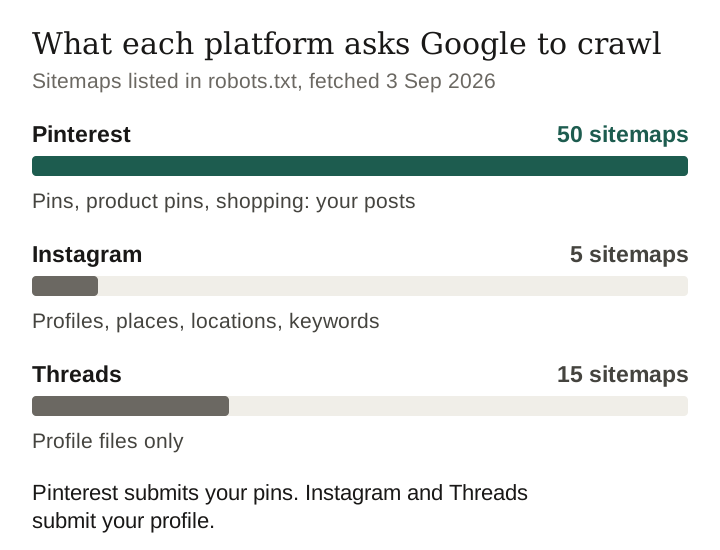
Pinterest submits your pins to Google. Instagram and Threads submit your profile. On 3 September 2026 we requested the robots.txt of all three with a Googlebot user agent and read what each offers. Pinterest listed 50 sitemaps, including files named product_pin_sitemap, video_product_pin_sitemap, shopping_sitemap and image_pin_sitemap. Instagram listed 5: places, locations, a keyword file and two profile files. Threads listed 15, every one of them a profile file.
That is the difference that decides an evergreen product link. Not reach, not the algorithm — which of these platforms treats your post as a document it wants indexed.
What we measured, and how
Every platform publishes a file at /robots.txt telling crawlers what they may fetch, and most list their sitemaps in it. A sitemap is the opposite instruction: it is a platform actively handing a search engine a list of URLs it would like crawled. Between them, the two files are a platform stating, in public and in writing, which of its pages it wants to exist in search.
On 3 September 2026 we requested /robots.txt from pinterest.com, instagram.com, threads.com, linkedin.com and youtube.com with a Googlebot user agent, then counted the rules that apply to Googlebot specifically and the sitemaps each file advertises. No login, no scraping of anybody's posts, and nothing here that a reader cannot re-run in a browser.
The numbers
| Platform | robots.txt size | User-agent blocks | Disallow rules for Googlebot | Sitemaps listed |
|---|---|---|---|---|
| 30,906 bytes | 315 | 217 | 50 | |
| 6,256 bytes | 36 | 11 | 5 | |
| Threads | 8,144 bytes | 36 | 16 | 15 |
| 120,190 bytes | 77 | 109 | 0 | |
| YouTube | 792 bytes | 2 | — | 2 |
Fetched 3 September 2026 with a Googlebot user agent. ‘Disallow rules for Googlebot’ counts the rules in the block addressed to Googlebot by name where one exists.
Read the rule counts and the ranking inverts what most creators expect. Pinterest disallows Googlebot from 217 paths; Instagram from 11. By that measure Instagram is the more permissive of the two, and its 11 rules do not touch post permalinks, reels or the explore surface at all — they cover comments, likes, direct messages, logging and internal APIs.
So the folk wisdom — that Instagram walls Google out — is not what Instagram's own file says. Something else is producing the difference creators observe, and the sitemaps are where it shows.
The sitemap names are the finding
| Platform | What its sitemaps are named after | Reading |
|---|---|---|
| image pins, video product pins, product pins, shopping, board links, ideas hubs, plus seasonal files for Christmas, New Year's Eve and Halloween | Content, tiered by quality, engagement and recency | |
| places, locations, two profile files, one keyword-entity file | Directories, not posts | |
| Threads | profile files, tiers 1 to 5 | Directories, not posts |
Pinterest's 50 files are content files, and they are segmented in a way that tells you Pinterest thinks hard about this: pins tiered by quality, by recent engagement and by recency; boards tiered by ‘cohesion’; a file named for a 2026 Q3 priority segment. There are separate files for product_pin_sitemap and video_product_pin_sitemap, and one called simply shopping_sitemap.
Instagram's five and Threads' fifteen contain no post file at all. They point Google at who is on the platform and where things are — profiles, places, locations, keyword entities. Not at what anyone posted.
One more detail worth a creator's attention in September. Three of Pinterest's files are named for Christmas pins and one for New Year's Eve, and they were being advertised on 3 September. If you have ever wondered why gift-guide pins are told to go up months early, that is the mechanism, stated by the platform in its own file rather than inferred from a case study.
Keep reading
The part that surprised us
We ran the same request twice against instagram.com with different user agents, because the first result looked like a failure. With an ordinary Chrome user agent, instagram.com/robots.txt returned 622,894 bytes of HTML with a text/html content type — a page, not a robots file. With a Googlebot user agent, the same URL returned 6,256 bytes of text/plain containing the actual directives.
Threads behaved the same way. Pinterest did not: it served the identical 30,906-byte file to both.
We are not going to characterise why, because we do not know and the honest version is more useful: if you go to check this yourself in a browser and get a page instead of a text file, you have not made a mistake. Fetch it as a crawler would and the file appears.
Where Instagram genuinely wins
None of the above makes Pinterest the better platform, and a comparison that only lists one side is an advertisement. Instagram wins on things this measurement cannot see:
- The audience is already there. Search visibility is worth nothing on a platform where nobody follows you, and a creator's existing following is not portable.
- Native product surfaces. Product tagging and in-app shopping behaviour are Instagram features with no Pinterest equivalent, and we cover them separately.
- Video formats. Reels is a different medium from a static pin, and some products only make sense in motion.
- Speed. A pin that ranks does so over months. A Reel that lands does so in a day. If the product is a limited drop, the slow surface is the wrong surface.
The honest summary is narrow: for a link that should still be earning in six months, the platform that submits your posts to Google has a structural advantage over the one that submits your profile. For everything else, this measurement has nothing to say.
What to do with this
- Put the evergreen thing on Pinterest. The buying-guide pin, the ‘what to look for’ graphic, the seasonal round-up — the pieces whose value does not expire in a week.
- Post the seasonal pins early. Pinterest was advertising Christmas and New Year's Eve sitemap files on 3 September. Content that is not there in September cannot be in the file.
- Do not expect an Instagram post to rank. It may; Instagram's own rules permit it. But the platform is not asking Google to fetch it, and planning as if it were is planning on a hope.
- Keep your own copy. Whichever platform you post to, the durable version of an evergreen link is one you host or control, because neither of these files is a promise to you.
- Re-check this yourself. Both files can change tomorrow, and the date on this page is the whole of its authority.
What this does not prove
- Permission is not indexation. robots.txt says what a crawler may fetch. It says nothing about whether Google chose to, or kept the result. We measured the invitation, not the attendance.
- We did not count indexed pages. No pin count, no post count, no site-search totals — those numbers are unstable and we would rather publish none than an unstable one.
- We did not read the sitemap files themselves, only the names each platform advertises. A file named for product pins is strong evidence of intent and not proof of contents.
- Our own site is young and low-authority. Nothing here is a benchmark drawn from our own ranking performance, because ours would be a floor rather than a guide.
- One morning. Every figure is 3 September 2026 and a platform can rewrite either file without telling anybody.
Frequently asked
Does Google index Pinterest pins?
Pinterest asks it to. On 3 September 2026 its robots.txt advertised 50 sitemaps including files named for image pins, product pins, video product pins and shopping. Whether Google indexes any given pin is Google's decision, not Pinterest's.
Does Google index Instagram posts?
Instagram's robots.txt does not block post permalinks or reels for Googlebot — only comments, likes, direct messages and internal endpoints. But none of its five sitemaps covers posts; they cover profiles, places and locations.
Which is better for affiliate links that last?
On this measurement, Pinterest, because it submits post-level content to search engines and Instagram submits profiles. On reach, video and native shopping features, Instagram is the stronger platform and this measurement does not touch those.
Why did instagram.com/robots.txt look like a web page?
Requested with a browser user agent it returned 622,894 bytes of HTML; requested as Googlebot the same URL returned a 6,256-byte text file. Threads behaved identically. We report the observation and do not speculate about the cause.
Should I stop posting product content to Instagram?
No. The two platforms answer different questions. Use Pinterest for the version of a post that should still work in six months, and Instagram for the audience that already follows you.
Method
- Requests: HTTPS GET to
/robots.txton pinterest.com, instagram.com, threads.com, linkedin.com and youtube.com, 3 September 2026, with a Googlebot user agent, and a second pass on the first three with a Chrome user agent. - Counts: user-agent blocks, Disallow and Allow lines, and Sitemap lines, parsed from the returned file. Where a block addressed to Googlebot by name existed, its rules were counted; otherwise the wildcard block was used.
- Pinterest's wildcard block reads
Disallow: /— unnamed crawlers are refused everything, while named ones including Googlebot get an explicit rule set. - Not measured: index counts, ranking, the contents of any sitemap file, and rendering behaviour of any post page.
- pinterest.com/robots.txt · instagram.com/robots.txt · threads.com/robots.txt
Keep reading
Last verified 3 September 2026 against the live robots.txt of pinterest.com, instagram.com, threads.com, linkedin.com and youtube.com
How this page was made. Drafted with AI (Claude); not yet independently re-checked. How we work