LinkToLooks · Guides · Creator Desk
Creator Desk
Sitemaps and IndexNow: what each one tells you, and how to check
Two announcement protocols, what their own documentation promises, and the check that tells you whether anyone at the other end is listening.
Part of: For creators
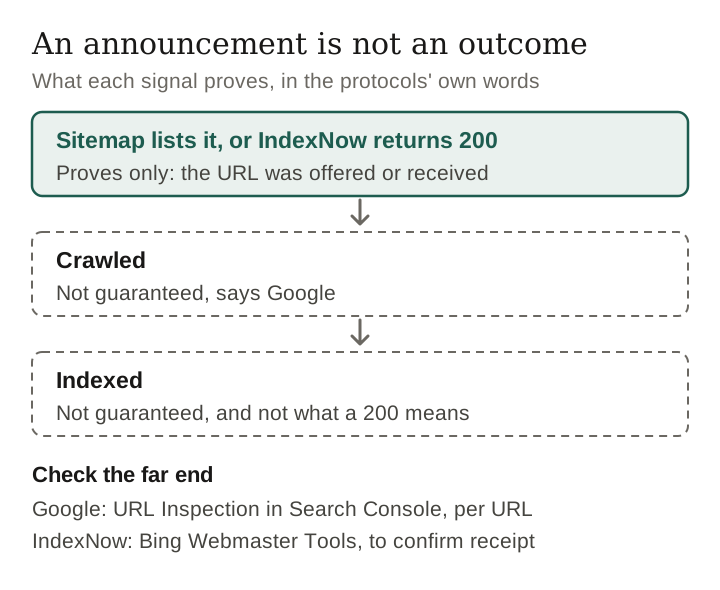
Both are announcements. A sitemap helps a search engine discover your URLs and does not guarantee they are crawled or indexed; an IndexNow HTTP 200 means only that the search engine received the URL.
Neither is useless and neither is what most guides describe. An announcement is not an outcome, and the mistake both protocols invite is reading a success code as one. The fix is a check at the far end, and this page walks through it.
What each one is, precisely
| XML sitemap | IndexNow | |
|---|---|---|
| What it is | A file listing your URLs with a last-modified date | An HTTP ping naming URLs that changed |
| Who reads it | Google, Bing, and anyone else who asks | The participants indexnow.org lists — Bing, Naver, Seznam, Yandex and Yep, plus the Internet Archive and Amazonbot — not Google |
| Speed | Read when the crawler next fetches it | Immediate, in that the request is received immediately |
| What success looks like | The file parses, URLs are listed | HTTP 200 |
| What success means | The URLs are offered for discovery. Nothing more. | The URL was received. Nothing more. |
| Effort to set up | One file, usually generated | One key file at the site root, then a request per deploy |
Read the fifth row twice. Both protocols answer a question about telling, and neither answers a question about reading. Every disappointment either one causes comes from reading the first as the second.
What a sitemap does, in Google’s words
Google’s sitemap documentation states both halves in one sentence: a sitemap helps search engines discover the URLs on your site, but it “doesn’t guarantee” that all of them will be crawled and indexed. Its guide to how Search works says the same of every page: Google does not guarantee that it will crawl, index or serve a page, even one that follows its guidelines.
So a URL can sit in a submitted, valid sitemap and still show in Search Console as “URL is unknown to Google”, which Search Console’s help defines as a URL Google has not seen before. Not rejected — unknown. The check below is how you find out how many of yours are in that state.
What a sitemap unambiguously does buy you: a complete, machine-readable inventory with dates, which is what makes a freshness signal possible at all, and a list to measure your own coverage against. Neither is nothing. Both are infrastructure rather than results.
One field in it deserves care. Google says it uses lastmod only when the value is consistently and verifiably accurate, and that it ignores priority and changefreq altogether.
What an IndexNow 200 means, in IndexNow’s words
IndexNow is genuinely simple: put a key file at your site root, then send a request naming the URLs that changed. A successful request returns HTTP 200, and the protocol’s own documentation says exactly how much that proves: the code “only indicates that the search engine has received your URL”. It is not a crawl and it is not an index entry.
The documentation also says participating engines share submitted URLs with each other, which is why one ping can reach several engines. Google is not on the participant list.
The API can behave perfectly while nothing happens at the other end. It is not the API’s job to tell you whether anybody is listening, and a 200 does not promise that anybody is. Bing’s own IndexNow setup page ends with the step that closes the gap: use Bing Webmaster Tools to verify that your URLs were received. Seeing your own site there means adding and verifying the site first, which is the step easiest to skip because nothing fails when you skip it.
Keep reading
Checking the far end on your own site
- Take a sample from your own sitemap. A few dozen URLs spread across it, not the newest ten; older and deeper pages are where gaps hide.
- Inspect each one in Search Console’s URL Inspection tool and write down the status it reports: indexed, “Discovered – currently not indexed”, “Crawled – currently not indexed”, or “URL is unknown to Google”.
- Count the states. They are different problems. Unknown means Google has not seen the URL at all; discovered means it knows the URL and has not crawled it yet; crawled but not indexed means it read the page and left it out.
- If you send IndexNow pings, do the same in Bing Webmaster Tools. Confirm that the URLs you submitted were received, and that the site shows crawl activity at all.
- Repeat on a schedule and keep the counts with their dates. One reading is a snapshot; the trend is the answer.
The lesson, which is not about sitemaps
The same shape of mistake turns up well past search:
When you add a step, add the check that measures what the step did. Not whether it ran. Not what it returned. What changed at the other end.
A status code measures the request. A coverage report measures the outcome. They are different instruments, and one of them arrives on its own while the other requires you to go and look.
For a creator the same trap sits in three familiar places: a scheduling tool reporting “posted” without anyone checking the post is visible, an affiliate link returning 200 to a page where the product is gone, and a submitted sitemap that makes coverage feel handled. In each case the receipt is real and the outcome is unmeasured.
What to actually set up
- A sitemap, if your site does not generate one. Most platforms do it for you. It is table stakes and it takes minutes.
- Real
lastmoddates. A date that moves when nothing changed is worse than no date: Google uses the field only when it is consistently and verifiably accurate. - Register in every relevant webmaster tool — plural. Without it you cannot see the far end, and Bing Webmaster Tools is where Bing says to confirm IndexNow submissions arrived.
- IndexNow if it is one line in your deploy. It is cheap, it reaches engines a sitemap reaches slowly, and it costs nothing if it does nothing. Do not build anything on top of its response code.
- Then measure the far end, on a schedule. Coverage reports in each engine’s own console are the only numbers that tell you what happened.
- Do not respond to flat coverage by publishing more. If pages are not being fetched, adding pages divides the same budget further.
Frequently asked
Does submitting a sitemap get pages indexed?
No. It helps a search engine discover your URLs. Google’s own sitemap documentation says a sitemap does not guarantee that all the items in it will be crawled and indexed.
Does Google support IndexNow?
No. Google is not among the participants listed by indexnow.org, which on 29 September 2026 named Bing, Naver, Seznam, Yandex and Yep, plus the Internet Archive and Amazonbot. Google discovers pages through crawling, sitemaps and links.
Does an IndexNow 200 mean the page was indexed?
No. The IndexNow documentation says a 200 only indicates that the search engine has received your URL. Whether it was crawled or indexed shows up only in that engine’s own webmaster tools.
Is IndexNow worth setting up?
If it is one line in your deploy, yes — it is cheap and reaches engines a sitemap reaches slowly. Add the site to Bing Webmaster Tools as well, which is where Bing says to verify that submitted URLs were received.
Should lastmod dates be updated on every deploy?
Only when the page actually changed. Google says it uses lastmod only when the value is consistently and verifiably accurate, and a date that moves without a change is neither.
Sources
- Google Search Central, Learn about sitemaps — a sitemap helps discovery and does not guarantee that every URL in it is crawled and indexed.
- Google Search Central, Build and submit a sitemap —
lastmodused when consistently and verifiably accurate;priorityandchangefreqignored. - Google Search Central, In-depth guide to how Google Search works — crawling, indexing and serving not guaranteed.
- Search Console Help, URL Inspection tool — “URL is unknown to Google” means Google has not seen the URL before.
- Search Console Help, Page indexing report — the “Discovered” and “Crawled – currently not indexed” statuses.
- IndexNow.org, Documentation — response codes; a 200 only indicates the URL was received; submitted URLs shared among participating engines.
- IndexNow.org, participating search engines — the participant list quoted above.
- Bing Webmaster Tools, IndexNow: get started — verify in Bing Webmaster Tools that submitted URLs were received.
Documentation cited on this page read 29 September 2026.
How this page was made. Drafted with AI (Claude); not yet independently re-checked. How we work