LinkToLooks · Guides · Creator Desk
Creator Desk
What a platform shutdown actually costs a creator
Not the page — the catalogue. And rebuilding one is harder than the advice admits, because a third of retailer URLs refuse a script outright.
Part of: For creators
The honest accounting. A platform shutdown costs you three things, and they are not equally recoverable: the page itself (trivial), the traffic already pointed at it (permanent, and usually small), and the link catalogue (expensive, and the only one worth preparing for). This page is about the third, and about why rebuilding a catalogue is harder than the advice usually admits.
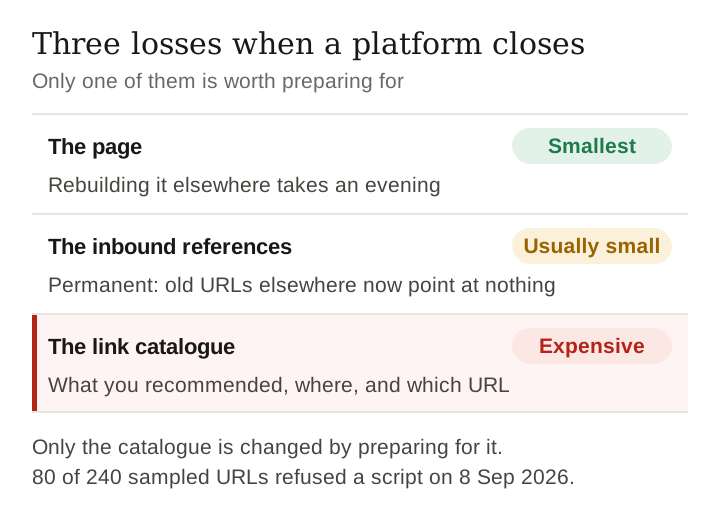
Three losses, only one of which matters
The page. Rebuilding a link page somewhere else takes an evening. This is the loss people picture and it is the smallest one.
The inbound references. Every place your old URL was written down — other people’s posts, a printed card, a podcast description, your own bio on four platforms — now points at nothing. You can fix the ones you control. You cannot fix the rest, and no amount of preparation changes that. It is a real loss and it is not usually large unless you have been linked by other sites, in which case it is the largest.
The catalogue. The list of what you recommended, where it was sold, and which URL pointed at it. Hundreds of decisions, made one at a time over years, encoded as a list you did not write down because the platform was holding it. This is the expensive one, and it is the only one where preparation changes the outcome completely.
Last verified 8 September 2026 against 240 destination URLs sampled from live US retailer feeds and requested once each on that date
You cannot rebuild it with a script: 80 of 240 URLs refused
The standard reassurance is that you can rebuild by working through your own posts, and that a bit of automation makes it quick. We put the automation half to the test. Taking a random sample of 240 destination URLs from live US retailer product feeds and requesting each once with an ordinary browser user agent:
| Response | URLs | What it means for a rebuild |
|---|---|---|
| HTTP 200 | 132 | You can read the page and confirm the product |
| HTTP 429 | 57 | Refused. Every Wayfair North America and Perigold URL in the sample. |
| HTTP 404 | 24 | Genuinely gone |
| HTTP 403 | 23 | Refused: Woot!, Zoro, Knetbooks.com |
| HTTP 500 | 4 | Server error |
80 of 240 URLs — a third — refused the request outright (4 more returned a server error), and the refusals cluster by retailer rather than by product: some shops answer scripts and some do not. A 429 nominally means you asked too often, so we checked it the only way worth checking: three URLs from one of those retailers, requested one at a time, eight seconds apart, with nothing else running. All three still returned 429. It is a bot defence, not a rate limit.
The consequence for a rebuild is specific and annoying. Anything you wanted to do at volume — check 400 old links, confirm which products still exist, re-derive a catalogue from a spreadsheet of URLs — works for the retailers that answer and simply does not run for the ones that do not. For those you are opening pages by hand, at human speed, one at a time. That is the real shape of the cost, and it is not in anyone’s migration guide.
Keep reading
Some of it was never recoverable anyway
Two measurements from the same night put a floor under the loss, and both cut the same way: part of any catalogue is gone whether or not the platform survives.
- 44.7% of listings are secondhand. 3,106 of 6,953 live US rows carried a condition of used. A secondhand listing is one item; when it sells there is no replacement URL, so those entries in your catalogue are a record of what you liked rather than something you can re-point. If your niche is fashion, jewellery or resale, this is most of your list.
- Links die while the platform is alive. In the same sample, 24 of the 138 URLs that a marketplace answered for — 17.4% — returned 404 on the day its own feed was still serving them as in stock. Attrition is continuous. A shutdown does not start the decay, it just removes your ability to see it.
Read together, those two say something slightly uncomfortable: a lot of the catalogue you are afraid of losing has already gone. That is not a reason to skip the backup. It is a reason to keep the backup in a form that survives the individual link — the retailer and the product in words, not just the URL — because that is the part that can be searched for again.
So what does it actually cost?
We are not going to give you an hours figure, because we would be making it up. We have not migrated a creator catalogue and we have no creators to ask. What we can give you is the structure of the bill, which is more useful than a fake number:
- Rebuilding the page: one evening, on any of the tools available. Small.
- Re-finding the products: the big line. Proportional to the number of links you kept, divided by however much of it a script can do — which our sample puts at roughly two thirds of retailers and none of the rest.
- Re-creating the links: proportional to the number of programmes you are in, plus whatever re-approval each one requires.
- Updating your own references: bios, pinned posts, video descriptions. Bounded, tedious, and worth doing first because it is what people actually click.
- Everyone else’s references: zero, because you cannot.
Notice that line two is the only one that scales with how successful you have been. The more you have built, the more a shutdown costs, and the less likely you are to have time to rebuild it. That is the argument for doing the boring part early rather than the argument for choosing a bigger platform, which is the conclusion most versions of this article reach and is not supported by anything.
The version of this that costs nothing
Twenty minutes, once, and then five minutes a month:
- A spreadsheet with four columns: the destination URL unwrapped, the retailer and product in words, where you posted it, and the date you last checked it.
- Kept somewhere with no relationship to the platform it describes.
- A saved copy of your own public link page, as a file, once a quarter. Your browser will do this in one keystroke.
- Nothing else. No tool, no subscription, no automation that will itself stop working.
The reason this is enough is the middle column. A dead URL tells you nothing about what it pointed at, which is why a list of URLs is a worse backup than a list of product names. Write the words down and a shutdown becomes an afternoon of searching rather than an archaeology project.
Frequently asked
What happens to your links if a creator platform shuts down?
Links that redirected through the platform stop resolving, so every place the old URL was written down points at nothing. The recommendations themselves are not lost if you kept a record of them; if you did not, the record was the platform's.
Can you rebuild a link catalogue automatically?
Only partly. Of 240 live retailer destination URLs requested once each on 8 September 2026, 80 refused the request: 57 with HTTP 429 and 23 with HTTP 403. Four more returned a server error. The refusals cluster by retailer, so whole shops are simply not scriptable and have to be opened by hand.
How much of a back catalogue can actually be recovered?
Less than the whole thing, whatever you do. 44.7% of live US listings in our pull were secondhand and therefore one of one, and 17.4% of one marketplace's sampled URLs were already 404 while its feed still listed them as in stock.
What is the cheapest insurance against a platform closing?
A four-column spreadsheet — unwrapped destination URL, retailer and product in words, where you posted it, date last checked — kept somewhere unconnected to the platform, plus a saved copy of your own public page each quarter.
Does using a bigger platform reduce the risk?
We have no evidence that it does and would not claim it. Nothing we measured says anything about which companies survive. The variable you control is whether you hold a copy of your own list.
Method and scope
The URL sample is 240 rows drawn at random with a fixed seed from 6,953 live US listings pulled, each destination requested once with an ordinary browser user agent and a 30-second timeout. Median round trip 1.82 seconds. A 200 was not read as proof that a product exists, and a refusal was not read as a dead link — those are different results and this page keeps them apart.
The seed list ships with the page. A method you cannot repeat is not a method. The 24 keyword seeds behind every figure here were: vintage denim jacket, leather handbag, running shoes, hiking boots, wool scarf, gold necklace, vinyl record, vhs tape, trucker hat, mini skirt, platform sandals, sunglasses, air fryer, electric kettle, cordless drill, office chair, dog bed, coffee mug, throw pillow, table lamp, yoga mat, bluetooth speaker, hardcover book, board game. Scope: root shoppingProducts, arguments keywords and advertiserCountries:["US"], four pages of 100 rows per seed, deduplicated on advertiser + title + destination URL, then post-filtered on each row’s own targetCountry. Asking price is salePrice where the row carries one and price otherwise. Peer-to-peer asks of $500 and over and repeated-digit asks are dropped as seller placeholders. No totalCount is quoted: on a keyword pull the API OR-matches the words, so the count is not coherent.
What this cannot show. We have not migrated anybody’s catalogue, we have no creators to ask, and we are not estimating hours. We also cannot tell you whether the retailers that refused us would refuse a person with a browser; the point is only that they refuse a script, which is what a bulk rebuild is.
How this page was made. Drafted with AI (Claude); not yet independently re-checked. How we work