LinkToLooks · Guides · Creator Desk
Creator Desk
Who owns your links? We read four sets of terms
You keep your copyright. What you grant, what survives your account and what you can take with you are three different questions — and the answers are quotable.
Part of: For creators
The question, narrowed
“Who owns your links” is really three questions, and they have different answers. Who owns the copyright in the photographs and captions you upload. What licence the platform takes over them. And whether you can get the list itself — which product, which retailer, which URL — out again when you leave.
Almost every platform answers the first one the same way: you keep your copyright. It is the second and third that differ, and the second is where the language gets long. What follows is quoted from terms we fetched on 7 September 2026, not characterised from memory.
Last verified 7 September 2026 against terms of service pages fetched live from each named platform, quoted verbatim
Sources fetched 7 September 2026 with a browser user-agent, and linked here so you can read them yourself. Amazon’s Associates Program Operating Agreement and its Program Policies returned 200; so did LTK’s terms of service and Linktree’s terms. Two did not: Beacons returned 403 and Meta’s platform terms returned 400, so neither is characterised here. ShopMy’s terms URL returned 200 but served a 446-word application shell with no terms text in it, so it is treated as unread. We quote what we could read and name what we could not. These are editorial citations, not affiliate links: we earn nothing if you follow them.
LTK: a perpetual, sublicensable licence to your data
From LTK’s terms of service, under the heading covering the licence you grant: you grant LTK “a non-exclusive, perpetual, worldwide, royalty-free license” to use your data in any manner, including to host, copy, distribute, sublicense, modify, publish and archive it, in whole or in part, in any medium known now or invented later, “as LTK sees fit in its sole discretion”.
Two words in that licence do the most work. Perpetual means the licence does not end when your account does. Sublicense means it can be passed on to a third party. Neither is unusual in platform terms; both are worth knowing you agreed to.
On account continuity, the same document is direct: LTK “may change, suspend or terminate your use of the Services”, with or without cause or notice. And on your posted content, it reserves “the right to cut, crop, edit” it.
Linktree: you keep your rights, they keep a perpetual licence
Linktree’s terms are written in plainer English and say something similar with less throat-clearing. The licence you grant covers using, displaying, distributing, modifying and creating derivative works of your content, plus “your name, image, voice, photograph, likeness” — and then explains itself: the licence is worldwide, royalty-free and perpetual, meaning Linktree “can use your content anywhere in the world, without paying you fees”, for as long as it likes.
To its credit the same section states the other half explicitly: “You’ll retain all of your rights in your content.” That is the ownership answer, and it is the right one.
The clause that matters more for a working creator is about leaving: once you delete your account, “you won’t be able to reactivate it or retrieve any of the content” or information you added to your profile. Deletion is the one action here with no undo, and the terms say so before you take it, which is more warning than most give.
Keep reading
Two we could not read, and one that would not render
This is the part most comparison articles quietly skip. We fetched five platforms’ terms with a normal browser user-agent. Three returned readable documents. Two refused, and one returned a page with no terms in it:
| Source | HTTP response | What we did |
|---|---|---|
| Amazon Associates policies and agreement | 200, readable | Quoted (see our Amazon comparison) |
| LTK terms of service | 200, readable | Quoted above |
| Linktree terms | 200, readable | Quoted above |
| ShopMy terms | 200, but a 446-word app shell with no terms text | Treated as unread. Not characterised. |
| Beacons terms | 403 Forbidden | Not characterised. |
| Meta platform terms | 400 Bad Request | Not characterised. |
We are naming those three as unverified rather than describing them from a summary somebody else wrote. A terms page that does not render its terms to a plain fetch is a fact about the page, not evidence about the company, and we are not going to convert one into the other. If you are choosing between platforms, read those three yourself in a browser, where they may well render fine.
Ours, on the same criteria
Judging ourselves by the standard we just applied:
- We publish no terms of service at all. On the test this page is built around — can a creator read what you claim over their content? — we score worse than both platforms quoted above. That is a real gap and it is ours to fix.
- What we do publish is a privacy page and a data-deletion page. The deletion page states that a deletion request is completed within 7 days of the request, and that it removes what we hold from your posts: the copies of your images, the products identified and the retailer links proposed.
- There is no export, and we say so. The same page states that deletion cannot be undone: a shop wanted back has to be built again from your posts, and only if you ask. Deleting cleanly and exporting usefully are different features, and we currently have the first one.
- Nothing is live until the creator approves it. When a creator asks, we read their public posts, identify products, match retailers and verify each match against the creator’s own photograph; the creator approves it in writing. There is no self-serve signup.
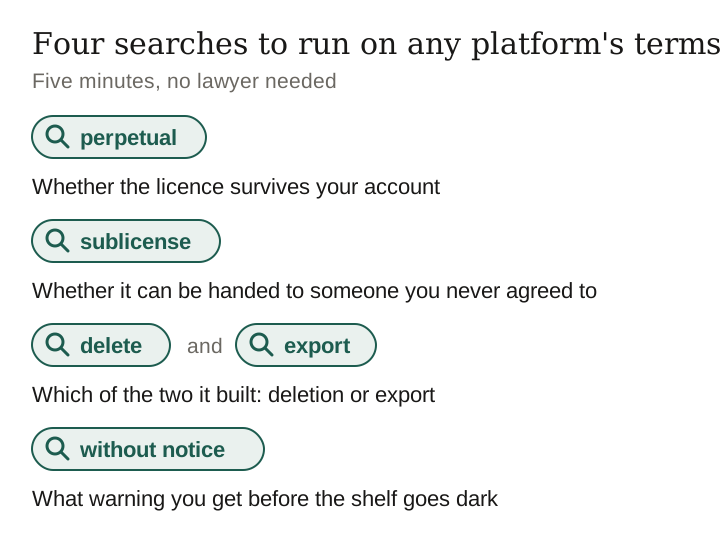
What to look for in any set of terms
Four searches, five minutes, any platform:
- Search “perpetual”. It tells you whether the licence survives your account.
- Search “sublicense”. It tells you whether it can be handed to someone you never agreed to.
- Search “delete” and “export”. A platform that describes deletion in detail and export not at all is telling you which of the two it built.
- Search “without notice”. It tells you what warning you get before the shelf goes dark.
None of this requires a lawyer, and doing it once for the platform you already use is the highest-value fifteen minutes in this whole subject.
Keep reading
Frequently asked
Do you own the content you post to a link-in-bio platform?
On the two sets of terms we could read, yes — Linktree states you retain all of your rights. What you also grant is a perpetual, royalty-free licence to the platform, which is a separate thing from ownership.
Can you get your link list back if you leave?
Linktree’s terms say that if you delete your account you cannot retrieve the content or information added to your profile. We could not verify export behaviour on platforms whose terms did not render to an automated fetch.
Does LinkToLooks publish terms of service?
Not at present. We publish an about page, a privacy page and a data-deletion page. On the test this article applies, that is worse than the platforms quoted here.
What does “perpetual licence” actually mean?
That the permission you granted does not expire when your account does. Linktree spells it out: it “can use your content anywhere in the world, without paying you fees”, for as long as it likes.
How this page was made. Drafted with AI (Claude); not yet independently re-checked. How we work