LinkToLooks · Guides · Creator Desk
Creator Desk
What happens to your links when you leave a platform?
The list can leave with you. The redirects cannot, and that is structural rather than anyone’s policy — so the insurance has to be something you keep yourself.
Part of: For creators
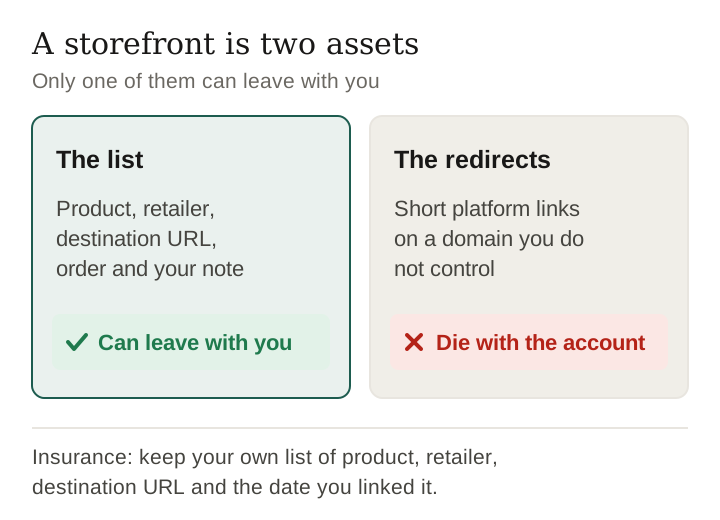
A storefront is two assets, and only one is yours
Every creator storefront, ours included, is really two things stacked together. The first is a list: which product, which retailer, which destination URL, in which order, with whatever note you wrote. The second is a set of redirects: the short platform-hosted links you actually pasted into captions, each one bouncing through the platform’s domain and carrying its affiliate identifiers.
The list is information and it can, in principle, leave with you. The redirects cannot. They resolve on a domain you do not control, through an affiliate account that is not yours, and on the day that account closes every one of them stops being a working link — in every caption, in every old post, everywhere they were ever pasted. That is not a policy failure. It is what a redirect is.
Which is why the useful question when leaving is never “can I export?” on its own. It is: can I export the list, and how many places did I paste a redirect I will now have to replace?

What the terms say happens
From terms fetched 7 September 2026. Linktree is the clearest of the ones we could read: once you delete your account, “you won’t be able to reactivate it or retrieve any of the content” or information you added to your profile.
LTK’s terms address the other direction — the platform ending the relationship rather than you: it “may change, suspend or terminate your use of the Services”, with or without cause or notice. And on the affiliate side, Amazon’s Operating Agreement reserves the right to “permanently… cease payment of… any and all commission income otherwise payable to you” on termination.
Put those together and the exposure is clear enough without any scare-mongering: the links can stop working on someone else’s timetable, and the earnings already accrued are not automatically safe either.
Last verified 7 September 2026 against terms of service pages fetched live from each named platform, quoted verbatim
Sources fetched 7 September 2026 with a browser user-agent, and linked here so you can read them yourself. Amazon’s Associates Program Operating Agreement and its Program Policies returned 200; so did LTK’s terms of service and Linktree’s terms. Two did not: Beacons returned 403 and Meta’s platform terms returned 400, so neither is characterised here. ShopMy’s terms URL returned 200 but served a 446-word application shell with no terms text in it, so it is treated as unread. We quote what we could read and name what we could not. These are editorial citations, not affiliate links: we earn nothing if you follow them.
What we checked, and what we could not
The honest scope of this page, because the difference matters.
What we did: fetched each platform’s published terms with a browser user-agent, recorded the HTTP status, and quoted the clauses that govern deletion, retrieval and termination. Three rendered. ShopMy returned an application shell with no terms text, Beacons returned 403 and Meta’s platform terms returned 400, so none of those three is described here.
What we did not: open creator accounts on those platforms, build storefronts, request exports and inspect the files. That is the check that would settle what actually exports, and we have not run it. Anyone telling you what a given platform’s export file contains, without having downloaded one, is describing a help-centre page.
So read this page as: here is what the contracts commit to, and here is the structural reason redirects cannot survive regardless of what any export contains.
Keep reading
The half that dies without anyone closing an account
There is a failure mode that arrives whether or not you ever leave: the destination itself goes away.
That reframes the whole subject. A creator worrying about portability is usually picturing a dramatic account closure. The ordinary case is quieter: a proportion of your back catalogue stops resolving to a buyable product every month, on its own, while every account stays open. The insurance against both is the same, and it is the section below.
Ours, on the same criteria
We are one of the platforms a creator might leave, so:
- We have no export feature. Stated plainly: if you left us today there is no button that hands you your list.
- Our deletion has no undo. Our data-deletion page says a deletion request is completed within 7 days of the request and removes what we hold from your posts — the copies of your images, the products identified and the retailer links proposed — and that it cannot be undone. Getting a shop back means building it again from your posts, and only if you ask. Clean deletion and useful export are different features; we offer the first.
- Our links are redirects like everyone else’s, and they would break on the same day for the same structural reason. We do not have a clever answer to that and neither does anyone else.
- What is genuinely different is that the storefront is built from your public posts, so the underlying material is not something we hold exclusively. Rebuilding is work; it is not recovery of something lost.
The twenty-minute insurance policy
Not a product pitch — this works against every platform including ours, and it is what we would do.
- Keep your own list, outside every platform. A spreadsheet with product, retailer, destination URL and the date you linked it. That single file is the asset; everything else is infrastructure you rent.
- Record the destination URL, not just the short link. The short link is the part that dies. The destination is the part you can rebuild from.
- Note where you pasted each one. The replacement cost of a redirect is not the link, it is finding the eleven captions it went into.
- Prefer one link-in-bio destination you control where you can — a domain you own pointing at whatever platform you currently use — so that a migration is a DNS change rather than a rewrite of your entire back catalogue.
- Re-check the oldest links on a schedule. Some of them are already dead and nobody sent you a notification.
Keep reading
Frequently asked
Do affiliate links stop working when you leave a platform?
Platform-hosted short links do, because they resolve on the platform’s domain through its affiliate account. The destination URLs behind them are unaffected, which is why keeping those is the whole insurance policy.
Can you export a creator storefront?
It depends on the platform, and we did not test exports because we hold no accounts on them. Linktree’s terms state that deleting your account means you cannot retrieve what you added to your profile.
Does LinkToLooks let you export a storefront?
No. There is no export feature today, and our deletion has no restore window. Both are stated rather than defended.
What is the single most useful precaution?
Keeping your own list of product, retailer and destination URL outside every platform. It costs minutes and it survives any platform decision.
How this page was made. Drafted with AI (Claude); not yet independently re-checked. How we work