LinkToLooks · Guides · Creator Desk
Creator Desk
How to invoice a brand when there is no network
A network defines the payable event, keeps the evidence, enforces the clock and collects the tax forms; invoice a brand directly and all four jobs become yours.
Part of: For creators
Direct answer. An affiliate network is four jobs bundled into one account: it defines the event that earns money, it holds the evidence that the event happened, it enforces a payment clock, and it collects your tax paperwork. Invoice a brand directly and all four become yours. The document is the easy part — a numbered invoice with dates, deliverables, a payment term and remittance details. The part that decides whether you get paid is what you agreed before you posted, because an invoice cannot create a term the other side never accepted. This page is a working checklist, not legal or tax advice; where a rule depends on your country or state we say so rather than guess.
Why this comes up at all
Direct deals are not a step up from affiliate links. They are what is left when there is no programme to join. Two situations produce them, and they are different problems.
The first is the brand with no affiliate programme at all — small labels, independent makers, most service businesses. There is nothing to apply to, so any arrangement is a private one by default.
The second is the category served by a marketplace rather than by brands — resale, vintage, one-of-one listings. To see whether that is you, run the count on your own links: reduce each outbound link to its host and mark the ones that point at a marketplace or resale site rather than at a brand’s own store. Those links have no brand on the other end to invoice: the seller is an individual, and the marketplace is not going to sign a content agreement with you. If a large share of your links looks like that, a direct deal is not a fallback available to you, and the honest planning answer is that money in that category comes from the marketplace’s own programme or not at all.
The four jobs the network was doing
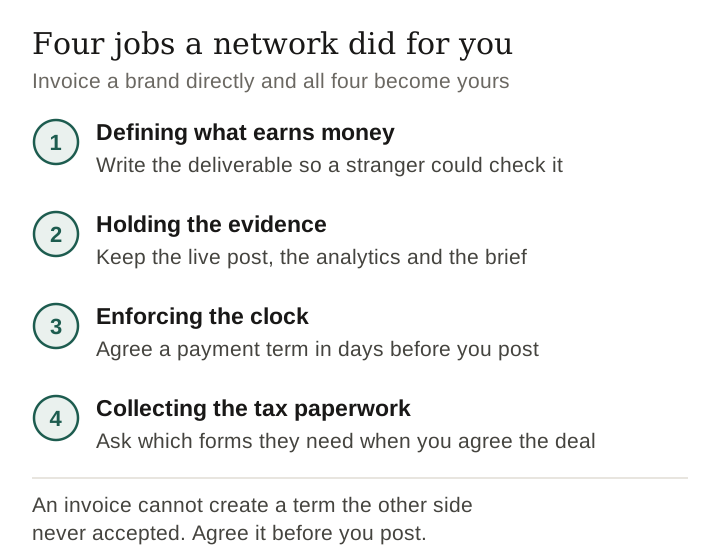
People describe going direct as cutting out the middleman. It is more accurate to say you are taking on four jobs that were previously invisible to you, because software you never had to configure was doing them.
1. Defining what earns money
In a programme the payable event is written into the terms: a sale, tracked to your link, inside a window, not returned. It is unambiguous because a machine has to evaluate it. In a direct deal the payable event is whatever the two of you said it was, and “a post” is not a definition. A post that goes up and comes down four hours later is a post. So is a Story frame that expires overnight. Write the deliverable so that a stranger reading it a year later could tell whether you did it.
2. Holding the evidence
The network is the referee and the record. Go direct and the record is yours to keep, on platforms that delete things. Screenshot the live post with its timestamp and URL visible, save the analytics panel at 24 hours and at 7 days, and keep the brief you were sent. Our guide to chasing a missing commission makes the same point inside a network, where at least a click id exists; outside one, nothing is logged unless you log it.
3. Enforcing the clock
A programme pays on a schedule whether or not anybody remembers. An invoice sits in somebody’s inbox. The clock exists only if a payment term was agreed, and “net 30” written for the first time on the invoice itself is a request, not a term.
4. Collecting the tax paperwork
A US network asks for a W-9 or a W-8BEN before it releases anything, which is irritating and also means the paperwork is done. A brand paying you directly may ask for the same form, may ask for nothing, or may sit on the payment until you produce something you did not know existed. Ask which forms they need when you agree the deal, not when you want the money.
Keep going on the money side
What to agree before you post — the nine lines
This is the part that decides the outcome, and it fits in an email. You do not need a contract template to send nine numbered lines and ask someone to reply “agreed”. A reply saying agreed, on a thread that quotes the lines, is a written record. A phone call is not.
| # | The line | Why this is the one that bites |
|---|---|---|
| 1 | Deliverable, precisely | “One in-feed Reel and one Story frame” is checkable. “A collaboration” is not. |
| 2 | Where it runs, and how long it stays up | Removal dates are the most common quiet dispute. Name the minimum live period. |
| 3 | The fee, and whether it is gross | State the number and the currency. If they are abroad, say who absorbs the transfer fee. |
| 4 | Payment term, in days, from what | Net 30 from invoice date and net 30 from post date are different deals. |
| 5 | What triggers the invoice | Usually the post going live. If it is brand approval, you have handed them the clock. |
| 6 | Usage rights | Whether they may re-run your content as an ad, on which surfaces, for how long. The term most often taken for free. |
| 7 | Exclusivity | Any category lock-out, and its length. An unbounded one is a job, not a post. |
| 8 | Revisions | How many rounds are included. Otherwise the fifth round is also included. |
| 9 | Who they actually are | Legal entity name, billing address, the accounts-payable contact, and the tax forms they need. |
Line 9 is the boring one and it is the one that strands invoices. The brand you talk to is often not the entity that pays — an agency, a parent company or a franchise operator may be. We see the same split in product data, where one company files under several separate advertiser names, and it has the same consequence here: the name on the front is not reliably the name that transacts. Ask for the legal entity in writing and address the invoice to it.
None of this requires a lawyer to draft. It does mean the agreement exists somewhere other than your memory, which is the only thing separating a deal from a hope.
What the invoice itself has to carry
An invoice is an accounts-payable document before it is anything else. It gets paid faster when it can be processed without a human having to ask you a question, and every missing field is one of those questions.
- A unique invoice number. Sequential, never reused. Their system may reject a duplicate silently.
- Your legal or business name and address, matching whatever tax form you gave them.
- Their legal entity and billing address, from line 9 — not the brand’s marketing name.
- Invoice date, and the due date as an actual date. Write “Due 8 October 2026 (net 30)”, not just “net 30”. Somebody has to key a date in.
- One line item per deliverable, with the live URL and the date it went live. That is the evidence and the description at once.
- Amount, currency and total. State the currency explicitly, even domestically.
- Tax handling as it applies to you — whether you are adding sales tax or VAT, or stating that none applies. This varies by where you and they are, and it is the one field we will not tell you how to fill in.
- Remittance details, and the PO number if they issued one. At a company that uses purchase orders, an invoice without one is routinely bounced unread.
- A payment method they can actually use. Ask rather than assume; the rails and their costs are covered in getting paid as a non-US creator.
Send it as a PDF, to the accounts-payable address rather than only to your contact, with your contact copied. Marketing does not pay invoices, and an invoice living in a marketing manager’s inbox is not in the system at all.
When the date passes
Escalate on the calendar, not on how you feel about it. The sequence below is written from how accounts-payable processes are structured, not from any creator’s account of what happened to them — we have no such accounts and will not invent one.
| When | What to send | What you are actually testing |
|---|---|---|
| Due date + 1 day | Short, neutral reply on the original thread, invoice re-attached. | Whether it was ever entered into their system. |
| +7 days | Email accounts payable directly; ask for invoice status and the payment-run date. | Most companies pay in scheduled runs. You may simply have missed one. |
| +14 days | Ask your contact to confirm internal approval, in writing. | Unapproved is a different failure from unpaid, and only they can fix it. |
| +30 days | A formal notice naming the invoice number, date, amount and agreed term. | Whether there is a dispute nobody told you about. |
| Beyond that | Small-claims procedures and debt collection differ by country; we do not cover them here. | — |
Two practical notes. Keep every chase on one thread, so the history is a single scroll rather than an archaeology exercise. And stop starting new work for a brand whose current invoice is overdue — continuing is how one unpaid invoice becomes three.
What this page cannot tell you
Three limits, stated plainly rather than buried at the bottom.
This is not legal or tax advice. Whether you charge sales tax or VAT, what a contract needs to be enforceable where you live, and what recourse you have are all jurisdictional. We describe mechanics and name the documents; a professional in your country answers the rest.
We hold no data on what brands actually pay. No rate benchmarks appear on this page, because we have none — and neither does anyone quoting one at you without naming their sample. Our rate card guide argues that at length.
We have never invoiced a brand. LinkToLooks has earned nothing and holds no network approvals. What is above is drawn from how payment terms and accounts-payable processes are structured. Where this page differs from one written by somebody with fifty invoices behind them, believe them — and notice whether they show you their numbers.
Frequently asked
Do I need a registered business to invoice a brand?
Not necessarily. In many places an individual can invoice under their own name, and the brand's requirement is usually a valid tax form rather than a company. What is required depends on where you live, so check locally rather than copying another creator's setup.
What payment term should I ask for?
Net 30 from the invoice date is the common commercial default and a reasonable opening position. The number matters less than agreeing it before you post and writing the actual due date on the invoice.
Should I ask for money up front?
Splitting the fee - part on signature, the rest on posting - is normal for a new relationship and moves some of the risk. Whether a given brand accepts it is a negotiation, not a rule.
Is a gifted product a payment?
It is consideration, and in many places it carries both disclosure obligations and possible tax consequences. Disclosure is not optional either way.
Can I invoice for a post that is already live?
You can send the invoice, but you have lost the leverage that made the terms binding. If nothing was written down, the practical move is to confirm the terms in writing now and invoice against that confirmation.
Keep reading
How this page was made. Drafted with AI (Claude); not yet independently re-checked. How we work