LinkToLooks · Guides · Creator Desk
Creator Desk
Keyword research for creators without a paid tool
The free routes give you real phrasings today. What they will never give you is volume — and confusing those two is how free research produces confident wrong answers.
Part of: For creators
The free routes are the autocomplete endpoints, Search Console, and the search results page itself — and the first of those is a public API you can read in a browser. We queried Google and DuckDuckGo autocomplete for six creator seeds on 4 September 2026 and got ten Google suggestions and up to eight DuckDuckGo suggestions for every one of them, with no account and no key.
What the paid tools sell on top of that is volume and difficulty — estimates of how many people search a phrase and how hard it would be to rank. Those are genuinely useful and genuinely not free. Everything else in a keyword tool, you can reproduce.
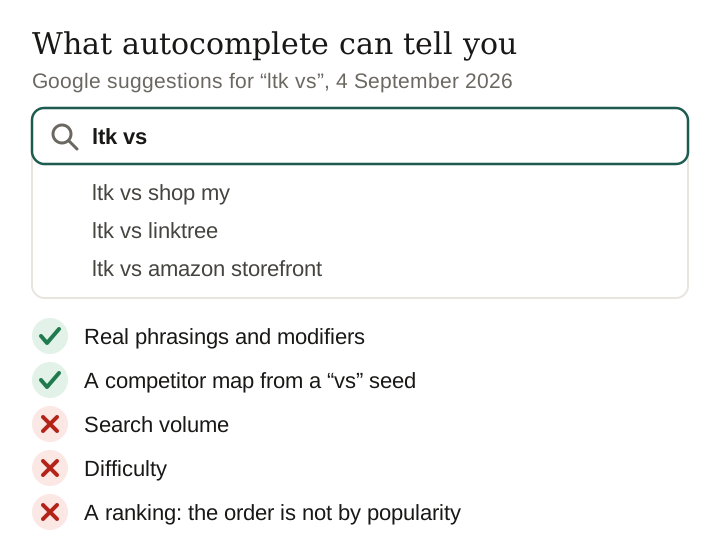
What autocomplete is, and what it is not
Autocomplete completes a partial query from things people have actually typed, filtered by the engine. That makes it a record of real phrasing. It is not a volume ranking: the order of the list is not a popularity chart, and nothing in the response tells you whether a suggestion was typed a thousand times or a hundred thousand.
Anybody presenting an autocomplete list as search volume is adding a number the data does not contain. We are telling you this first because it is the mistake that makes free keyword research produce confident wrong answers.
What it is genuinely good for is phrasing and modifiers. It shows you the words people put next to your topic, which is the part you cannot guess from your own vocabulary.

Six creator seeds, pulled live this morning
Every row below came back from a live request on 4 September 2026. Nothing is edited, reordered or filtered.
Seed: “how do creators”
| Google suggests | DuckDuckGo suggests |
|---|---|
| how do creators make money on tiktok | how do creators make money on tiktok |
| how do creators make money on instagram | how do creators make money on instagram |
| how do creators make money on youtube | how do creators make money on roblox |
| how do creators get paid on tiktok | how do creators make money on youtube |
| how do creators make money on facebook | how much do content creators make |
| how do creators make money on roblox | how do content creators make money |
| how do creators earn from instagram | how much money do content creators make |
| how do creators get paid on youtube | how much do content creators get paid |
Look at what dominates: the platform is the modifier, and the verb is almost always “make money” or “get paid”. Nobody is typing “monetisation strategy”. If your page is titled with the industry word rather than the typed word, you have written a page for a phrase nobody uses.
Seed: “ltk vs”
| Google suggests | DuckDuckGo suggests |
|---|---|
| ltk vs shop my | ltk vs shopmy |
| ltk vs linktree | ltk vs linktree |
| ltk vs amazon storefront | ltl vs ftl |
| ltk vs shop my reddit | ltk andee layne |
| ltk vs mavely | ltk and nelly |
| ltk vs benable | ltk analytics tools |
| ltk vs | ltk and shopmy |
| ltk vs shopify | ltk vision |
This is the most useful seed on the page and it is worth explaining why. A comparison seed returns a competitor list assembled by the people doing the comparing, which is a better market map than any directory. Note also that the two engines disagree on spelling — one returns “shop my” as two words, the other as one. Both are real user phrasings and a page can carry both.
Seed: “creator taxes”
| Google suggests | DuckDuckGo suggests |
|---|---|
| creator taxes | content creator tax deductions australia |
| content creator taxes | paystub creator that calculates taxes |
| content creator taxes canada | how to file taxes as a content creator |
| tiktok creator taxes | content creator taxes |
| ugc creator taxes | content creator business code for taxes |
| content creator taxes reddit | — |
| onlyfans creator taxes | — |
| content creator taxes and expenses | — |
Two things jump out. First, country modifiers appear immediately, which tells you a generic page will disappoint most of the people who find it. Second, “reddit” appears as a suggestion — people are explicitly asking to be shown a forum rather than an article. That is a signal about trust, and it is worth taking personally rather than defensively.
Seed: “affiliate disclosure”
| Google suggests | DuckDuckGo suggests |
|---|---|
| affiliate disclosure | affiliate disclosure |
| affiliate disclosure examples | affiliate disclosure examples |
| affiliate disclosure''projector''amazon | affiliate disclosure template |
| affiliate disclosure generator | affiliate disclosure blog |
| affiliate disclosure quotes amazon | affiliate disclosure statement |
| affiliate disclosure home decor amazon | affiliate disclosure generator |
| affiliate disclosure gardening amazon | affiliate disclosure generator free |
| affiliate disclosure fashion amazon | amazon affiliate disclosure statement |
Here the modifier stack is a niche list: home decor, gardening, fashion, travel, food. One topic, five audiences, and each of them typing their own vertical into the box. That is a content plan delivered by an endpoint that costs nothing.
Keep reading on getting found
How to read a suggestion list
- Modifiers are the finding, not the head term. “affiliate disclosure” is contested by every large publisher. “affiliate disclosure for gardening” is a question with an audience and almost no competition.
- A question form beats a noun phrase. Suggestions starting how, what, can and does are people describing a problem, and a problem is something you can answer completely.
- Comparison seeds map a market. Type your category plus “vs” and read who the audience thinks the alternatives are.
- Disagreement between engines is information. Where Google and DuckDuckGo return different lists, you are seeing two different user populations.
- Ignore the ordering. It is not a volume rank and treating it as one is how free research goes wrong.
The other free routes, ranked by what they cost you
| Route | What it gives you | What it costs | Honest limit |
|---|---|---|---|
| Autocomplete endpoints | real phrasings and modifiers, instantly | nothing, no account | no volume, no difficulty, order is not a ranking |
| Search Console (your own site) | queries you actually appeared for, with impressions and position | nothing, needs site ownership | only shows queries you already rank for — useless before you rank |
| The results page itself | People Also Ask, related searches, and who currently wins | nothing but your time | personalised and volatile; read it logged out |
| Bing Webmaster Tools | keyword research with actual volume figures, free tier | nothing, needs site verification | Bing volumes, not Google volumes |
| Forum and community search | the exact words people use when nobody is optimising | nothing but your time | no scale, and you will over-weight the loudest thread |
The one most creators skip is the second. If your site has any history at all, Search Console is showing you queries you already half-rank for, which is the cheapest traffic available to you: a page sitting at position 14 for a phrase you did not know you targeted is a better next job than a new page about a phrase you guessed.
The limit is the one in the table. A site that has not yet started appearing in search has no query list to mine, so this route becomes useful only once your pages do appear — which is a fact about timing, not an argument against the method.
What the paid tools actually sell
We are not going to pretend the free routes are equivalent. Three things are genuinely behind the paywall, and one of them matters more than the others.
- Volume estimates. Modelled, not measured, and often wrong at the long tail — but a rough number beats no number when you are choosing between twenty topics.
- Difficulty scores. A proxy for how strong the incumbents are. You can approximate this free by reading the first page of results and asking whether you could plausibly write something better.
- Competitor keyword lists. The genuinely hard one to reproduce, because it needs a large crawl of the entire index. Nothing free gives you a useful version.
Our position: for a creator publishing a handful of pages a month, the volume estimate is the only one worth paying for, and even that is a convenience rather than a requirement. If your topic list comes from the questions your own audience already asks you, you have a better signal than a modelled number.
A workflow you can run this week
- Write down five seeds in your audience’s words, not the industry’s.
- Run each seed through both autocompletes and paste everything into one list. Ten minutes.
- Add the “vs” variant of each seed and do it again. This is where the competitor map comes from.
- Keep only the question forms and the niche modifiers. Discard the bare head terms; you will not win them and they do not describe a problem.
- Search your three favourites logged out and read the People Also Ask box. Those become your section headings.
- Check who is already winning. If the first page is five publishers with staff writers, pick a longer phrase. If it is three forum threads and a listicle, that is an opening.
- Write one page, then wait. Whatever tool you use, the feedback loop is weeks long, and the impatience is what makes people buy a subscription instead of waiting.
Frequently asked
Is scraping autocomplete against the rules?
Typing into a search box is not. Automated bulk querying is a different matter and the terms of the engine you are querying govern it. For the volume a creator needs — a few dozen seeds — this is a browser and a notebook.
Does autocomplete show search volume?
No. It shows phrasings people have used, filtered by the engine. The order is not a popularity ranking and the response contains no counts. Treating it as volume is the main way this method produces wrong answers.
Which free tool is closest to a paid one?
Bing Webmaster Tools, because its keyword research gives real volume figures at no cost. They are Bing volumes, which run smaller than Google’s, so use them for relative comparison rather than absolute planning.
How many keywords should a page target?
One question, answered completely, with the related phrasings appearing naturally because you covered the topic. Pages built to hit a keyword list read like pages built to hit a keyword list.
Method and scope
Suggestions were pulled on 4 September 2026 from the public autocomplete endpoints of Google and DuckDuckGo, one request per seed, no location or personalisation parameters set, results recorded verbatim in the order returned. Autocomplete is personalised and regional in ordinary use, so the same seed from your machine may return a different list — that is a property of the service, not an error in either reading. These endpoints carry no volume data and we have not modelled any.
Keep reading
How this page was made. Drafted with AI (Claude); not yet independently re-checked. How we work