LinkToLooks · Guides · Creator Desk
Creator Desk
Linking a $330 treadmill is a different job from linking a $15 jump rope
Price changes the catalogue, the stock risk, the hidden costs and the retailer mix — and leaves the one term everyone quotes completely unmeasured.
Part of: For creators
Direct answer. Price changes four things about a product link, and only one of them is the commission. Across 5,835 live US listings we pulled on 8 September 2026, the median asking price in these twenty categories was $42.61, but the category medians run from $15.00 for a jump rope to $329.99 for a treadmill — a 22x spread inside one loosely-defined niche. As the price rises, the catalogue gets shallower, the listing carries more unstated cost (shipping, assembly, freight), the decision takes longer than your post stays visible, and the retailer mix shifts away from marketplaces. What does not change in any way we can measure is your conversion rate, because nobody publishes it — including us.
Last verified 8 September 2026 against 5,835 live US listings across twenty outdoor and fitness search terms, pulled during this batch
How wide the spread actually is
“Outdoor and fitness” sounds like one niche. Priced, it is not one niche at all. Here is every term we pulled, sorted by median asking price, with the share of its priced listings at or above $200.
| Search term | Priced rows | Median ask | 10th–90th percentile | Share ≥ $200 |
|---|---|---|---|---|
| treadmill | 249 | $329.99 | $62.99 – $2,649.99 | 63.1% |
| weight bench | 294 | $144.99 | $68.34 – $349.99 | 29.9% |
| exercise bike | 363 | $144.00 | $25.00 – $679.99 | 38.3% |
| camping chair | 213 | $88.80 | $42.99 – $173.99 | 6.1% |
| camping stove | 242 | $79.99 | $30.02 – $245.99 | 12.8% |
| dumbbells | 231 | $77.99 | $21.86 – $296.99 | 20.3% |
| kettlebell | 264 | $68.99 | $25.00 – $209.99 | 11.4% |
| camping tent | 242 | $63.99 | $16.85 – $246.99 | 14.9% |
| cooler | 323 | $52.19 | $16.00 – $785.99 | 16.7% |
| hiking backpack | 279 | $50.00 | $18.00 – $125.00 | 1.1% |
| headlamp | 360 | $49.99 | $12.00 – $1,409.20 | 23.1% |
| trekking poles | 285 | $49.95 | $16.89 – $169.95 | 4.2% |
| hydration pack | 325 | $30.00 | $14.00 – $91.65 | 1.8% |
| foam roller | 343 | $26.35 | $7.15 – $49.99 | 0.9% |
| sleeping bag | 294 | $25.00 | $10.00 – $85.50 | 2.0% |
| yoga block | 320 | $25.00 | $10.99 – $55.00 | 0.3% |
| water bottle | 260 | $20.00 | $9.00 – $35.99 | 0.0% |
| gym bag | 282 | $20.00 | $10.00 – $55.00 | 0.4% |
| resistance bands | 315 | $18.00 | $8.99 – $52.00 | 0.3% |
| jump rope | 328 | $15.00 | $6.99 – $70.74 | 4.6% |
Two of those percentile ranges should stop you. Headlamp’s 90th percentile is $1,409.20 and cooler’s is $785.99, which is not what either word means to a shopper. Both searches pull in an entirely different industry: “cooler” returns transmission and oil coolers, “headlamp” returns vehicle headlamp assemblies. It is a small share of rows — 14 of 323 and 13 of 360 by a conservative screen — but they sit in the expensive tail and they stretch the range. Our guide to what a product search actually returns covers that failure at length; the point here is that a price range is the first place it shows up.
Keep reading on pricing

The arithmetic, and the term nobody can fill in
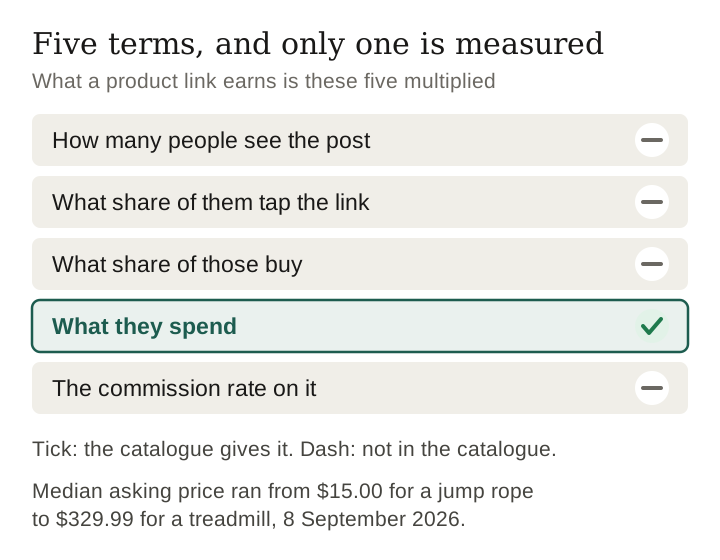
The appeal of high-ticket is obvious: at a 5% rate, a $330 treadmill pays what eleven $15 jump ropes pay. The chain that gets you there has five terms:
- how many people see the post,
- what share of them tap the link,
- what share of those buy,
- what they spend,
- and the commission rate on it.
We can measure exactly one of those five, and it is the fourth one. The catalogue tells us what things cost. It says nothing about reach, tap rate or conversion, and we hold no programme approvals, so we have no rate to report either. Anybody who hands you a clean “high-ticket earns 8x more” figure has filled in four terms they did not measure.
What can be said without inventing anything is directional and still useful: a higher price raises the value of a sale and lowers the number of sales, and the two move in opposite directions by amounts nobody in this industry has published. Treat high-ticket as a change in the shape of the outcome — fewer, larger, later — not as a multiplier.
The stock intuition is wrong, and here is the number
We expected expensive listings to go out of stock more often, because expensive things are made in smaller runs. That is not what the data says. Grouping every priced row by what it costs:
| Asking price | Rows | Marked out of stock | Rows excluding marketplaces | Out of stock |
|---|---|---|---|---|
| Under $25 | 1,762 | 7.2% | 848 | 14.9% |
| $25 – $50 | 1,445 | 7.3% | 877 | 12.1% |
| $50 – $100 | 1,069 | 13.1% | 826 | 16.9% |
| $100 – $200 | 810 | 16.5% | 736 | 18.2% |
| $200 – $500 | 428 | 8.6% | 415 | 8.9% |
| $500 and up | 298 | 5.0% | 298 | 5.0% |
The out-of-stock rate peaks in the $100–$200 band and then falls by more than half. The most expensive band is the best-stocked one in the whole pull. That is the opposite of the folklore, and the likeliest reason is dull: cheap and mid-priced gear moves fast and is restocked in waves, while a $2,000 treadmill sits on a specialist retailer’s shelf until somebody buys it. We are describing what the availability field says, not why it says it.
The second column is there because the first one lies. Peer-to-peer marketplace rows — 1,814 of 5,835 — contain zero listings marked out of stock. Not a low number: zero. Those rows crowd the cheap bands and drag their apparent out-of-stock rate down to 7%. Strip them out and the cheap bands roughly double. This is the same effect our page on retailers that never mark a product out of stock measured from the retailer side, arriving here from the price side.
What a high-ticket listing does not tell you
The gap between the price on the listing and the price your reader pays grows with the number. On a $15 jump rope there is nothing to hide. On a $400 bench there are four things, and the feed carries none of them.
Shipping and freight
Nothing in the catalogue rows we read carries a shipping cost. A weight bench, a treadmill and a chest cooler are all in the size class where delivery is quoted at checkout, sometimes as freight with a scheduled window. If you write “$249” and the reader is shown $249 plus $89 delivery, the number you published was wrong for them.
Assembly
Racks, benches and bikes usually arrive flat. That is not a defect and it is not a secret, but it is a real cost in the reader’s evening and it belongs in the post rather than in their surprise.
Returns
Sending back a $20 water bottle is an errand. Sending back a 90 kg bench is a negotiation, and in affiliate terms it is also a reversal: a commission you were shown and then lose. Our guide to returns and reversals covers the mechanics. The relevant point for high-ticket is that your exposure to a single reversal scales with the price of the thing.
Variants that are not the price you quoted
41.8% of the rows we read carry an itemGroupId, meaning they belong to a family of variants sold under one product. The $144 you quote can be the 20 lb version of a set that runs to $600. Name the exact variant or quote the range.
The retailer mix changes under you
Cheap gear in these categories is heavily secondhand: 98.2% of the gym-bag rows and 88.5% of the hiking-backpack rows came from peer-to-peer marketplaces. Expensive gear is not. Every row we read priced at $500 or more came from a conventional retailer.
That matters for two reasons that have nothing to do with taste. A marketplace listing is usually one unit, so it dies when it sells rather than when the product is discontinued. And the marketplaces that dominate the cheap end are exactly the destinations with the thinnest creator programmes — the fragmentation our page on where the big marketplaces actually pay creators lays out. Moving up in price moves you toward retailers you can actually be approved by. That is a genuine, unglamorous argument for high-ticket, and it is not the one usually made.
What to actually do with this
- Check whether your category even has a top tier. Water bottles do not: 0.0% of 260 listings reached $100. No amount of strategy adds a price band that the catalogue does not contain.
- Quote the variant, not the family. If four in ten rows are part of a variant group, four in ten quoted prices are ambiguous unless you say which one.
- Say “before shipping” out loud on anything in the size class that gets freighted. It costs you five words and buys you the reader who would otherwise feel misled.
- Do not plan around a conversion rate you were given. If a figure has no method attached, it is somebody’s hope with a decimal point on it.
- Expect the mid-price band to break first. The $100–$200 rows were the likeliest to be out of stock, and that is where a lot of gift-guide content sits.
What this measurement cannot show
- It cannot tell you what converts. We hold no click or sale data of any kind. Every sentence above about buyer behaviour is reasoning from prices, and is labelled as such.
- It cannot tell you commission rates. They are not in the catalogue and we hold no programme approvals.
- It is one read of one catalogue on one evening. A US view here is a post-filter on each row’s own country field, and that field moves week to week, so the sample size is not stable and a repeat pull will not return the same rows.
- Twenty search terms are not the outdoor and fitness market. They are twenty queries a shopper might type. The terms are printed in the method below so the pull can be repeated.
- The out-of-stock field is retailer-declared and some retailers never set it, which is why the marketplace-free column exists.
Frequently asked
Is high-ticket affiliate content worth it?
It changes the shape of the outcome rather than multiplying it: fewer sales, larger ones, longer decisions. Whether that is better depends on conversion rates that nobody publishes, so treat any confident answer with suspicion, including a confident yes.
What counts as high-ticket?
There is no standard threshold. In the twenty categories we pulled, 12.5% of priced listings were $200 or more and 5.1% were $500 or more, so $200 is a reasonable line for gear. In a category like water bottles, where nothing reached $100, the line would be much lower.
Do expensive products go out of stock more often?
Not in this pull. The out-of-stock rate peaked at 18.2% in the $100-$200 band and fell to 5.0% above $500, once peer-to-peer marketplace rows - which never mark anything out of stock - were excluded.
Should I quote the price with shipping?
You cannot, from feed data: no row we read carried a shipping cost. The honest move is to quote the listed price, date it, and say that delivery is quoted at checkout for large items.
Does a higher price mean a higher commission rate?
We cannot answer that. Commission rates are not in the product catalogue and we hold no approvals, so we have never seen a rate card we could quote.
Method and scope
5,912 US listings pulled from the CJ product catalogue on 8 September 2026 across twenty outdoor and home-fitness search terms, four pages of 100 rows per term, de-duplicated on advertiser plus title plus destination URL and then filtered on each row’s own targetCountry. Network demo advertisers (77 rows) are excluded, leaving 5,835. Asking price is salePrice where the row has one and price otherwise.
Search terms, in full, so the pull can be repeated: camping tent, sleeping bag, camping stove, cooler, headlamp, hiking backpack, trekking poles, camping chair, water bottle, hydration pack, dumbbells, kettlebell, resistance bands, foam roller, jump rope, exercise bike, weight bench, treadmill, gym bag, yoga block. The pull script is kept in the repository alongside this page.
Counts are of listings, not of products: one product listed by three retailers is three rows. Advertiser and category shares describe what one catalogue exposed to one company ID on one evening. They are floors, not censuses.
Keep reading
How this page was made. Drafted with AI (Claude); not yet independently re-checked. How we work