LinkToLooks · Guides · Creator Desk
Creator Desk
What to say when someone asks if you actually use it
A reader is not testing whether you own the thing. They are testing whether you will tell them the truth when it is inconvenient.
Part of: For creators
Direct answer. Say no, in one sentence, and then say what you did do instead. “I haven’t tried this one — I picked it because it was the cheapest of the eleven retailers I checked” keeps the reader, keeps your disclosure accurate, and keeps you out of the one category of claim that a fact check destroys. The alternative — a vague answer that implies ownership — is the single fastest way to lose an audience, because the person asking has usually already guessed.
Last verified 8 September 2026 against 5,835 live US listings and their field completeness, measured during this batch
Why the question gets asked
Nobody asks a supermarket whether it has eaten the pasta. They ask a person, because a person recommending something carries an implied claim of experience that a shelf does not. That implied claim is the whole reason creator recommendations are worth more than a category page, and it is also the liability.
The question usually arrives for one of three reasons, and they need different answers:
- Genuine curiosity about fit or durability. The reader wants a fact you may not have. This is the easy one.
- Suspicion that the post is an ad. The reader wants to know your incentive. Answer the incentive question, not the ownership one.
- A specific doubt about one product. Often they know something you do not. Ask what prompted it.
We have an unusual stake in this. This publication has never worn, tested or handled any product it writes about, and never claims otherwise. Everything we know comes from reading live retailer data and dating it. That is a real limitation and we say so on every page; it is also why we can write this one without flinching.
The four bad answers, and what each one costs
| The answer | Why people give it | What it costs |
|---|---|---|
| “I love it!” | It is friendly and it dodges the question. | It reads as yes. If the truth comes out later, the audience does not reread it as ambiguity — they read it as a lie. |
| “It has amazing reviews” | It is true and it is evidence. | It is a non-answer to the question asked, and everybody notices. Give it after the no, not instead of it. |
| Silence, or deleting the comment | The question feels hostile. | It converts one person's doubt into everyone's. A deleted question is read as an answer. |
| Repeating the brand's own copy | It sounds authoritative and it is right there. | You have adopted somebody else's claim as your own. Our page on claims you cannot make screened 5,040 retailer descriptions and found exactly how much of that copy is unsupported. |
Keep reading on honesty
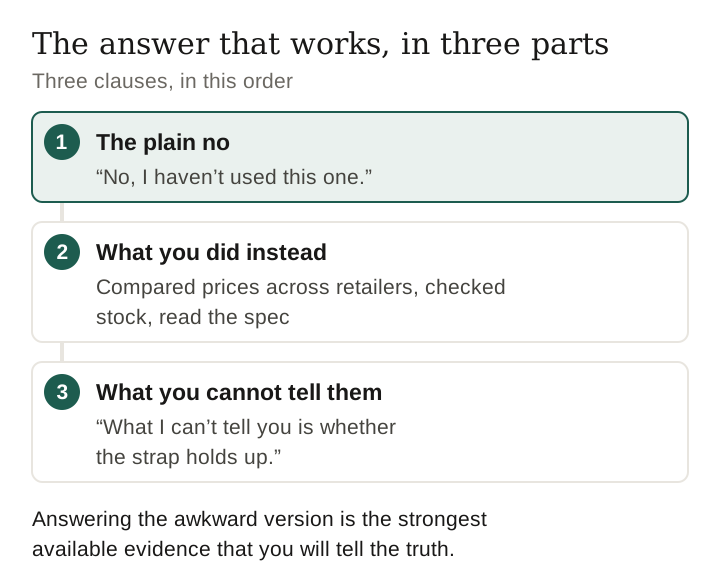
The answer that works, in three parts
It is short. Three clauses, in this order.
- The plain no. “No, I haven’t used this one.” Not “not personally”, not “not yet” unless it is true.
- What you did instead. This is the part that saves it. “I compared it against eleven other retailers on price and stock”, or “I picked it because it was the only one in this price band that was actually in stock”, or “I read the spec and it is the only one with the mount I was describing.”
- What you would want to know before buying. Hand them the open question. “What I can’t tell you is whether the strap holds up — if anyone here has had one a year, say so.” This turns your gap into the comment thread’s subject and is frequently the most useful thing on the post.
The mechanism is simple. A reader is not primarily testing whether you own the thing; they are testing whether you will tell them the truth when it is inconvenient. Answering the awkward version of the question is the strongest available evidence that you will.
What you can offer instead of having used it
“I have not tried it” is only a weak answer if you stop there. Four substitutes that a reader will accept, roughly in order of how much work they take.
1. A dated price check across retailers
“Eleven retailers had this category on 8 September and this was the cheapest” is a fact nobody else in the thread has, and it is true whether or not you own anything. It goes stale, which is why it carries a date.
2. A stock and availability check
Whether the thing can actually be bought, today, from a retailer that is not one seller with one unit. In our pull, 31.1% of listings came from peer-to-peer marketplaces where the item is a single unit — and none of those rows ever reported being out of stock, so the field itself will not tell your reader.
3. The specification that decides the purchase
Capacity, weight, dimensions, wattage, temperature rating. These are in the listing, they are checkable by the reader, and quoting one is a more useful contribution than an opinion. The catch is that they are often missing: only 16.6% of the listings we read stated a material and 52.2% filled the size field at all. When the spec is absent, say it is absent.
4. Naming what would change your mind
“If this turns out to have the flimsy clip the older model had, ignore me” costs nothing and is worth more than three adjectives. It also gives your audience a reason to come back and tell you.
What a listing actually supports
The line between what a listing proves and what it merely says is the whole game. From the 5,835 listings we read this evening:
| You can say | Because | You cannot say |
|---|---|---|
| “$68.99 was the median asking price across sixteen retailers today” | You computed it and dated it. | “This is the best value” — value includes durability, which you have not observed. |
| “The listing says 600 g and aluminium” | It is a quote, attributed to the listing. | “It is light and sturdy” — that is your judgement of a thing you have not lifted. |
| “Only three retailers carried this brand” | It is a count you made. | “Hard to find” — a claim about the market, from a sample. |
| “The retailer describes it as machine washable” | Attribution does the work. | “It washes well” — you have not washed it. |
Every row of that table is the same move: attribute, or measure, or stay quiet. It is not a limitation on what you can write about. It is a limitation on which verbs you can use.
When you cannot possibly have used them all
A twelve-item round-up is where this gets uncomfortable, because nobody owns twelve tents. Two conventions solve it, and both are better than the usual silence.
Separate the list. “Three I have used, nine I shortlisted on price and stock” — stated at the top, once. Readers do not expect you to own everything; they expect you to say which is which.
State the selection rule. If the twelve were chosen because they were the only ones under $50 that were in stock across more than one retailer, that is your editorial contribution, and it is a stronger one than a fake testimonial. Our note on how many products to link in one post covers the length side of the same problem.
One thing not to do: quietly write every item in the same warm voice so the three you own and the nine you do not read identically. That is the version a reader eventually notices, and it costs you the three real ones as well.
Where this page stops
- It is not legal or regulatory advice. Disclosure obligations vary by country and by what you received. Our pages on platform labels versus disclosure and disclosure outside the US cite the sources we could actually verify.
- We have no data on what these answers do to engagement. We hold no audience metrics of any kind. The argument above is from first principles and from our own editorial standard, not from a measured outcome, and we would rather say so than invent a percentage.
- The field-completeness figures are one pull. 5,835 listings, twenty outdoor and fitness search terms, one evening. Other categories will differ.
- We have used none of the products this page mentions. Which is, in fairness, the point.
Frequently asked
What do I say if I have not used the product?
Say so plainly, then say what you did instead - compared prices across retailers, checked stock, read the spec - and name the thing you cannot tell them. Three clauses, one sentence each.
Does admitting it lose me credibility?
We have no engagement data and will not pretend otherwise. What we can say is that the alternative is a claim that fails the first time it is checked, and that a reader asking the question has usually already formed a suspicion.
Can I say I love it if a brand gifted me the product?
If you have used it and you do, yes - with disclosure of the gift. If you have not used it, the sentence is not about liking it, it is about having it, and that is the part your audience is asking about.
What if I have used an older model?
Say exactly that: which model, when, for how long. A specific partial answer is far stronger than a general one, and it is checkable.
How do I handle a twelve-item round-up?
Split the list at the top: the ones you have used, and the ones you shortlisted, with the rule you used to shortlist them. The rule is your editorial contribution and it is worth stating.
Method and scope
The field-completeness and marketplace figures come from 5,912 US listings pulled from the CJ product catalogue on 8 September 2026 across twenty outdoor and home-fitness search terms, de-duplicated on advertiser plus title plus destination URL and filtered on each row’s own targetCountry; network demo advertisers (77 rows) excluded, leaving 5,835. Material was present on 971 rows (16.6%) and the size field on 3,043 (52.2%). Peer-to-peer marketplace rows were 1,814 of 5,835 (31.1%), of which none were marked out of stock.
The rest of this page is editorial: it is our own standard, stated as advice, and it rests on the argument rather than on a measurement. We have not measured how audiences respond to any of these answers and hold no data that would let us.
Keep reading
How this page was made. Drafted with AI (Claude); not yet independently re-checked. How we work